...

Contact Skychem Group for more chemical solutions, If you have questions or need more information, please contact us.
Respond within 24 hours

Textile Dyeing Lab Setup: Lab-Dip Workflow, Equipment, and Scale-Up

A dyeing lab is where color decisions are made before any fabric enters a production machine. Strong lab practice speeds up shade approvals, produces recipes that transfer cleanly to the dyehouse, and keeps color consistent from lot to lot.

This guide covers how to plan and run a textile dyeing laboratory, from space and equipment to the lab-dip workflow, reproducibility controls, and scale-up. It is written for mill technicians, lab managers, and buyers who need dependable color from first approval to final shipment.

Lab Setup Essentials

Space, Water, and Utilities

Start with a dedicated, well-ventilated room divided into three zones: chemical preparation and weighing, dyeing and washing-off, and color evaluation. Humidity and dust from the first two zones can damage balances and spectrophotometers, so keep color assessment in a separate, calm space with controlled lighting.

Water is part of every recipe, so treat it as a controlled material. Hardness, pH, and metal content can shift a shade or reduce dye solubility. Most labs use softened or deionized water and match it as closely as possible to production water. Some also use the purity grades in ISO 3696 as a benchmark for laboratory water. Test the water on a fixed schedule and record the results.

Plan the utilities as well:

  • Stable electrical supply
  • Hot and cold water with floor drains
  • Compressed air, if the machines require it
  • Enough bench space for drying and conditioning samples

Safety and Waste Handling

Dyes and auxiliaries are chemicals, so equip the lab accordingly:

  • Fume extraction at the weighing station
  • Eyewash and emergency shower access
  • Chemical-resistant gloves and goggles
  • Clear labels on every stock solution
  • Safety data sheets within easy reach
  • Separate storage for acids, alkalis, and oxidizers

Collect spent dye baths, rinse water, and expired stock solutions in labeled containers and dispose of them according to local wastewater rules. A simple waste log makes audits much easier.

Core Lab Equipment

Lab Dyeing Machines

The sample dyeing machine is the heart of the lab. Most labs use infrared or heated-bath machines with sealed beakers or canisters that rotate or shake to imitate the liquor movement of production. Prioritize accurate temperature control, programmable heating gradients, and enough positions to run several recipes at once. A lab padder is a useful addition for pad-dyeing and pad-batch development.

Balances and Dispensing Tools

Small weighing errors turn into visible shade differences at scale. An analytical balance reading to 0.1 mg suits dye powders, and a precision balance handles fabric and auxiliaries. Calibrated pipettes or an automatic dispensing system keep liquid volumes consistent between operators.

Spectrophotometer and Light Booth

A spectrophotometer measures color objectively and drives computer color matching. A light booth lets people judge a shade under standard light sources such as D65, TL84, and incandescent. Use both. The instrument shows how close the match is, and the booth reveals metamerism, which is when two samples match under one light source but not under another.

Equipment Main role What to check when buying
Lab dyeing machine Runs trial dyeings under controlled temperature and agitation Temperature accuracy, number of positions, program flexibility
Analytical balance Weighs dyes and chemicals Readability, calibration support, draft shield
Pipettes or auto-dispenser Dispenses stock solutions Accuracy, repeatability, ease of cleaning
Spectrophotometer Measures color and supports recipe prediction Measurement geometry, software, calibration routine
Light booth Supports visual shade assessment Multiple standard light sources, neutral gray interior
pH and conductivity meters Monitor bath and water conditions Calibration frequency, probe durability

Lab-Dip Workflow

Each step below feeds the next, and skipping one usually costs extra rounds later.

Shade Brief and Target Matching

Every lab dip starts with a clear brief. Collect these details before dyeing anything:

  • The target: a physical swatch, a Pantone reference, or a digital standard
  • The substrate and its weight
  • The end use
  • The fastness requirements
  • The agreed shade tolerance

Settling the tolerance up front prevents disputes later, because “close enough” means different things to different people.

Substrate Preparation

A lab dip predicts bulk results only if the lab fabric behaves like the bulk fabric. Use the same construction, the same fiber lot where possible, and the same pretreatment. Scoured and bleached cotton, heat-set polyester, and neutralized fabrics all dye differently from raw or poorly prepared goods. Cut samples to a fixed weight, commonly 5 to 10 grams, and condition them the same way every time.

Recipe Formulation

Build the first recipe from a color-matching system, from approved recipes for similar shades, or from the colorist’s experience. Prepare dye stock solutions at known concentrations, such as 1% or 0.1%, so small quantities are easy to measure.

The calculation is straightforward. A 2% shade on weight of fiber (owf) for a 5 gram sample needs 0.1 g of dye, which equals 10 mL of a 1% stock solution. Then add the auxiliaries, salt, alkali, or acid that the dye class requires, and set the lab liquor ratio.

Gloved hands pipetting navy-blue dye solution beside an undyed cotton swatch.

Dyeing and Evaluation

Run the trial with the same temperature profile, dosing steps, and time planned for production. Rinse, soap, and dry the sample the way it will be processed in bulk, because unfixed dye and drying conditions both change the final shade.

Evaluate the result against the target with the spectrophotometer and the light booth. If the shade is off, adjust the recipe in small, logical steps and run another round. After approval, test the fastness properties the buyer specifies. For wash fastness, many buyers refer to AATCC Test Method 61 or an equivalent ISO method. Finally, redye the approved recipe once to confirm that it repeats.

Reproducibility Control

SOPs and Calibration

Reproducibility comes from discipline. Write standard operating procedures (SOPs) for weighing, stock preparation, dyeing programs, washing-off, drying, and color measurement, and make sure every operator follows them the same way.

Calibrate on a schedule. Balances, pipettes, pH meters, machine temperature sensors, and the spectrophotometer all drift over time. A simple calendar of daily, weekly, and annual checks keeps the lab accurate and audit-ready.

Material Consistency and Residual Alkali

Even a perfect recipe fails when the materials change. Dye lots vary in strength, fabric lots vary in absorbency, and water and chemicals can change over time. To keep this under control:

  • Record lot numbers for every dye, auxiliary, and fabric
  • Check each new dye lot against a standard before regular use
  • Check the pH of incoming fabric

Fabric preparation matters just as much. Leftover alkali from pretreatment can interfere with dyes and finishes, especially on cellulosic fabrics, so understanding the causes and controls of residual alkali is time well spent.

Data Recording

Treat every lab dip as data. For each trial, record the recipe, fabric details, water source, dyeing program, operator, spectrophotometer readings, and the final decision. Express color difference with a recognized formula, such as the CMC method described in ISO 105-J03, so that “within tolerance” has one meaning for everyone.

Over time, this archive becomes a searchable library. When a similar shade arrives, the colorist can start from a proven recipe instead of a blank page, which reduces the number of lab-dip rounds.

Scale-Up Control

Key Variables Before Bulk Dyeing

An approved lab dip is a reference point, not a guarantee. The lab and the dyehouse are different environments, so test the variables that change before committing to a full lot. A structured method to evaluate auxiliary samples before bulk dyeing helps trace any shade change to a single cause.

Variable Typical lab condition Typical bulk condition Control tip
Liquor ratio Higher, such as 1:10 to 1:20 Lower, often 1:5 to 1:10 Recalculate any chemical dosed in g/L
Heating and cooling rate Fast and tightly controlled Slower and machine dependent Match the gradient as closely as the machine allows
Liquor circulation Beaker rotation or shaking Pump, nozzle, or fabric movement Check levelness in a pilot trial
Alkali or salt dosing Added at once or in precise steps Metered over time Copy the lab dosing profile in bulk
Water quality Deionized or softened Plant water, often variable Test and treat production water

Liquor Ratio and Machine Differences

Liquor ratio is one of the biggest sources of surprise. Dye amounts are calculated on weight of fiber, so they do not change with the ratio. However, salt, alkali, and auxiliaries dosed in grams per liter do change, and a shorter ratio also affects dye exhaustion and levelness. A recipe that works at 1:15 in the lab can behave differently at 1:6 in a jet machine.

Machine type adds another layer. Jet, overflow, soft-flow, beam, and package machines each circulate liquor differently, which affects dye migration and leveling. Run a pilot trial on the actual machine type before the first full lot, adjust the recipe based on the result, and record every change.

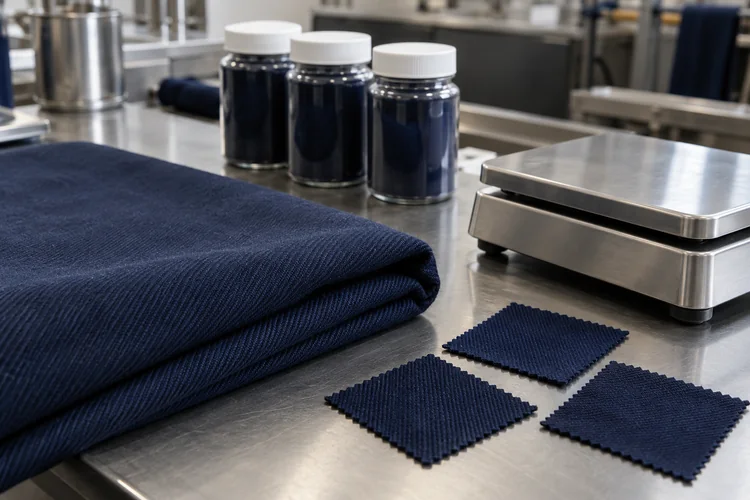
1. Navy-blue polyester twill fabric and a lab-dip swatch beside an industrial dyeing machine.

Shade Drift and Scale-Up Problems

Some problems appear only at production scale. Spots, sedimentation, and gradual shade drift can occur when dye baths are unstable, particularly with disperse dyes at high temperature. Other common issues include:

  • Uneven dyeing from poor circulation
  • Tailing from slow or uneven dosing
  • Shade differences between finished and unfinished fabric

When a problem appears, work backward through the variables in the table above, one at a time, and keep notes. The next shade benefits from every lesson recorded.

Dyes and Auxiliaries for Lab Use

Dye Selection by Fiber

The right dye class depends on the fiber, the fastness target, and the dyeing method. Using the same dye series and grade in the lab and in production removes one major source of variation.

Fiber Common dye class Key lab control
Cotton and viscose Reactive, direct, vat Salt and alkali dosing, thorough soaping
Polyester Disperse Dyeing temperature, bath pH, reduction clearing
Nylon and wool Acid, metal complex pH, leveling, temperature ramp
Acrylic Cationic Retarder use, careful heating
Blends Combination of the above Sequential or one-bath compatibility

Cotton and viscose. Reactive dyes differ by reactive group, so choose the series that fits the process:

  • Skyzol General Series (KN and M types): vinyl sulfone, or vinyl sulfone with monochlorotriazine, for conventional exhaust dyeing with a full color range.
  • Skyzol RGB: selected for matched compatibility, directness, and reactivity, which suits sensitive shades, pad dyeing, and cold pad-batch. Skyzol Black RGB is a black reactive dye for cotton, rated at 2% owf with light fastness 4-5, wash fastness 4-5, dry rubbing 4, wet rubbing 3, and chlorine bleach 2-3.
  • Skyzol KE/TE: monochlorotriazine type for dyeing at about 80°C, with good hydrolysis stability and levelness. It suits viscose, towels, and mercerized cotton, but not cold pad-batch.
  • Skyzol Deep Shade Series: high build-up, substantivity, exhaustion, and fixation for dark shades.

Polyester. Disperse dyes are graded by energy level, and the lab program must match the grade:

  • Skycron E: low temperature (115 to 120°C) with strong leveling and light fastness, but lower wash and sublimation fastness. It suits light shades.
  • Skycron SE: medium temperature (125°C), balancing leveling, compatibility, and fastness.
  • Skycron S: high temperature (130 to 135°C) with excellent fastness. Hold the bath at pH 4.5 to 5.5 for Disperse Blue 79.
  • Skycron CC: high build-up and good compatibility for microfiber fabrics.

Medium and dark polyester shades usually need reduction clearing after dyeing to remove unfixed disperse dye. A typical alkaline bath uses 2 to 4 g/L of reducing agent at 70 to 80°C for 15 to 20 minutes. Include this step in the lab dip so that the approved shade and fastness reflect what the bulk lot will deliver.

Key Auxiliaries and Stock Solutions

Auxiliaries often decide whether a recipe is stable or temperamental. Typical lab additions include dispersing, leveling, sequestering, buffering, and wetting agents. The range of dyeing auxiliaries covers dispersants, leveling agents, fixing agents, penetrants, defoamers, soaping agents, and anti-backstaining agents, with grades matched to polyester, cellulosic, nylon, wool, silk, acrylic, and denim processes. They suit high-temperature and high-pressure dyeing, thermosol dyeing, and normal-temperature dyeing.

Check the technical data before adding any auxiliary to a recipe. For example, Sylic D2713 is a low-foam, anionic soaping detergent with a pH of 6.0 to 8.0 (1% solution), used at 1.0 to 3.0 g/L for washing off acrylic and acrylic blends after dyeing. Test the dosage in the lab before it reaches the floor.

Good stock solution habits protect repeatability:

  • Prepare solutions fresh, or follow a clear shelf-life rule
  • Label each bottle with the product name, concentration, preparation date, and operator
  • Stir or heat as the dye class requires
  • Filter when needed so undissolved particles do not appear as spots

Gloved hand aligning three navy-blue cotton twill swatches in a light booth for shade comparison.

FAQ

What equipment is needed for a textile dyeing lab?

A lab dyeing machine, an analytical balance, pipettes or a dispenser, a spectrophotometer, a standard light booth, and pH and temperature meters. Add glassware, a dryer, and safety equipment such as fume extraction and an eyewash station. A lab padder helps if pad-dyeing recipes are part of the work.

How many lab-dip rounds are normal before approval?

It depends on the shade, the fabric, and the buyer’s tolerance. Light shades on familiar fabrics may match in one or two rounds, while dark, bright, or metamerism-sensitive shades often need more. A good recipe archive and computer color matching usually reduce the number of rounds.

Why do lab-dip results differ from bulk dyeing?

The usual causes are differences in liquor ratio, heating rate, liquor circulation, dosing, water quality, and fabric preparation. A pilot trial on the actual machine and tight control of these variables close most of the gap.

How can a lab improve dyeing reproducibility?

Write and follow SOPs, calibrate instruments on a schedule, and keep water quality consistent. Track dye and fabric lot numbers and log every trial in a searchable database. Training operators to weigh and dose the same way matters as much as the equipment.

Which dyes and auxiliaries suit lab-dip development?

Choose the dye class that fits the fiber, such as reactive dyes for cotton and disperse dyes for polyester, and use the same series planned for bulk. For disperse dyes, match the lab temperature to the energy level of the grade. Pair the dyes with auxiliaries suited to the production process, and test any new product in the lab first.

Sandy

With years of experience in chemical dyes and textile auxiliaries, I’m dedicated to sharing insights into the latest technologies, sustainable innovations, and market trends.

Recent Articles

Cotton yarn passing through metal guides during processing.

Textile Lubricants for Yarn and Fabric Processing: Selection, Dosage, and Compatibility

Table of Contents What Do Textile Lubricants Do? Choosing the Right Textile Lubricant Match the Fiber and Construction Match the Process and Equipment Compare Formulations Dosage and Application Understand the Dosage Basis Calculate Product Requirements Establish the Working Dosage Friction Control in Production Compatibility With Dyes and Auxiliaries Check Bath Stability Check Downstream Performance Validate Before Scale-Up Common Problems and Solutions FAQ How is textile lubricant dosage calculated? Can yarn lubricants be used in a dye bath? What is the difference between a textile lubricant and a softener? How can lubricant residues be removed before dyeing? Textile lubricants help control friction as fibers, yarns, and fabrics move through production. The right formulation and application can improve running stability, reduce abrasion, and support consistent processing. Selection depends on the substrate, equipment, and processing route. A lubricant must perform at the required application level without creating deposits or interfering with subsequent dyeing, printing, or finishing. This guide explains how to select textile lubricants, calculate application quantities, evaluate friction control, and check compatibility. What Do Textile Lubricants Do? Textile lubricants modify contact between textile materials and processing surfaces. Their functions differ across production stages. Processing stage Main lubrication objective Key evaluation points Fiber preparation and spinning Support controlled fiber movement while maintaining suitable cohesion Processing stability, distribution, static control where required Winding and knitting Maintain consistent yarn running behavior Yarn-to-metal friction, tension variation, breaks, deposits Warping and weaving Manage abrasion and yarn contact Size compatibility, yarn breaks, desizing requirements Sewing thread finishing Support thread passage through guides, tension devices, and needles Friction consistency, sewing performance, heat-related damage Wet fabric processing Reduce rubbing and associated abrasion or crease-mark risks Fabric movement, bath stability, foam, dye compatibility Fabric finishing Improve surface smoothness and sewability Handle, absorbency, shade, subsequent treatments These auxiliaries differ from machinery oils, which primarily lubricate components such as needles, bearings, and gears. Machinery oils should not replace substrate-applied lubricants unless specifically designed and approved for that use. Wet-processing anti-crease lubricants also differ from durable wrinkle-resistant finishes. They help reduce damaging friction during processing rather than impart lasting wrinkle resistance to the finished fabric. Choosing the Right Textile Lubricant Match the Fiber and Construction For yarn, record fiber composition, yarn count, spun or filament construction, twist, hairiness, and existing finish. Fine filament yarn and coarse spun yarn can require different lubrication and application conditions. For fabric, consider construction, weight, stretch content, and sensitivity to surface damage. Confirm suitability for elastane-containing materials under the intended treatment conditions. Test the substrate in its actual incoming condition. Existing spin finishes, sizing agents, surfactants, and softeners can affect wetting, lubricant pickup, and compatibility. Match the Process and Equipment Select spinning and yarn-processing auxiliaries according to the contact points that need lubrication and the requirements of the next production stage. For winding and knitting, prioritize uniform application and stable yarn tension. For weaving, evaluate abrasion and running behavior alongside sizing and desizing. Test sewing thread under representative speeds, tension settings, needles, and fabrics. Wet-processing lubricants must suit the intended temperature, pH, electrolyte concentration, and mechanical conditions. A yarn wax is not automatically suitable for a dye bath. The formulation must also work with the application equipment. Viscosity, dilution behavior, and feed consistency can influence distribution through metered applicators, kiss rolls, spray systems, exhaust baths, and padding equipment. Compare Formulations Wax emulsions, oil-based lubricants, and silicone-containing formulations offer different combinations of lubrication, application behavior, and removability. Performance depends on the complete formulation, including emulsifiers and functional additives. Sylic F3740 polyethylene wax emulsion is a nonionic formulation with 28–30% solids for textile lubrication and surface smoothness. It suits screening for processes requiring wax-based surface lubrication. Its concentration is relevant when calculating product consumption, while trials must establish friction control, deposit formation, and cleaning effectiveness. Solids content should not be treated as confirmed active content. Sylic F3741 silicone wax combines macromolecular polysiloxane and wax in a nonionic formulation. Evaluate it where a silicone-and-wax treatment is needed for lubrication and smoothness. Selection must account for application uniformity and removal before subsequent wet processing. Neither nonionic character nor silicone content alone establishes bath compatibility or antistatic performance. For either formulation, obtain the current technical data sheet to confirm the application method, dosage basis, and operating conditions. Dosage and Application Understand the Dosage Basis Dosage, bath concentration, and textile add-on describe different quantities. Term Meaning What to confirm % owf Product mass as a percentage of the specified textile weight Supplied product or diluted preparation g/L Product concentration in the treatment bath Bath volume and concentration basis Wet pickup Retained liquor mass as a percentage of dry textile mass Actual pickup during production Product add-on Applied or retained commercial product relative to textile weight Nominal or measured value, and measurement stage Active add-on Applied or retained active ingredient relative to textile weight Confirmed active content Yarn-processing instructions may use oiling rate or oil-on-yarn. Check the definition and measurement method before converting either value into equipment settings. Calculate Product Requirements For an exhaust recipe expressed as a percentage of textile weight: Product mass = textile mass × dosage percentage ÷ 100 Treating 500 kg of yarn at a hypothetical dosage of 1% owf requires 5 kg of commercial product. This is the amount introduced, not necessarily the amount deposited. For bath preparation: Product mass in grams = concentration in g/L × bath volume in liters An 800 L bath at a hypothetical concentration of 10 g/L requires 8,000 g, or 8 kg, of product. For padding with an aqueous bath having a density close to 1 kg/L: Nominal product add-on (%) = concentration (g/L) × wet pickup (%) ÷ 1,000 At 10 g/L and 70% wet pickup, nominal product add-on is 0.7% of dry textile weight. This assumes the retained liquor has the stated bath concentration. Incoming moisture, bath depletion, and replenishment can affect the estimate. These examples illustrate calculations, not recommended operating dosages. Understanding dosage and add-on in textile finishing helps prevent errors when comparing recipes or scaling up treatments. Establish the Working

Explore More »
Cotton twill samples beside dye samples and a scale.

Reactive Dye Pricing: Quotes, MOQ, and Total Dyeing Cost

Table of Contents What Drives Reactive Dye Prices? Dye Identity and Performance Strength and Product Form Supply and Order Conditions How to Compare Reactive Dye Quotes Match Product Specifications Check Commercial Terms Compare Landed Costs How MOQ Affects Purchasing Cost Confirm MOQ per Color and Order Balance Discounts and Inventory How to Calculate Total Dyeing Cost Dye Cost per Kilogram of Fabric Chemicals and Processing Costs Reprocessing and Quality Losses Worked Cost Comparison What to Include in a Quote Request FAQ How much do reactive dyes cost per kilogram? Why do quotes for the same dye differ? Are higher-strength reactive dyes more economical? What is the MOQ for reactive dyes? Can different colors be combined to meet the MOQ? How do I calculate dyeing cost per kilogram of fabric? The lowest reactive dye price per kilogram does not always produce the lowest dyeing cost. A less expensive product may require a higher dosage, a longer wash-off cycle, or more frequent shade corrections. A higher-priced alternative may be more economical if production trials confirm better color yield or lower processing costs. Compare reactive dye offers at three levels: quoted price, landed cost, and dyeing cost per kilogram of acceptable fabric. Product specifications, MOQ, and delivery terms determine whether those comparisons are meaningful. What Drives Reactive Dye Prices? Dye Identity and Performance Reactive dyes vary in chemical structure, color, formulation, and application requirements. These differences affect both manufacturing cost and performance in the dyehouse. Identify the exact product grade and Color Index identity, where applicable. A shared trade name does not establish equivalence, and products with the same Color Index identity can still differ in commercial strength, shade, and formulation. Select reactive dyes for the intended application before comparing prices. Assess solubility, compatibility in dye combinations, required fastness, and consistency between batches. The required shade depth matters as well. A product that performs well in pale shades may not deliver the most economical result at a deep shade. Compare candidates at the actual production shade and on representative fabric. Strength and Product Form Commercial strength designations such as 100%, 150%, and 200% describe color strength relative to a reference standard. They do not indicate chemical purity. For example, a 150% grade nominally has 1.5 times the color strength of its 100% reference under the specified test conditions. That relationship should not be assumed across suppliers using different standards or automatically converted into a production dosage. Powder and liquid products also need a common comparison basis. Price them against validated consumption, handling requirements, storage conditions, and transport costs. A lower price per kilogram of liquid does not necessarily mean a lower cost per kilogram of fabric. Supply and Order Conditions Raw material availability, energy costs, manufacturing requirements, currency movements, and logistics can affect a quotation. Order conditions add another layer: Quantity: Larger orders may qualify for volume discounts. Availability: Stocked grades and products requiring a production run may have different lead times. Packaging: Special pack sizes or labeling can add cost. Payment: Credit periods and other payment conditions may influence pricing. Delivery: Urgent transport can outweigh savings on the dye itself. When requesting a revised offer, specify the quantity, delivery schedule, or other condition that has changed. How to Compare Reactive Dye Quotes Match Product Specifications Give each supplier the same technical brief: fabric composition, target shade, application method, and acceptance requirements. Where available, provide an approved fabric sample or current dye reference. Use the following checklist to separate product differences from commercial differences. Comparison item What to confirm Why it matters Product identity Exact grade, Color Index identity where applicable, and intended process Similar names do not guarantee equivalent performance Commercial strength Reference standard, test conditions, and tolerance Strength percentages require a common basis Application results Validated dosage, shade, solubility, levelness, and fastness These determine suitability and consumption Quantity and packaging Net weight, pack size, MOQ, and price tier These affect purchase cost and inventory Commercial terms Currency, payment conditions, lead time, and quote validity Offers may reflect different commitments Delivery basis Trade term, named location, and excluded charges Unit prices may cover different delivery costs Approve the product through laboratory testing, followed by an appropriate production trial. Keep the substrate and process conditions consistent during initial comparisons, then document any adjustments needed. Check Commercial Terms For international orders, identify the selected Incoterms® 2020 rule and the named place or port. These rules allocate delivery responsibilities, costs, and risks between buyer and seller. Agree separately on payment timing, product specifications, acceptance procedures, and how quality claims will be handled. A trade term does not replace the purchase agreement. Compare Landed Costs Bring every offer to the same destination and cost basis before choosing a supplier. Landed dye cost/kg = Total acquisition cost ÷ Net kilograms received Include the product invoice plus applicable freight, insurance, import duties, clearance, and inland delivery that are not already covered. Avoid counting charges twice. Treat recoverable taxes separately from permanent costs, while accounting for their effect on cash flow. Use the landed dye price in subsequent recipe-cost calculations. How MOQ Affects Purchasing Cost Confirm MOQ per Color and Order Minimum order quantity can apply per product, per color, or per shipment. Confirm all applicable conditions. A supplier may accept a mixed-color shipment while retaining a minimum for each grade. Likewise, a standard 25 kg package, for example, does not prove that the MOQ is 25 kg. The minimum may involve several packages. Ask separately about laboratory samples and production-trial quantities. These may be available under different terms from routine bulk orders. Balance Discounts and Inventory Evaluate volume discounts against consumption, storage requirements, shelf life, and working capital. Slow-moving shades can tie up cash and leave stock unused, offsetting the lower purchase price. For recurring purchases, discuss scheduled releases or staged deliveries where available. Confirm whether the quoted price covers the full commitment, how long stock can be held, and whether additional delivery charges apply. How to Calculate Total Dyeing Cost Dye Cost per Kilogram of Fabric

Explore More »
TIANKUN to Meet Global Textile Industry Partners at ITMA ASIA + CITME 2026

TIANKUN to Meet Global Textile Industry Partners at ITMA ASIA + CITME 2026

Table of Contents About TIANKUN Explore Our Five Key Product Solutions 1. TIANKUN Color Solutions 2. Skycron® High-Performance Color Fastness Solutions 3. Sylic® Denim Processing Solutions 4. Skyguard® Water/Oil Repellent Solutions 5. Sylic® Textile Auxiliaries Meet Our Team in Shanghai Get Your FREE Invitation Code Visit TIANKUN at ITMA ASIA + CITME 2026 H7.1-A25 November 20–24, 2026 | Shanghai, China | Hall 7.1, Booth A25 Hangzhou Tiankun Chem Co., Ltd. (TIANKUN) is pleased to announce its participation in ITMA ASIA + CITME 2026, taking place from November 20 to 24, 2026, at the National Exhibition and Convention Center in Shanghai, China. At this year’s exhibition, TIANKUN will present a comprehensive portfolio of textile chemical solutions covering dyeing, printing, denim processing, and textile finishing. We look forward to connecting with textile manufacturers, industry professionals, and business partners from around the world. About TIANKUN Founded in 1999, Hangzhou Tiankun Chem Co., Ltd. specializes in the development and supply of textile chemicals. Since expanding its international business in 2008, the company has supplied products to customers in more than 40 countries and regions. As part of SkyChem Group, TIANKUN combines product development, technical support, and industry experience to provide reliable chemical solutions for textile processing. Explore Our Five Key Product Solutions At ITMA ASIA + CITME 2026, TIANKUN will showcase five major product categories: 1. TIANKUN Color Solutions A wide range of disperse, reactive, direct, acid, basic, vat, sulphur, and solvent dyes, together with fluorescent whitening agents, liquid dyes, and pigment pastes for textile printing. 2. Skycron® High-Performance Color Fastness Solutions Featuring the Disperse TXF, KXF, and SWF series, designed for textile applications with demanding color fastness requirements. 3. Sylic® Denim Processing Solutions Including enzymes, anti-staining agents, washing and softening products, and functional auxiliaries for denim processing. 4. Skyguard® Water/Oil Repellent Solutions Including C6/PFCs-Free, durable water repellent, and multifunctional finishing solutions. 5. Sylic® Textile Auxiliaries Covering pretreatment, dyeing, softening, and functional finishing, with products such as wetting agents, degreasing agents, leveling agents, fixing agents, silicone softeners, and specialty auxiliaries. Meet Our Team in Shanghai During the exhibition, visitors are welcome to meet the TIANKUN team, learn more about our product portfolio, discuss specific textile processing requirements, and explore potential business cooperation. Get Your FREE Invitation Code Complimentary invitation codes available Planning to attend ITMA ASIA + CITME 2026? TIANKUN is pleased to offer complimentary invitation codes to customers and business partners. Contact our team to request your free invitation code and complete your exhibition registration. We look forward to welcoming you in Shanghai! Info@tiankunchemical.com Visit TIANKUN at ITMA ASIA + CITME 2026 H7.1-A25 Date: November 20–24, 2026 Venue: National Exhibition and Convention Center, Shanghai, China Website: www.skychemi.com Contact us today to request your FREE invitation code and arrange a meeting with our team.

Explore More »
Blue acrylic yarn and knitted fabric samples for evaluating basic dye shades.

How to Source Basic Dyes for Acrylic: Manufacturer Guide

Table of Contents What Are Basic Dyes? Basic Dyes vs Cationic Dyes Why They Suit Acrylic Fibers Compatible Fibers Acrylic Fibers Cationic-Dyeable Polyester Modified Nylon Key Quality Parameters Color Strength and Shade Consistency Light and Wash Fastness Solubility and Compatibility Value How to Evaluate a Manufacturer Capacity and Technical Expertise Batch Consistency and Quality Control Certifications and Compliance Color Matching and Sample Support Compliance Requirements REACH and Restricted Substances OEKO-TEX and ZDHC Standards Sourcing Process Define Specifications Run Samples and Trials Compare Quotes, MOQ and Lead Time Common Sourcing Mistakes Choosing on Price Alone Ignoring Dye-Fiber Compatibility Pairing Dyes With Auxiliaries Retarders and Leveling Agents Benefits of One-Stop Sourcing Choosing a Reliable Supplier What to Expect From a Dye and Auxiliary Supplier How to Request a Quote or Sample FAQs About Sourcing Basic Dyes What are basic dyes used for in textiles? Can basic dyes be used on cotton or wool? How can basic dye quality be tested before a bulk order? What is the difference between basic dyes and disperse dyes? What does the compatibility value (K) mean for basic dyes? What pH range is used for dyeing acrylic with basic dyes? How should auxiliaries be chosen for dyeing acrylic? Buying basic dyes can look simple until a shade drifts between lots, a dye bath turns patchy, or a customer asks for compliance paperwork that is not on file. Acrylic and cationic-dyeable fibers leave little room for error. The dye strikes fast, barely migrates, and exposes small mistakes in chemistry or process control. This guide explains what basic dyes are, which fibers they suit, which quality parameters matter, and how to evaluate a manufacturer before placing a bulk order. What Are Basic Dyes? Basic dyes are water-soluble, positively charged (cationic) colorants known for very bright shades and high color strength. Their charge makes them bond readily with fibers that contain negatively charged dye sites. Basic Dyes vs Cationic Dyes In textile sourcing, the two names usually describe the same family. “Basic dye” is the older, general term. “Cationic dye” is the term most suppliers now use for modern grades developed for acrylic and modified fibers. Using both terms in an inquiry avoids confusion, since some price lists and buyers still use only one. Why They Suit Acrylic Fibers Acrylic polymers contain anionic groups, often sulfonate groups introduced through comonomers during fiber production. Cationic dye molecules are attracted to these sites and bond firmly. The result is strong affinity, high color yield, and the vivid shades associated with acrylic knitwear, blankets, and pile fabrics. That same affinity creates the main process challenge. The dye can strike too fast and unevenly, so good results depend on three controls: Slow, controlled heating, typically from about 80°C up to the boil A mildly acidic dye bath, usually around pH 4 to 5.5 The right auxiliaries for the dye and fiber combination Compatible Fibers Basic dyes work best on fibers with built-in anionic dye sites. Fiber Why it accepts basic dyes Sourcing note Acrylic Anionic groups in the polymer attract cationic dyes Main application; check dye compatibility in combination shades Cationic-dyeable polyester (CDP) Sulfonate groups added during polymer modification Dyeing conditions differ from standard polyester Modified nylon Modified to carry anionic sites Confirm the fiber grade before ordering dyes Acrylic Fibers Acrylic is the core market for basic dyes, covering yarn, sweaters, plush, blankets, and carpets. Dyes for this fiber should perform in both batch and continuous dyeing, with stable levelness and reliable fastness. Cationic dyes for acrylic fibers are available in labeled strength grades of 200%, 250%, and 300%, so offers can be compared on the same basis. A technical data sheet should be this specific. Skyzon Blue X-GRL 300%, a basic dye for acrylic fiber and fabric with excellent dispersion and compatibility, lists the following: Strength: 300% Compatibility value (K): 3.5 pH stable range: 2 to 5 Light fastness (xenon): grade 6 Washing fastness: grade 4 for shade change, grade 4 to 5 for staining on cotton and acrylic Rubbing fastness: grade 4 to 5, dry and wet Perspiration fastness: grade 4 for shade change, grade 4 to 5 for staining Cationic-Dyeable Polyester CDP gives polyester fabrics bright shades and cross-dyeing options that standard polyester cannot offer. Its chemistry and dyeing conditions differ from conventional disperse dyeing, so a dye that performs well on acrylic may not behave the same way on CDP. For more detail on dye classes and conditions, see cationic dyes for modified polyester. Modified Nylon Some nylon grades are modified to accept cationic dyes, usually for special effects or cross-dyeing. This is a niche application. Confirm the exact fiber type with the yarn supplier and run a lab dip before bulk production. Key Quality Parameters Price per kilogram says little until the dye’s actual performance is clear. These parameters belong on every specification sheet. Color Strength and Shade Consistency Strength figures such as 200% or 300% only mean something against a defined reference standard. Ask which standard the manufacturer uses and how lot-to-lot variation is controlled. A dye that is 10% weaker than expected quietly raises batch cost and can throw off an established recipe. Request measured shade-difference data between lots, ideally from a spectrophotometer, instead of relying on visual comparison alone. Light and Wash Fastness Fastness needs depend on the end use. Outdoor furnishings need strong light fastness, while knitwear and home textiles often prioritize wash and rub performance. Each dye should come with ratings for light, washing, rubbing, and perspiration, as in the example above, tested at the shade depth planned for production. For background on rating systems, see color fastness in textiles. Solubility and Compatibility Value Poor solubility causes spots, filter residue, and uneven dyeing. Confirm the recommended dissolving temperature and pH, and check that the dye’s pH stable range covers the planned dye bath. Compatibility matters just as much. Because basic dyes barely migrate on acrylic, dyes combined in one shade must behave alike. This behavior is expressed as a compatibility value (K),

Explore More »

Contact Us for Textile Auxiliaries and Dyes

Contact Skychem Group for more chemical solutions, If you have questions or need more information, please contact us.
We will respond within 24 hours

Get a project quote

Tell us your project requirements, country, and intended application.

Sandy

With years of experience in chemical dyes and textile auxiliaries, I’m dedicated to sharing insights into the latest technologies, sustainable innovations, and market trends.

Recent Articles

Cotton yarn passing through metal guides during processing.

Textile Lubricants for Yarn and Fabric Processing: Selection, Dosage, and Compatibility

Table of Contents What Do Textile Lubricants Do? Choosing the Right Textile Lubricant Match the Fiber and Construction Match the Process and Equipment Compare Formulations Dosage and Application Understand the Dosage Basis Calculate Product Requirements Establish the Working Dosage Friction Control in Production Compatibility With Dyes and Auxiliaries Check Bath Stability Check Downstream Performance Validate Before Scale-Up Common Problems and Solutions FAQ How is textile lubricant dosage calculated? Can yarn lubricants be used in a dye bath? What is the difference between a textile lubricant and a softener? How can lubricant residues be removed before dyeing? Textile lubricants help control friction as fibers, yarns, and fabrics move through production. The right formulation and application can improve running stability, reduce abrasion, and support consistent processing. Selection depends on the substrate, equipment, and processing route. A lubricant must perform at the required application level without creating deposits or interfering with subsequent dyeing, printing, or finishing. This guide explains how to select textile lubricants, calculate application quantities, evaluate friction control, and check compatibility. What Do Textile Lubricants Do? Textile lubricants modify contact between textile materials and processing surfaces. Their functions differ across production stages. Processing stage Main lubrication objective Key evaluation points Fiber preparation and spinning Support controlled fiber movement while maintaining suitable cohesion Processing stability, distribution, static control where required Winding and knitting Maintain consistent yarn running behavior Yarn-to-metal friction, tension variation, breaks, deposits Warping and weaving Manage abrasion and yarn contact Size compatibility, yarn breaks, desizing requirements Sewing thread finishing Support thread passage through guides, tension devices, and needles Friction consistency, sewing performance, heat-related damage Wet fabric processing Reduce rubbing and associated abrasion or crease-mark risks Fabric movement, bath stability, foam, dye compatibility Fabric finishing Improve surface smoothness and sewability Handle, absorbency, shade, subsequent treatments These auxiliaries differ from machinery oils, which primarily lubricate components such as needles, bearings, and gears. Machinery oils should not replace substrate-applied lubricants unless specifically designed and approved for that use. Wet-processing anti-crease lubricants also differ from durable wrinkle-resistant finishes. They help reduce damaging friction during processing rather than impart lasting wrinkle resistance to the finished fabric. Choosing the Right Textile Lubricant Match the Fiber and Construction For yarn, record fiber composition, yarn count, spun or filament construction, twist, hairiness, and existing finish. Fine filament yarn and coarse spun yarn can require different lubrication and application conditions. For fabric, consider construction, weight, stretch content, and sensitivity to surface damage. Confirm suitability for elastane-containing materials under the intended treatment conditions. Test the substrate in its actual incoming condition. Existing spin finishes, sizing agents, surfactants, and softeners can affect wetting, lubricant pickup, and compatibility. Match the Process and Equipment Select spinning and yarn-processing auxiliaries according to the contact points that need lubrication and the requirements of the next production stage. For winding and knitting, prioritize uniform application and stable yarn tension. For weaving, evaluate abrasion and running behavior alongside sizing and desizing. Test sewing thread under representative speeds, tension settings, needles, and fabrics. Wet-processing lubricants must suit the intended temperature, pH, electrolyte concentration, and mechanical conditions. A yarn wax is not automatically suitable for a dye bath. The formulation must also work with the application equipment. Viscosity, dilution behavior, and feed consistency can influence distribution through metered applicators, kiss rolls, spray systems, exhaust baths, and padding equipment. Compare Formulations Wax emulsions, oil-based lubricants, and silicone-containing formulations offer different combinations of lubrication, application behavior, and removability. Performance depends on the complete formulation, including emulsifiers and functional additives. Sylic F3740 polyethylene wax emulsion is a nonionic formulation with 28–30% solids for textile lubrication and surface smoothness. It suits screening for processes requiring wax-based surface lubrication. Its concentration is relevant when calculating product consumption, while trials must establish friction control, deposit formation, and cleaning effectiveness. Solids content should not be treated as confirmed active content. Sylic F3741 silicone wax combines macromolecular polysiloxane and wax in a nonionic formulation. Evaluate it where a silicone-and-wax treatment is needed for lubrication and smoothness. Selection must account for application uniformity and removal before subsequent wet processing. Neither nonionic character nor silicone content alone establishes bath compatibility or antistatic performance. For either formulation, obtain the current technical data sheet to confirm the application method, dosage basis, and operating conditions. Dosage and Application Understand the Dosage Basis Dosage, bath concentration, and textile add-on describe different quantities. Term Meaning What to confirm % owf Product mass as a percentage of the specified textile weight Supplied product or diluted preparation g/L Product concentration in the treatment bath Bath volume and concentration basis Wet pickup Retained liquor mass as a percentage of dry textile mass Actual pickup during production Product add-on Applied or retained commercial product relative to textile weight Nominal or measured value, and measurement stage Active add-on Applied or retained active ingredient relative to textile weight Confirmed active content Yarn-processing instructions may use oiling rate or oil-on-yarn. Check the definition and measurement method before converting either value into equipment settings. Calculate Product Requirements For an exhaust recipe expressed as a percentage of textile weight: Product mass = textile mass × dosage percentage ÷ 100 Treating 500 kg of yarn at a hypothetical dosage of 1% owf requires 5 kg of commercial product. This is the amount introduced, not necessarily the amount deposited. For bath preparation: Product mass in grams = concentration in g/L × bath volume in liters An 800 L bath at a hypothetical concentration of 10 g/L requires 8,000 g, or 8 kg, of product. For padding with an aqueous bath having a density close to 1 kg/L: Nominal product add-on (%) = concentration (g/L) × wet pickup (%) ÷ 1,000 At 10 g/L and 70% wet pickup, nominal product add-on is 0.7% of dry textile weight. This assumes the retained liquor has the stated bath concentration. Incoming moisture, bath depletion, and replenishment can affect the estimate. These examples illustrate calculations, not recommended operating dosages. Understanding dosage and add-on in textile finishing helps prevent errors when comparing recipes or scaling up treatments. Establish the Working

Explore More »
Cotton twill samples beside dye samples and a scale.

Reactive Dye Pricing: Quotes, MOQ, and Total Dyeing Cost

Table of Contents What Drives Reactive Dye Prices? Dye Identity and Performance Strength and Product Form Supply and Order Conditions How to Compare Reactive Dye Quotes Match Product Specifications Check Commercial Terms Compare Landed Costs How MOQ Affects Purchasing Cost Confirm MOQ per Color and Order Balance Discounts and Inventory How to Calculate Total Dyeing Cost Dye Cost per Kilogram of Fabric Chemicals and Processing Costs Reprocessing and Quality Losses Worked Cost Comparison What to Include in a Quote Request FAQ How much do reactive dyes cost per kilogram? Why do quotes for the same dye differ? Are higher-strength reactive dyes more economical? What is the MOQ for reactive dyes? Can different colors be combined to meet the MOQ? How do I calculate dyeing cost per kilogram of fabric? The lowest reactive dye price per kilogram does not always produce the lowest dyeing cost. A less expensive product may require a higher dosage, a longer wash-off cycle, or more frequent shade corrections. A higher-priced alternative may be more economical if production trials confirm better color yield or lower processing costs. Compare reactive dye offers at three levels: quoted price, landed cost, and dyeing cost per kilogram of acceptable fabric. Product specifications, MOQ, and delivery terms determine whether those comparisons are meaningful. What Drives Reactive Dye Prices? Dye Identity and Performance Reactive dyes vary in chemical structure, color, formulation, and application requirements. These differences affect both manufacturing cost and performance in the dyehouse. Identify the exact product grade and Color Index identity, where applicable. A shared trade name does not establish equivalence, and products with the same Color Index identity can still differ in commercial strength, shade, and formulation. Select reactive dyes for the intended application before comparing prices. Assess solubility, compatibility in dye combinations, required fastness, and consistency between batches. The required shade depth matters as well. A product that performs well in pale shades may not deliver the most economical result at a deep shade. Compare candidates at the actual production shade and on representative fabric. Strength and Product Form Commercial strength designations such as 100%, 150%, and 200% describe color strength relative to a reference standard. They do not indicate chemical purity. For example, a 150% grade nominally has 1.5 times the color strength of its 100% reference under the specified test conditions. That relationship should not be assumed across suppliers using different standards or automatically converted into a production dosage. Powder and liquid products also need a common comparison basis. Price them against validated consumption, handling requirements, storage conditions, and transport costs. A lower price per kilogram of liquid does not necessarily mean a lower cost per kilogram of fabric. Supply and Order Conditions Raw material availability, energy costs, manufacturing requirements, currency movements, and logistics can affect a quotation. Order conditions add another layer: Quantity: Larger orders may qualify for volume discounts. Availability: Stocked grades and products requiring a production run may have different lead times. Packaging: Special pack sizes or labeling can add cost. Payment: Credit periods and other payment conditions may influence pricing. Delivery: Urgent transport can outweigh savings on the dye itself. When requesting a revised offer, specify the quantity, delivery schedule, or other condition that has changed. How to Compare Reactive Dye Quotes Match Product Specifications Give each supplier the same technical brief: fabric composition, target shade, application method, and acceptance requirements. Where available, provide an approved fabric sample or current dye reference. Use the following checklist to separate product differences from commercial differences. Comparison item What to confirm Why it matters Product identity Exact grade, Color Index identity where applicable, and intended process Similar names do not guarantee equivalent performance Commercial strength Reference standard, test conditions, and tolerance Strength percentages require a common basis Application results Validated dosage, shade, solubility, levelness, and fastness These determine suitability and consumption Quantity and packaging Net weight, pack size, MOQ, and price tier These affect purchase cost and inventory Commercial terms Currency, payment conditions, lead time, and quote validity Offers may reflect different commitments Delivery basis Trade term, named location, and excluded charges Unit prices may cover different delivery costs Approve the product through laboratory testing, followed by an appropriate production trial. Keep the substrate and process conditions consistent during initial comparisons, then document any adjustments needed. Check Commercial Terms For international orders, identify the selected Incoterms® 2020 rule and the named place or port. These rules allocate delivery responsibilities, costs, and risks between buyer and seller. Agree separately on payment timing, product specifications, acceptance procedures, and how quality claims will be handled. A trade term does not replace the purchase agreement. Compare Landed Costs Bring every offer to the same destination and cost basis before choosing a supplier. Landed dye cost/kg = Total acquisition cost ÷ Net kilograms received Include the product invoice plus applicable freight, insurance, import duties, clearance, and inland delivery that are not already covered. Avoid counting charges twice. Treat recoverable taxes separately from permanent costs, while accounting for their effect on cash flow. Use the landed dye price in subsequent recipe-cost calculations. How MOQ Affects Purchasing Cost Confirm MOQ per Color and Order Minimum order quantity can apply per product, per color, or per shipment. Confirm all applicable conditions. A supplier may accept a mixed-color shipment while retaining a minimum for each grade. Likewise, a standard 25 kg package, for example, does not prove that the MOQ is 25 kg. The minimum may involve several packages. Ask separately about laboratory samples and production-trial quantities. These may be available under different terms from routine bulk orders. Balance Discounts and Inventory Evaluate volume discounts against consumption, storage requirements, shelf life, and working capital. Slow-moving shades can tie up cash and leave stock unused, offsetting the lower purchase price. For recurring purchases, discuss scheduled releases or staged deliveries where available. Confirm whether the quoted price covers the full commitment, how long stock can be held, and whether additional delivery charges apply. How to Calculate Total Dyeing Cost Dye Cost per Kilogram of Fabric

Explore More »
TIANKUN to Meet Global Textile Industry Partners at ITMA ASIA + CITME 2026

TIANKUN to Meet Global Textile Industry Partners at ITMA ASIA + CITME 2026

Table of Contents About TIANKUN Explore Our Five Key Product Solutions 1. TIANKUN Color Solutions 2. Skycron® High-Performance Color Fastness Solutions 3. Sylic® Denim Processing Solutions 4. Skyguard® Water/Oil Repellent Solutions 5. Sylic® Textile Auxiliaries Meet Our Team in Shanghai Get Your FREE Invitation Code Visit TIANKUN at ITMA ASIA + CITME 2026 H7.1-A25 November 20–24, 2026 | Shanghai, China | Hall 7.1, Booth A25 Hangzhou Tiankun Chem Co., Ltd. (TIANKUN) is pleased to announce its participation in ITMA ASIA + CITME 2026, taking place from November 20 to 24, 2026, at the National Exhibition and Convention Center in Shanghai, China. At this year’s exhibition, TIANKUN will present a comprehensive portfolio of textile chemical solutions covering dyeing, printing, denim processing, and textile finishing. We look forward to connecting with textile manufacturers, industry professionals, and business partners from around the world. About TIANKUN Founded in 1999, Hangzhou Tiankun Chem Co., Ltd. specializes in the development and supply of textile chemicals. Since expanding its international business in 2008, the company has supplied products to customers in more than 40 countries and regions. As part of SkyChem Group, TIANKUN combines product development, technical support, and industry experience to provide reliable chemical solutions for textile processing. Explore Our Five Key Product Solutions At ITMA ASIA + CITME 2026, TIANKUN will showcase five major product categories: 1. TIANKUN Color Solutions A wide range of disperse, reactive, direct, acid, basic, vat, sulphur, and solvent dyes, together with fluorescent whitening agents, liquid dyes, and pigment pastes for textile printing. 2. Skycron® High-Performance Color Fastness Solutions Featuring the Disperse TXF, KXF, and SWF series, designed for textile applications with demanding color fastness requirements. 3. Sylic® Denim Processing Solutions Including enzymes, anti-staining agents, washing and softening products, and functional auxiliaries for denim processing. 4. Skyguard® Water/Oil Repellent Solutions Including C6/PFCs-Free, durable water repellent, and multifunctional finishing solutions. 5. Sylic® Textile Auxiliaries Covering pretreatment, dyeing, softening, and functional finishing, with products such as wetting agents, degreasing agents, leveling agents, fixing agents, silicone softeners, and specialty auxiliaries. Meet Our Team in Shanghai During the exhibition, visitors are welcome to meet the TIANKUN team, learn more about our product portfolio, discuss specific textile processing requirements, and explore potential business cooperation. Get Your FREE Invitation Code Complimentary invitation codes available Planning to attend ITMA ASIA + CITME 2026? TIANKUN is pleased to offer complimentary invitation codes to customers and business partners. Contact our team to request your free invitation code and complete your exhibition registration. We look forward to welcoming you in Shanghai! Info@tiankunchemical.com Visit TIANKUN at ITMA ASIA + CITME 2026 H7.1-A25 Date: November 20–24, 2026 Venue: National Exhibition and Convention Center, Shanghai, China Website: www.skychemi.com Contact us today to request your FREE invitation code and arrange a meeting with our team.

Explore More »
Blue acrylic yarn and knitted fabric samples for evaluating basic dye shades.

How to Source Basic Dyes for Acrylic: Manufacturer Guide

Table of Contents What Are Basic Dyes? Basic Dyes vs Cationic Dyes Why They Suit Acrylic Fibers Compatible Fibers Acrylic Fibers Cationic-Dyeable Polyester Modified Nylon Key Quality Parameters Color Strength and Shade Consistency Light and Wash Fastness Solubility and Compatibility Value How to Evaluate a Manufacturer Capacity and Technical Expertise Batch Consistency and Quality Control Certifications and Compliance Color Matching and Sample Support Compliance Requirements REACH and Restricted Substances OEKO-TEX and ZDHC Standards Sourcing Process Define Specifications Run Samples and Trials Compare Quotes, MOQ and Lead Time Common Sourcing Mistakes Choosing on Price Alone Ignoring Dye-Fiber Compatibility Pairing Dyes With Auxiliaries Retarders and Leveling Agents Benefits of One-Stop Sourcing Choosing a Reliable Supplier What to Expect From a Dye and Auxiliary Supplier How to Request a Quote or Sample FAQs About Sourcing Basic Dyes What are basic dyes used for in textiles? Can basic dyes be used on cotton or wool? How can basic dye quality be tested before a bulk order? What is the difference between basic dyes and disperse dyes? What does the compatibility value (K) mean for basic dyes? What pH range is used for dyeing acrylic with basic dyes? How should auxiliaries be chosen for dyeing acrylic? Buying basic dyes can look simple until a shade drifts between lots, a dye bath turns patchy, or a customer asks for compliance paperwork that is not on file. Acrylic and cationic-dyeable fibers leave little room for error. The dye strikes fast, barely migrates, and exposes small mistakes in chemistry or process control. This guide explains what basic dyes are, which fibers they suit, which quality parameters matter, and how to evaluate a manufacturer before placing a bulk order. What Are Basic Dyes? Basic dyes are water-soluble, positively charged (cationic) colorants known for very bright shades and high color strength. Their charge makes them bond readily with fibers that contain negatively charged dye sites. Basic Dyes vs Cationic Dyes In textile sourcing, the two names usually describe the same family. “Basic dye” is the older, general term. “Cationic dye” is the term most suppliers now use for modern grades developed for acrylic and modified fibers. Using both terms in an inquiry avoids confusion, since some price lists and buyers still use only one. Why They Suit Acrylic Fibers Acrylic polymers contain anionic groups, often sulfonate groups introduced through comonomers during fiber production. Cationic dye molecules are attracted to these sites and bond firmly. The result is strong affinity, high color yield, and the vivid shades associated with acrylic knitwear, blankets, and pile fabrics. That same affinity creates the main process challenge. The dye can strike too fast and unevenly, so good results depend on three controls: Slow, controlled heating, typically from about 80°C up to the boil A mildly acidic dye bath, usually around pH 4 to 5.5 The right auxiliaries for the dye and fiber combination Compatible Fibers Basic dyes work best on fibers with built-in anionic dye sites. Fiber Why it accepts basic dyes Sourcing note Acrylic Anionic groups in the polymer attract cationic dyes Main application; check dye compatibility in combination shades Cationic-dyeable polyester (CDP) Sulfonate groups added during polymer modification Dyeing conditions differ from standard polyester Modified nylon Modified to carry anionic sites Confirm the fiber grade before ordering dyes Acrylic Fibers Acrylic is the core market for basic dyes, covering yarn, sweaters, plush, blankets, and carpets. Dyes for this fiber should perform in both batch and continuous dyeing, with stable levelness and reliable fastness. Cationic dyes for acrylic fibers are available in labeled strength grades of 200%, 250%, and 300%, so offers can be compared on the same basis. A technical data sheet should be this specific. Skyzon Blue X-GRL 300%, a basic dye for acrylic fiber and fabric with excellent dispersion and compatibility, lists the following: Strength: 300% Compatibility value (K): 3.5 pH stable range: 2 to 5 Light fastness (xenon): grade 6 Washing fastness: grade 4 for shade change, grade 4 to 5 for staining on cotton and acrylic Rubbing fastness: grade 4 to 5, dry and wet Perspiration fastness: grade 4 for shade change, grade 4 to 5 for staining Cationic-Dyeable Polyester CDP gives polyester fabrics bright shades and cross-dyeing options that standard polyester cannot offer. Its chemistry and dyeing conditions differ from conventional disperse dyeing, so a dye that performs well on acrylic may not behave the same way on CDP. For more detail on dye classes and conditions, see cationic dyes for modified polyester. Modified Nylon Some nylon grades are modified to accept cationic dyes, usually for special effects or cross-dyeing. This is a niche application. Confirm the exact fiber type with the yarn supplier and run a lab dip before bulk production. Key Quality Parameters Price per kilogram says little until the dye’s actual performance is clear. These parameters belong on every specification sheet. Color Strength and Shade Consistency Strength figures such as 200% or 300% only mean something against a defined reference standard. Ask which standard the manufacturer uses and how lot-to-lot variation is controlled. A dye that is 10% weaker than expected quietly raises batch cost and can throw off an established recipe. Request measured shade-difference data between lots, ideally from a spectrophotometer, instead of relying on visual comparison alone. Light and Wash Fastness Fastness needs depend on the end use. Outdoor furnishings need strong light fastness, while knitwear and home textiles often prioritize wash and rub performance. Each dye should come with ratings for light, washing, rubbing, and perspiration, as in the example above, tested at the shade depth planned for production. For background on rating systems, see color fastness in textiles. Solubility and Compatibility Value Poor solubility causes spots, filter residue, and uneven dyeing. Confirm the recommended dissolving temperature and pH, and check that the dye’s pH stable range covers the planned dye bath. Compatibility matters just as much. Because basic dyes barely migrate on acrylic, dyes combined in one shade must behave alike. This behavior is expressed as a compatibility value (K),

Explore More »

Contact Us for Textile Auxiliaries and Dyes

Contact Skychem Group for more chemical solutions, If you have questions or need more information, please contact us.
We will respond within 24 hours

Get a project quote

Please tell us the requirements, the country and the application.

Scroll to Top
Email WhatsApp

Contact Us for Textile Auxiliaries and Dyes

Contact Skychem Group for more chemical solutions, If you have questions or need more information, please contact us.
We will respond within 24 hours