Focusing on efficient wastewater treatment in textile, papermaking and other industries
Skychem provides one-stop wastewater treatment solutions designed for industrial enterprises, which are widely used in high-pollution industries such as textile printing and dyeing, papermaking, and chemicals. We are not involved in municipal water supply, but are committed to solving problems such as high chroma, high COD, and difficult degradation in industrial wastewater, helping customers quickly meet discharge standards or achieve water resource reuse.

Skychem’s treatment process revolves around “three-step efficient treatment”, with professional chemicals and on-site technical services:
Rapid decomposer
Effectively destroys macromolecular pollutants in wastewater and improves subsequent treatment efficiency.
Sedimentation aid
Rapidly flocculates and settles suspended solids, reduces SS and turbidity, and improves clarification effect.
Decolorizing flocculant
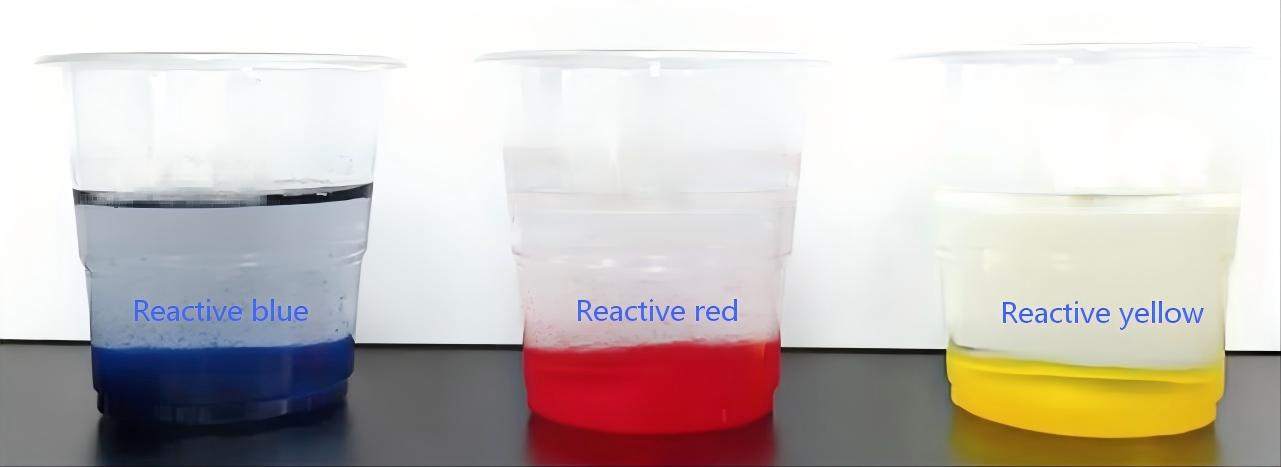
Developed for high-chroma wastewater, especially suitable for reactive dyes, acid dyes and paper dyeing wastewater, significantly reduces chroma and synergistically reduces COD.
Applicable industries
Textile printing and dyeing (dyeing and printing wastewater)
Papermaking (black liquor and white water treatment)
Fine chemicals (dye, pigment and auxiliary agent production)
Paint and ink wastewater
Water reuse/zero discharge pretreatment system
Solutions :
Product Information
| Product Name | Basic Characteristics | Application Description |
| Decolorant Series sylic FU5537 | Solid content ≥55%CAS No.: 55295-98-2pH (30% aqueous solution): 3.0–5.0Viscosity (20°C): 30–500 cps | 1. Mainly used for high-color wastewater decolorization in dye manufacturing plants, suitable for reactive, acidic, and disperse dye wastewater.2. Also applicable in textile dyeing & printing, pigments, ink, and papermaking wastewater treatment. |
| PAC Series Sylic FU5535 | Appearance: Yellow granulesAl₂O₃ content: ≥28%Basicity: 40.0–90%pH (1% aqueous solution): 3.5–5.0Water insoluble matter: ≤1.5% | 1. Rapid floc formation, large flocs, and fast settling speed.2. Wide applicable pH range (5–9), with minimal reduction in effluent pH and alkalinity.3. Suitable for different water temperatures; good solubility and stable performance even at low temperatures. |
| PAM Series Sylic FU5531G | Appearance: Granules or powderMolecular weight: 8 millionIonicity: 20% | 1. Mainly used for sludge dewatering, solid-liquid separation, coal washing, mineral processing, and papermaking wastewater treatment.2. Also applicable in industrial wastewater and municipal sewage treatment. |
Product Introduction
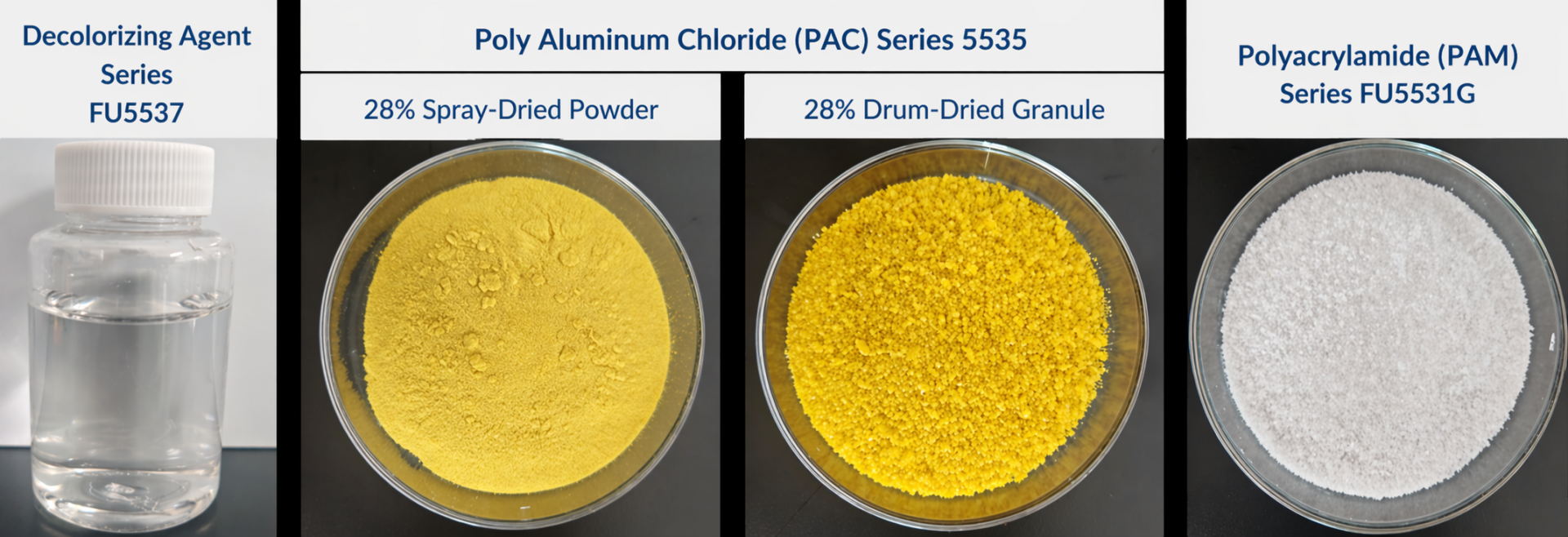
1. Decolorizing Agent Series FU5537
Main Ingredient: Dicyandiamide-formaldehyde resin
Application: This product is mainly used to remove color from high-chroma wastewater from dye factories. It is suitable for treating wastewater containing reactive, acidic, and disperse dyes. It can also be used to treat wastewater from textile, dye, pigment, printing ink, and paper mills.
2. Polyaluminum Chloride (PAC) Series FU5535
Main Ingredient: A water-soluble inorganic polymer between AlCl3 and Al(OH)3. Its chemical formula is [Al2(OH)nCl6-NLm], where m represents the degree of polymerization and n represents the degree of neutralization of PAC.
The image above shows two polyaluminum chloride products from our company. The left is a spray-dried product, which is in powder form; the right is a drum-dried product, which is in granular form. Both can be diluted and dissolved in water.
Product Applications: The main difference between polyaluminum chloride (PAC) and traditional inorganic coagulants is that traditional inorganic coagulants target low-molecular-weight crystalline salts, while PAC has a variable polycarboxylic acid complex structure. It exhibits rapid flocculation and sedimentation, is suitable for a wide pH range, is non-corrosive to pipes and equipment, and has a significant water purification effect. It effectively removes color, chemical oxygen demand (COD), and heavy metal ions such as arsenic and mercury. This product is widely used in drinking water, industrial water, and wastewater treatment.
3. Polyacrylamide (PAM) FU5531G
Main Components: Polyacrylamide, FU5531G Product Characteristics: 20% ionicity, molecular weight 8 million.
Product Applications: Polyacrylamide molecules with positively charged groups (CONH2) can disperse in solution to form suspended particles that connect with each other, exhibiting a strong flocculation effect. This accelerates the sedimentation of suspended particles and significantly speeds up solution clarification and promotes filtration. Therefore, it is widely used in water treatment, power, mining, coal processing, asbestos products, petrochemicals, papermaking, textiles, sugar industry, pharmaceuticals, environmental protection, and other fields.
Application Principle
Step 1: Decolorizing Agent Neutralization: The decolorizing agent works primarily through the neutralization of the dye molecules’ charge and flocculation. A small amount is added, resulting in small flocs.
Step 2: Polyaluminum Chloride (PAC) (Neutralization + Adsorption Bridging): PAC works through a dual mechanism of charge neutralization and adsorption bridging, gradually increasing the size of the decolorizing agent and dye flocs.
Neutralization: The positively charged groups generated by PAC hydrolysis combine with the negatively charged colloidal particles in the sludge, lowering their surface potential, weakening interparticle repulsion, and promoting floc formation.
Adsorption Bridging: The active groups on the PAC molecular chain can simultaneously adsorb multiple particles, forming a network structure, accelerating floc aggregation and sedimentation.
Step 3: Polyacrylamide (Adsorption Bridging and Network Sweeping): The addition of polyacrylamide relies mainly on adsorption bridging and network sweeping mechanisms to gradually settle the flocs.
Adsorption bridging: PAM long-chain molecules bind to sludge particles through functional groups, linking tiny flocs into larger particles and improving solid-liquid separation efficiency. Mesh capture and sweeping: The mesh structure formed by high-concentration PAM solution can directly capture fine particles, enhancing dewatering effects.
Scope of Application
1. Used for decolorizing high-chroma wastewater from dye factories, suitable for reactive, acidic, and disperse dye wastewater;
2. Can be used for wastewater treatment in textile printing and dyeing, pigment, ink, and papermaking industries;
Usage Method
Currently, the determination of the dosage of decolorizing agents in printing and dyeing wastewater involves a process of small-scale testing followed by large-scale testing. The process of small-scale testing (laboratory experiments) and large-scale testing (wastewater operation and commissioning) is explained below for reference.
Small-scale test procedure: Take an appropriate amount of wastewater (more than 200ml) in a beaker and adjust the pH value to between 7.5 and 9; dilute the required reagents: dilute the decolorizing agent 50 times (i.e., 2% mass concentration), polyaluminum chloride (PAC) 50 times, and polyacrylamide (PAM) 1000 times; Add the reagents dropwise, first adding the decolorizing agent and stirring, then adding the polyaluminum chloride and stirring, and finally adding the PAM and stirring, then let it stand; (Whether to add the decolorizing agent or polyaluminum chloride first needs to be determined according to the experiment of different wastewater.) Calculate the dosage of decolorizing agent and other reagents per ton of wastewater based on the experimental data.
Observe whether the color of the supernatant meets the requirements. If not, adjust the dosage of the reagent and repeat step three. Calculate the dosage of the decolorizing agent (using a specific test as an example). Large-scale test procedure: First, dilute the required reagent in the dosing equipment. Adjust the dosing flow rate based on the results of the small-scale test. If there is a biological treatment tank, add it to the outlet of the biological treatment tank; if there is no biological treatment tank, add it directly to the sedimentation tank. Adjust the dosage according to the color of the effluent from the sedimentation tank until the discharge standards are met.
Formula for calculating reagent dosage: Reagent dosage = [(number of drops/20) × mass concentration/volume of test wastewater] × 10^6 Prepared reagents: Decolorizing agent (2% solution, i.e., diluted 50 times)
PAC (2% solution)
PAM (0.1% aqueous solution) Take 200ml of test wastewater (color 200, COD 110) in a beaker, adjust the pH to 7.5-9, add 10 drops of decolorizing agent solution (1ml is equivalent to 20 drops) using a dropper, stir, then add 12 drops of PAC, stir, and finally add 2 drops of PAM, stir, let stand for one minute, and the effluent meets the national Class I discharge standard. The dosage of decolorizing agent = [(10/20) × 2%/200] × 10⁶ = 50 ppm
The dosage of PAC = [(12/20) × 2%/200] × 10⁶ = 60 ppm
The dosage of PAM = [(2/20) × 1%/200] × 10⁶ = 0.5 ppm
ppm is one part per million. A dosage of 50 ppm of decolorizing agent is equivalent to adding 50 grams of decolorizing agent concentrate to one ton of wastewater. Similarly, the dosage of PAC is 60 grams, and the dosage of PAM is 0.5 grams.
Application effects:
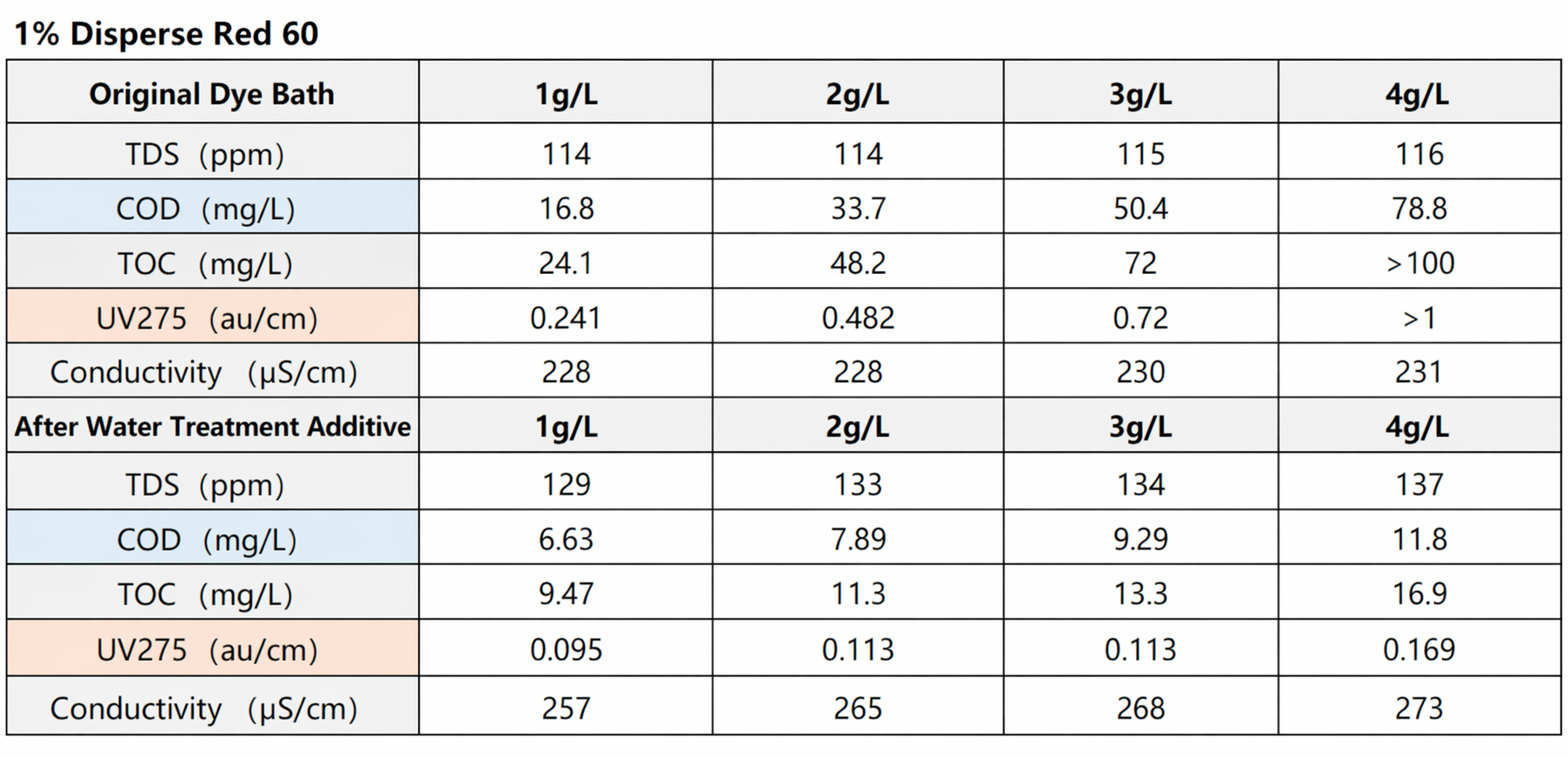
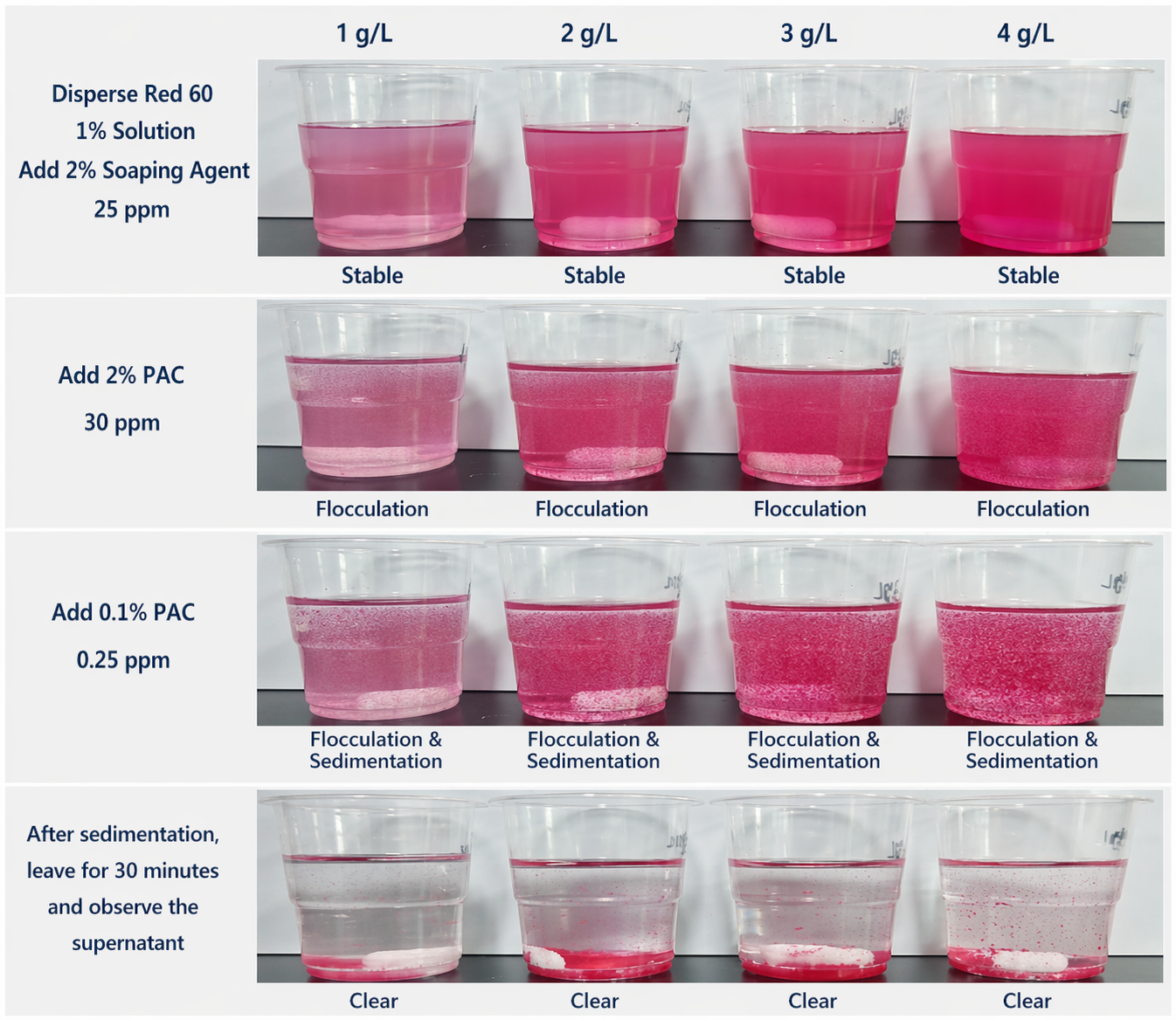
Disperse dyes:
Reactive dyes :