Cotton can look clean and still absorb water unevenly. Residual wax, knitting oil, or sizing material can interfere with wetting and cause inconsistent results during bleaching, dyeing, or finishing.
Scouring agents for cotton support penetration, emulsification, and impurity removal. Selecting a product with suitable alkali stability, setting an appropriate dosage, and verifying absorbency after washing are central to reliable pretreatment.
Because pretreatment influences fabric quality and dyeing uniformity, product selection should be based on performance under actual mill conditions.

How Scouring Agents Remove Cotton Wax
Wetting and Penetration
Raw cotton contains waxes, pectins, and other noncellulosic materials. Knitting and weaving can introduce additional oils, lubricants, and sizes. These impurities differ in composition, so identifying them is the first step toward an effective treatment.
Surfactants help the bath wet the fiber surface and penetrate the fabric structure. Dense woven fabrics, compact knits, and yarn packages require adequate liquor access as well as suitable chemistry.
Select wetting agents for cotton pretreatment according to the bath conditions and machinery. Rapid wetting supports cleaning, but it does not prove that wax and oil have been removed.
Wax Removal and Dispersion
Conventional alkaline scouring relies on several complementary actions:
- Alkali treatment: Saponifies susceptible fatty components and helps remove pectic and other noncellulosic materials.
- Emulsification: Helps transfer hydrophobic impurities into the treatment liquor.
- Dispersion: Keeps loosened material distributed in the bath until it can be washed away.
Not all cotton wax components are saponifiable. Effective removal therefore depends on surfactant performance and washing, as well as alkali.
If removed impurities are not adequately dispersed, they can redeposit on the fabric or accumulate on equipment. Oily spots, deposits, and uneven absorbency may result even when the nominal chemical dosage appears sufficient.
Washing Out Impurities
Washing removes the released impurities and residual chemicals. Temperature, water exchange, circulation, and liquor carryover determine its effectiveness. Check these conditions before increasing the scouring agent dosage; additional auxiliary will not compensate for inadequate rinsing.
For woven cotton, address the sizing system separately or through a validated combined process. A scouring agent should not be assumed to remove every type of size. Cotton blends also require conditions compatible with the other fibers present.
Alkali Stability in Cotton Scouring
What Alkali Stability Means
An alkali-stable scouring agent remains usable and effective in the intended alkaline bath. Stability depends on alkali concentration, temperature, exposure time, water quality, and the other chemicals present.
A product suitable for a dilute exhaust bath may behave differently in concentrated padding liquor. Likewise, room-temperature compatibility does not establish performance during steaming or hot batch treatment.
For cotton and cotton-blend pretreatment, Sylic P1200 alkali-stable scouring agent combines scouring and penetration functions and is suitable for cold pad-batch applications. Its technical specifications state stability in a 200 g/L sodium hydroxide solution. This stability value does not define the working alkali dosage or establish performance at every temperature and holding time.
How to Test Compatibility
Use a laboratory bath that reproduces production conditions, including the water supply, chemical concentrations, addition sequence, temperature, and holding time.
Check for separation, precipitation, deposits, and changes in foam during preparation, heating, and holding. Then treat representative fabric and compare its absorbency with an established production reference using the sampling procedure described below. Physical stability alone does not establish effective cleaning.
Some formulations are naturally cloudy. Evaluate changes against normal product behavior rather than treating clarity as proof of compatibility.
For combined scouring and peroxide bleaching, test the complete formulation, including the peroxide stabilizer and sequestering agent. Caustic compatibility alone is insufficient.
Before testing, obtain the technical data sheet, safety data sheet, and application guidance. Confirm the conditions behind any stability claim and the product’s suitability for the intended machinery.
Setting the Scouring Agent Dosage
Understand Dosage Units
Scouring agent dosage is commonly expressed as:
- g/L: Grams of product per liter of treatment liquor.
- % owf: Product mass as a percentage of dry fabric mass.
In an exhaust process, conversion requires the actual bath volume relative to fabric mass. At 10 liters of liquor per kilogram of fabric, 1 g/L supplies 10 g of product per kilogram, equivalent to 1% owf. This is a calculation example, not a recommended dosage.
Padding works differently. Bath concentration and wet pickup determine the amount carried onto the fabric, while replenishment and bath dilution affect consistency during a production run.
Compare supplied products on the same basis. Confirm whether dosage refers to the original product or a diluted preparation. Solids content alone does not measure cleaning efficiency.
Factors That Affect Dosage
Dosage depends on impurity load, fabric construction, machinery, liquor ratio or wet pickup, temperature, treatment time, and washing efficiency.
When selecting scouring agents for cotton pretreatment, use formulation-specific application guidance. The following P1200 reference ranges show how dosage changes with the process:
| Process | P1200 reference dosage | Associated application conditions |
| Batch treatment | 1.5–2.5 g/L | 98–100°C; reference treatment time of 30–60 minutes |
| Continuous scouring and steaming | 7–12 g/L | 98–102°C |
| Cold pad-batch pretreatment | 7–15 g/L | Hold at 35°C for 16–24 hours, followed by steaming and washing |
These product-specific values connect dosage with the intended treatment conditions. They are not complete recipes: follow the accompanying alkali, peroxide where applicable, and washing guidance, and validate the process for the fabric being treated.
Optimize Through Trials
Use a controlled trial to find a reliable dosage:
- Establish a reference treatment using the recommended process conditions.
- Compare lower and higher auxiliary dosages without changing the other variables.
- Use comparable greige material and an identical washing sequence.
- Record absorbency uniformity, foam, deposits, and fabric condition.
- Confirm the preferred treatment through a downstream dyeing trial where appropriate.
Repeat the preferred treatment on representative material before scaling up.
For buying decisions, compare chemical consumption and total treatment cost per metric ton of fabric. Include washing demand and reprocessing where relevant. A lower purchase price provides little benefit if it requires a higher dose or produces inconsistent preparation.

Measuring and Controlling Absorbency
Water-Drop and Wicking Tests
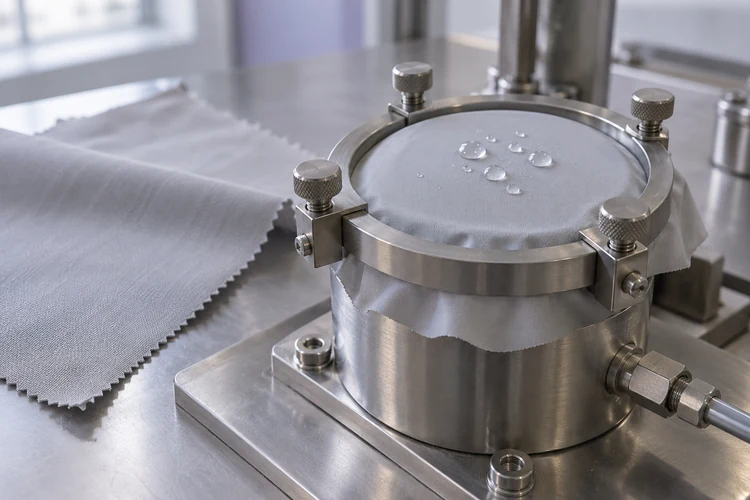
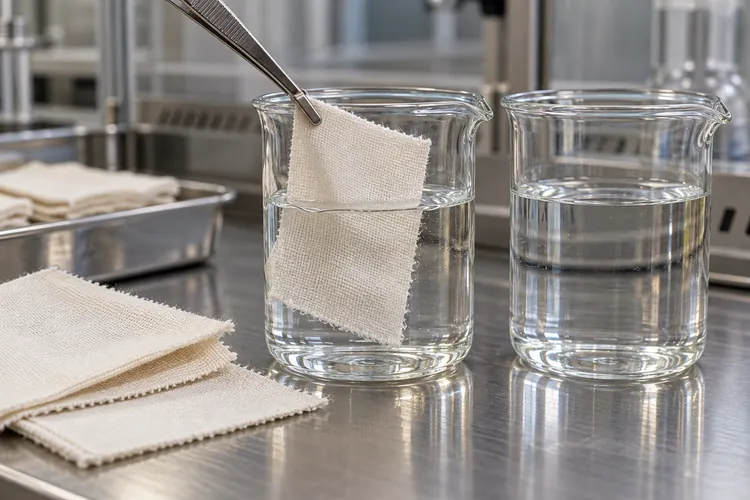
A water-drop test measures how quickly a defined drop wets into the fabric. It is useful for screening surface wettability, provided the drop size, placement, sample condition, and endpoint remain consistent.
A wicking test measures capillary transport through the textile structure. It complements water-drop testing because quick surface wetting does not necessarily indicate uniform water movement through the fabric.
Neither result directly quantifies residual wax. When absorbency results are unclear or defects persist, additional impurity analysis may be needed.
Check Uniformity
Test properly washed, dried, and conditioned samples before softening or another finish changes the surface behavior. Residual surfactant can improve apparent wettability even when cleaning is incomplete.
Sample across the fabric width and length, including positions likely to differ in liquor exposure. For yarn, use a sampling method suited to the package or processing format.
Record individual results and their spread, not only the average. A few slowly absorbing areas may indicate a penetration problem that an acceptable average conceals.
Set Acceptance Criteria
Define absorbency targets for the fabric construction, test procedure, and next processing stage. Avoid applying one universal absorption-time limit to every cotton product.
Preparation checks should also address:
- Residual alkalinity: Confirm that washing and any required neutralization produce the conditions needed for the next bath.
- Residual peroxide: Check and remove it after peroxide bleaching when required by the following process.
- Fabric condition: Assess strength, appearance, and other relevant quality requirements.
Whiteness and absorbency should be evaluated separately. A white-looking fabric is not necessarily uniformly absorbent, and a well-scoured fabric may still need bleaching for the intended shade.
Troubleshooting Scouring Problems
Compare actual operating conditions with the validated reference, including incoming material, water quality, and machine loading.
| Problem | Possible contributors | First checks |
| Slow or uneven wetting | Restricted penetration, poor circulation, bath incompatibility | Loading, liquor flow, wet pickup where applicable, and wetting performance |
| Poor absorbency after washing | Residual wax or size, insufficient treatment, ineffective rinsing | Desizing result, actual temperature and time, dosing accuracy, and wash sequence |
| Oily spots or deposits | Inadequate dispersion, redeposition, water-quality interference | Bath behavior, equipment cleanliness, water hardness, and carryover |
| Excessive foam | Unsuitable auxiliary, excessive dosage, strong agitation | Product suitability, dosing, and operating conditions |
| Variable batch results | Changing impurity load or inconsistent processing | Incoming material, liquor ratio, temperature records, and chemical additions |
Hard water can interfere with some bath components and contribute to deposits. Trace metals, particularly iron, also require attention during peroxide bleaching because they can accelerate peroxide decomposition.
Where water-quality interference is confirmed, consider Sylic P1500A dispersing and sequestering agent, an anionic powder with alkali resistance and chelating and dispersing functions for calcium, magnesium, and iron. Reference dosages are 0.5–1.5 g/L for continuous processing and 2.0–3.0 g/L for batch processing, adjusted to water quality and bath conditions. Its role is metal-ion control; it does not replace the scouring agent needed for wax and oil removal.
Use controlled trials to isolate the cause rather than changing auxiliary dosage, alkali, and treatment conditions together.
For product selection or a sample trial, provide fabric composition, construction, machinery, liquor ratio or wet pickup, the current recipe, washing conditions, and absorbency results.

FAQ
What Does a Cotton Scouring Agent Do?
It helps the bath penetrate cotton, emulsify waxes and oils, and disperse impurities so washing can remove them.
How Does Scouring Remove Cotton Wax?
Alkali and surfactants act together: saponification removes susceptible components, while emulsification and washing remove other hydrophobic material.
How Is Alkali Stability Tested?
Test the complete bath under the intended concentration, temperature, and holding conditions, then confirm cleaning performance on fabric.
What Dosage Should Be Used for Cotton Scouring?
Use the product-specific process recommendation as a starting point and validate the dosage through controlled trials.
Why Is Absorbency Still Poor After Scouring?
Residual wax or size, poor penetration, insufficient treatment, redeposition, or inadequate washing may be responsible.
How Should Cotton Absorbency Be Tested?
Use water-drop or wicking tests on washed, dried, and conditioned samples. Check multiple locations against process-specific acceptance criteria.
Can Scouring and Peroxide Bleaching Share One Bath?
Yes, with compatible auxiliaries and a suitable stabilizer system. Validate absorbency, whiteness, fabric condition, and residual peroxide control.