...

Contact Skychem Group for more chemical solutions, If you have questions or need more information, please contact us.
Respond within 24 hours

Low-Foam Wetting Agents: A Textile Pretreatment Guide

Fast wetting helps desizing, scouring, and bleaching chemicals reach the fabric evenly. The challenge is to achieve that penetration without creating foam that interferes with the machine. A wetting agent may perform well in a laboratory beaker but behave differently when the bath is pumped and circulated through a production machine.

A suitable low-foam wetting agent must work with the fabric, equipment, and complete pretreatment recipe. The main questions are straightforward: Does the fabric wet quickly? Does foam remain manageable? Does the treated fabric show the required cleanliness and absorbency?

How Low-Foam Wetting Agents Work

Wetting agents reduce surface tension, helping the treatment bath spread over the fabric and enter the spaces within yarns and fiber bundles. This is particularly useful when natural cotton waxes, processing oils, or a dense fabric construction slow penetration.

Understanding how textile wetting agents work also helps explain an important distinction: fast wetting does not necessarily mean effective cleaning. Fabric may wet quickly in a bath containing surfactants but remain poorly absorbent after washing because waxes or oils are still present.

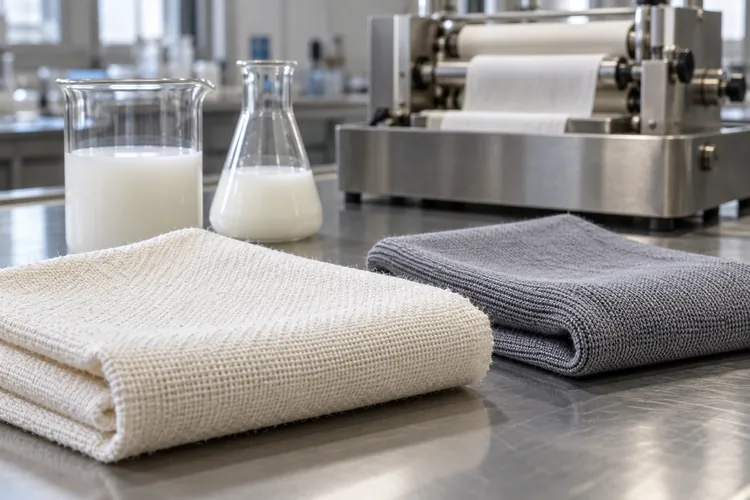
Cotton fabric passing through a pretreatment padding bath.

Wetting, Cleaning, and Foam Control

These functions are related, but they serve different purposes.

Auxiliary Main job What to check
Wetting agent Helps the bath spread and penetrate Wetting speed and uniformity
Scouring agent or detergent Helps remove waxes, oils, and other impurities Cleaning and prevention of redeposition
Defoamer Breaks foam and may limit further buildup Foam control, compatibility, and fabric deposits

Some products combine wetting with cleaning and emulsification. Emulsification helps break oily material into small droplets that can be carried in the bath and removed during washing. Check whether the chosen product provides enough cleaning support or whether a separate detergent is needed.

Low-foam formulations limit the amount of foam produced or how long it lasts. They do not guarantee a foam-free bath at every dose, temperature, or circulation rate.

Why Foam Control Matters

Jet and soft-flow machines repeatedly circulate the bath through the textile. Agitation and air entering the liquid can create bubbles, which surfactants may stabilize. Persistent foam can disrupt bath handling, contribute to overflow, and make steady operation harder to maintain.

On continuous pretreatment lines, foam in padding baths or washing sections can also interfere with consistent application and rinsing.

Foam behavior may change during the process. A bath that produces little foam at the scouring temperature may foam during cooling or dilution. Other ingredients matter, too. Detergents, sizing residues, oils, and chemicals left from earlier stages can change the result.

For this reason, a clean-water test at room temperature is only an initial check. The full recipe must be evaluated under conditions that reflect production.
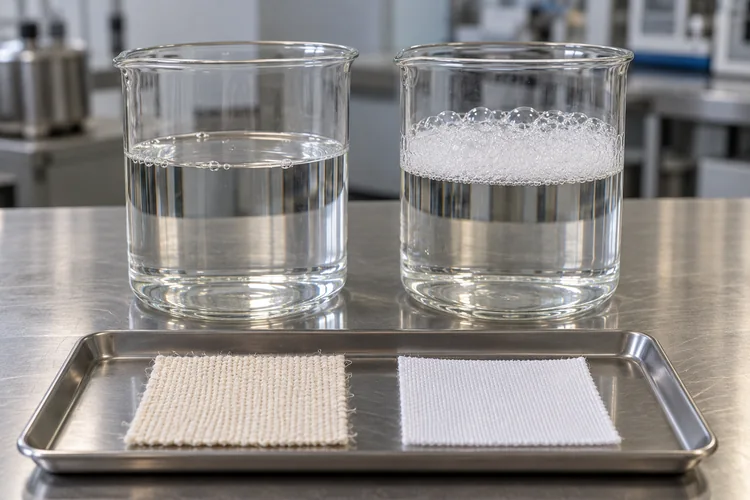
Two textile test baths with different foam levels.

Choosing the Right Wetting Agent

Match the Fabric and Equipment

Start with the material being processed and the machine being used.

  • Cotton: Consider natural waxes, added oils, sizing materials, and the planned scouring conditions.
  • Polyester and blends: Check the processing oils and spin finishes that need to be removed.
  • Dense fabrics and yarn packages: Assess penetration into the structure, not just surface wetting.
  • Continuous lines: Make sure wetting occurs within the available contact time.
  • Jet and soft-flow machines: Check foam under the intended circulation conditions and liquor ratio.

A wetting agent cannot correct poor liquid flow through a yarn package or uneven application across the fabric. Check the machine’s ability to deliver the bath as well as the chemical’s ability to improve wetting.

Check Bath Compatibility

Confirm performance at the intended temperature, alkali concentration, and water hardness.

The checks should match the process:

  • For enzyme desizing, confirm compatibility with the enzyme and its operating conditions.
  • For alkaline scouring, check wetting and stability at the actual alkali level.
  • For peroxide bleaching, test the complete recipe, including the peroxide stabilizer and sequestering agent.

Look for separation, precipitation, deposits, and slower wetting. A change in appearance does not always mean the product has failed, so compare it with measured performance.

Where the wetting agent does not provide enough cleaning, use compatible textile scouring agents to help remove waxes and oils. Check the combined recipe for both cleaning and foam.

Match Product Parameters to the Process

For trials that require penetration and emulsification with low foam, evaluate Sylic P1412 nonionic low-foaming wetting agent. The relevant specifications are:

  • Main component: Polyoxyethylene compounds.
  • Ionic character: Nonionic.
  • pH: 6–8 in a 1% aqueous solution.
  • General application dose: 0.5–3.0 g/L for textile dyeing and finishing processes.

The product’s penetration and emulsification properties are relevant when the bath needs to enter the textile and help disperse oily impurities. However, nonionic character alone does not prove low-foam performance. The stated pH describes the diluted product; it does not define the bath’s operating range or prove resistance to strong alkali.

Before using P1412 in pretreatment, confirm its suitability for the intended alkali level, peroxide recipe, and equipment. Request wetting and foam test results with the conditions clearly stated, then establish the working dose through trials. The general dose range should not be treated as a universal pretreatment recipe.

Testing and Dosage

Run a Practical Trial

Use representative untreated fabric or yarn, mill water, and the intended recipe. Compare each candidate with the current production product.

Decide what counts as an acceptable result before testing. Then check four areas:

  1. Wetting speed: Use a suitable wetting or sinking test with consistent sample preparation. Repeat measurements. Trapped air and fabric construction can affect sinking time, so interpret it alongside other observations.
  2. Foam height and collapse: Measure foam after a set period of agitation, then record how quickly it disappears. Repeat at relevant temperatures and during cooling and dilution.
  3. Treated-fabric quality: Check cleaning, absorbency, and whiteness where needed. Wash and condition samples in the same way so residual surfactant does not distort the comparison.
  4. Machine performance: Run promising candidates in the production machine. Record operating stability, additional defoamer use, and subsequent dyeing results.

Document the dose, temperature, bath chemistry, and agitation for each test. Without those details, differences between products are difficult to interpret.

Water-drop testing on scoured cotton fabric.

Set the Working Dose

Start with product-specific guidance and compare several doses under the intended conditions. Select the lowest dose that consistently meets the wetting, cleaning, and foam requirements.

Keep the units clear:

  • g/L means grams of commercial product per liter of bath.
  • % owf, or percentage on weight of fabric, expresses the commercial product dose relative to fabric weight.

For example, 0.5% owf equals 5 grams of product per kilogram of fabric. At a liquor ratio of 10 liters per kilogram, that equals 0.5 g/L. This example shows how to convert the units; it is not a recommended dose.

In continuous padding, the bath concentration and wet pickup determine how much product is carried onto the fabric. Wet pickup is the amount of liquid retained by the fabric after padding, expressed relative to its dry weight. An exhaust-process dose cannot be transferred directly to padding without accounting for this difference.

Adding more product may increase foam and rinsing demand without improving performance. Raise the dose only when the trial shows a clear benefit.

Compare Cost at the Effective Dose

Compare chemical cost per kilogram of treated textile at the dose needed to achieve acceptable results. Drum price alone does not show which product is more economical.

Also, solids content does not necessarily equal active surfactant content. Ask what the declared concentration measures before comparing concentrated products.

Include savings from lower defoamer use, fewer washes, or less reprocessing only when trials confirm them.

Common Problems and Fixes

Identify the main problem before changing the recipe. Slow wetting, poor cleaning, and excessive foam may need different corrections.

Problem Possible causes What to check
Persistent foam Excess dose, other surfactants, residual chemicals, or air entering the bath Verify dosing, test the complete recipe, and inspect the circulation system
Slow penetration Unsuitable product, heavy contamination, short contact time, or unsuitable bath conditions Test the actual fabric at the intended temperature and alkali level; check contact time and liquid flow
Low foam but poor cleaning Too little detergency or emulsification, or inadequate scouring Review the cleaning chemicals, treatment time, and temperature
Foam during cooling or rinsing Changes in surfactant behavior or chemicals remaining from treatment Test through cooling and dilution; review washing and chemical carryover
Uneven absorbency Uneven bath application, incomplete cleaning, or inconsistent washing Compare samples across the fabric and check application and washing conditions

When choosing a defoamer for textile processing, check compatibility with the bath and inspect treated fabric for spots or deposits. Removing visible foam does not correct incomplete cleaning or uneven liquid flow.

To select suitable textile pretreatment auxiliaries, provide the fabric composition, machine type, liquor ratio, operating temperature, alkali concentration, and complete recipe. Explain when foam appears and how long it lasts. These details help narrow the product choice and plan a useful trial.

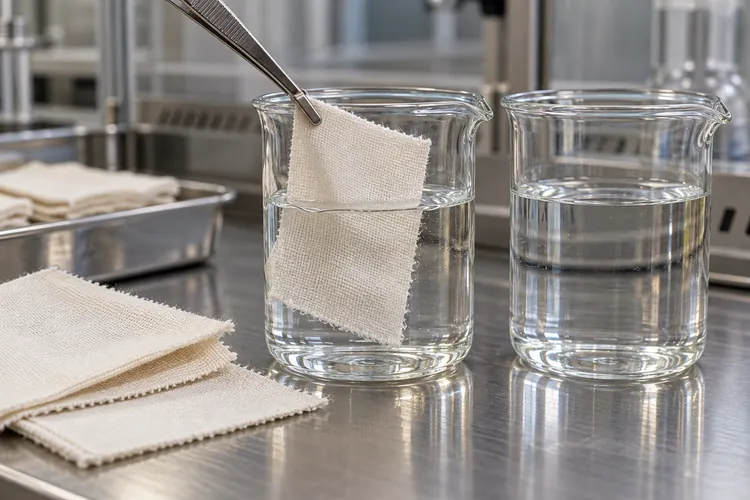
Cotton fabric partially immersed in a wetting-test bath.

FAQ

Are all nonionic wetting agents low foaming?

No. Nonionic describes the surfactant’s ionic character, not its foam behavior. Foam depends on the product’s composition, dose, temperature, and agitation.

Can low-foam wetting agents tolerate alkali and peroxide?

Some can, but low foam does not prove chemical compatibility. Confirm the product’s application guidance and test the complete recipe at the intended alkali concentration and temperature.

Why does a low-foam wetting agent still produce foam?

The dose, agitation, temperature, and other bath ingredients may differ from the conditions used to test the product. Residual chemicals and air entering the circulation system can also contribute.

Can a low-foam wetting agent replace a defoamer?

Sometimes. A suitable wetting agent may reduce or eliminate separate defoamer use, but the result depends on the complete recipe and equipment. Check performance during treatment, cooling, and rinsing before changing the production recipe.

Sandy

With years of experience in chemical dyes and textile auxiliaries, I’m dedicated to sharing insights into the latest technologies, sustainable innovations, and market trends.

Recent Articles

Cotton swatch in an alkaline bath compatibility trial.

Scouring Agents for Cotton: Wax Removal, Dosage & Absorbency

Table of Contents How Scouring Agents Remove Cotton Wax Wetting and Penetration Wax Removal and Dispersion Washing Out Impurities Alkali Stability in Cotton Scouring What Alkali Stability Means How to Test Compatibility Setting the Scouring Agent Dosage Understand Dosage Units Factors That Affect Dosage Optimize Through Trials Measuring and Controlling Absorbency Water-Drop and Wicking Tests Check Uniformity Set Acceptance Criteria Troubleshooting Scouring Problems FAQ What Does a Cotton Scouring Agent Do? How Does Scouring Remove Cotton Wax? How Is Alkali Stability Tested? What Dosage Should Be Used for Cotton Scouring? Why Is Absorbency Still Poor After Scouring? How Should Cotton Absorbency Be Tested? Can Scouring and Peroxide Bleaching Share One Bath? Cotton can look clean and still absorb water unevenly. Residual wax, knitting oil, or sizing material can interfere with wetting and cause inconsistent results during bleaching, dyeing, or finishing. Scouring agents for cotton support penetration, emulsification, and impurity removal. Selecting a product with suitable alkali stability, setting an appropriate dosage, and verifying absorbency after washing are central to reliable pretreatment. Because pretreatment influences fabric quality and dyeing uniformity, product selection should be based on performance under actual mill conditions.   How Scouring Agents Remove Cotton Wax Wetting and Penetration Raw cotton contains waxes, pectins, and other noncellulosic materials. Knitting and weaving can introduce additional oils, lubricants, and sizes. These impurities differ in composition, so identifying them is the first step toward an effective treatment. Surfactants help the bath wet the fiber surface and penetrate the fabric structure. Dense woven fabrics, compact knits, and yarn packages require adequate liquor access as well as suitable chemistry. Select wetting agents for cotton pretreatment according to the bath conditions and machinery. Rapid wetting supports cleaning, but it does not prove that wax and oil have been removed. Wax Removal and Dispersion Conventional alkaline scouring relies on several complementary actions: Alkali treatment: Saponifies susceptible fatty components and helps remove pectic and other noncellulosic materials. Emulsification: Helps transfer hydrophobic impurities into the treatment liquor. Dispersion: Keeps loosened material distributed in the bath until it can be washed away. Not all cotton wax components are saponifiable. Effective removal therefore depends on surfactant performance and washing, as well as alkali. If removed impurities are not adequately dispersed, they can redeposit on the fabric or accumulate on equipment. Oily spots, deposits, and uneven absorbency may result even when the nominal chemical dosage appears sufficient. Washing Out Impurities Washing removes the released impurities and residual chemicals. Temperature, water exchange, circulation, and liquor carryover determine its effectiveness. Check these conditions before increasing the scouring agent dosage; additional auxiliary will not compensate for inadequate rinsing. For woven cotton, address the sizing system separately or through a validated combined process. A scouring agent should not be assumed to remove every type of size. Cotton blends also require conditions compatible with the other fibers present. Alkali Stability in Cotton Scouring What Alkali Stability Means An alkali-stable scouring agent remains usable and effective in the intended alkaline bath. Stability depends on alkali concentration, temperature, exposure time, water quality, and the other chemicals present. A product suitable for a dilute exhaust bath may behave differently in concentrated padding liquor. Likewise, room-temperature compatibility does not establish performance during steaming or hot batch treatment. For cotton and cotton-blend pretreatment, Sylic P1200 alkali-stable scouring agent combines scouring and penetration functions and is suitable for cold pad-batch applications. Its technical specifications state stability in a 200 g/L sodium hydroxide solution. This stability value does not define the working alkali dosage or establish performance at every temperature and holding time. How to Test Compatibility Use a laboratory bath that reproduces production conditions, including the water supply, chemical concentrations, addition sequence, temperature, and holding time. Check for separation, precipitation, deposits, and changes in foam during preparation, heating, and holding. Then treat representative fabric and compare its absorbency with an established production reference using the sampling procedure described below. Physical stability alone does not establish effective cleaning. Some formulations are naturally cloudy. Evaluate changes against normal product behavior rather than treating clarity as proof of compatibility. For combined scouring and peroxide bleaching, test the complete formulation, including the peroxide stabilizer and sequestering agent. Caustic compatibility alone is insufficient. Before testing, obtain the technical data sheet, safety data sheet, and application guidance. Confirm the conditions behind any stability claim and the product’s suitability for the intended machinery. Setting the Scouring Agent Dosage Understand Dosage Units Scouring agent dosage is commonly expressed as: g/L: Grams of product per liter of treatment liquor. % owf: Product mass as a percentage of dry fabric mass. In an exhaust process, conversion requires the actual bath volume relative to fabric mass. At 10 liters of liquor per kilogram of fabric, 1 g/L supplies 10 g of product per kilogram, equivalent to 1% owf. This is a calculation example, not a recommended dosage. Padding works differently. Bath concentration and wet pickup determine the amount carried onto the fabric, while replenishment and bath dilution affect consistency during a production run. Compare supplied products on the same basis. Confirm whether dosage refers to the original product or a diluted preparation. Solids content alone does not measure cleaning efficiency. Factors That Affect Dosage Dosage depends on impurity load, fabric construction, machinery, liquor ratio or wet pickup, temperature, treatment time, and washing efficiency. When selecting scouring agents for cotton pretreatment, use formulation-specific application guidance. The following P1200 reference ranges show how dosage changes with the process: Process P1200 reference dosage Associated application conditions Batch treatment 1.5–2.5 g/L 98–100°C; reference treatment time of 30–60 minutes Continuous scouring and steaming 7–12 g/L 98–102°C Cold pad-batch pretreatment 7–15 g/L Hold at 35°C for 16–24 hours, followed by steaming and washing These product-specific values connect dosage with the intended treatment conditions. They are not complete recipes: follow the accompanying alkali, peroxide where applicable, and washing guidance, and validate the process for the fabric being treated. Optimize Through Trials Use a controlled trial to find a reliable dosage: Establish a reference treatment using the recommended process conditions.

Explore More »
Cotton and polyester samples beside textile finishing emulsions.

How to Select Textile Finishing Chemicals for Production?

Table of Contents Define Production Requirements Check Chemical Compatibility Bath Compatibility Fabric Compatibility Determine the Required Add-On Dosage vs. Add-On Calculate and Control Add-On Validate Finishing Performance Test Against Acceptance Criteria Confirm Production Repeatability Review Supplier Specifications Technical Data and Batch Quality Documentation and Support Make the Final Selection FAQ Can finishing chemicals be mixed in one bath? What is the difference between dosage and add-on? Does more softener always improve performance? Can finishing chemicals affect shade and fastness? Which supplier specifications matter most? What should be tested before bulk production? A finishing chemical can produce an excellent lab sample and still disappoint on the production line. The fabric may feel different across the width, the shade may shift after drying, or deposits may appear after the bath has been running for several hours. These problems are often linked to how the chemical fits the fabric, recipe, and equipment. Selecting textile finishing chemicals therefore takes more than comparing product descriptions or price per kilogram. You need to confirm compatibility, determine the required add-on, validate performance, and review the supplier’s specifications. Define Production Requirements Start with the fabric and the result you need. “Soft finish” is too broad to guide a reliable purchase. A towel needs softness while retaining water absorption. A polyester knit may need a smooth handle without compromising moisture transport. A cotton shirt may need easy-care performance while retaining acceptable strength. Check washing effectiveness and residual salts, alkali, surfactants, or fixing agents before finishing. Use the following selection brief to capture the fabric and process requirements. Turn customer expectations into acceptance criteria: an agreed handle reference, shade tolerance, functional performance target, and required wash durability. Then confirm whether the production line can deliver the necessary application and thermal conditions. Record line speed and fabric temperature during drying or curing, rather than relying on the machine setpoint alone. Selection factor What to establish Why it matters Fabric Fiber blend, construction, weight, and stretch content Determines the substrate on which the finish must work Processing history Dye system, washing, and residual chemicals Helps identify interaction and shade risks Finishing target Desired handle, absorbency, or functional effect Creates a basis for comparing products Application process Padding, exhaustion, spraying, or foam Determines how chemistry reaches the fabric Acceptance criteria Performance limits and required wash durability Defines whether a trial passes For handle-focused applications, shortlist textile softening auxiliaries according to the substrate and desired feel. Keep other functional requirements in the selection brief so that improving softness does not come at the expense of another essential property. Check Chemical Compatibility Bath Compatibility The complete finishing bath needs to remain stable under actual operating conditions. A product that disperses well in clean water may behave differently in hard process water or when combined with a fixing agent, resin, catalyst, or another softener. Review the ionic types of textile softeners as an initial compatibility check. Cationic and anionic products can interact and cause instability, but ionic classification alone does not establish whether a particular recipe is suitable. Emulsion design, concentration, pH, and the other ingredients also matter. Confirm the supplier’s recommended working pH, water quality, temperature, dilution procedure, and addition sequence. Avoid direct contact between concentrates unless the mixing instructions specifically allow it. Use a practical compatibility trial: Prepare the complete recipe with production water at the intended concentrations. Follow the planned dilution and addition sequence. Hold the bath for a period representative of production, including relevant temperature and shear conditions. Check for flocculation, separation, deposits, excessive foam, or changes from the mixture’s normal appearance. Apply the recipe to representative fabric and evaluate the finished result. Fabric Compatibility Apply the finish to the intended substrate and shade, including representative white, pale, and dark styles where relevant. Screen for discoloration, spotting, and changes in absorbency after drying or curing. Use the performance checks in Section 4 to qualify the result. Determine the Required Add-On Dosage vs. Add-On Dosage is the amount of commercial product introduced into the process. Add-on expresses the amount applied or retained relative to dry fabric weight. State the basis clearly: commercial product, active ingredient, or measured dry finish. These values are not interchangeable. In padding, bath concentration is commonly expressed in grams per liter. Wet pickup is the mass of liquor retained after squeezing, expressed as a percentage of dry fabric weight: Wet pickup (%) = retained liquor mass ÷ dry fabric mass × 100 Use these values to estimate the nominal commercial-product add-on. For wet-on-wet processing, incoming moisture can dilute the bath, so the simple estimate needs additional process checks. For an aqueous bath with a density close to 1 kg/L: Nominal product add-on (%) = bath concentration (g/L) × wet pickup (%) ÷ 1,000 If the supplier confirms the active content by mass, convert the percentage to a decimal fraction: Nominal active add-on (%) = product add-on (%) × active fraction These estimates assume that the retained liquor has the stated bath concentration. They do not establish the amount of functional chemistry retained after curing, washing, or other subsequent processing. Calculate and Control Add-On Consider an illustrative padding recipe containing 20 g/L of commercial product, with 70% wet pickup and a supplier-declared active content of 30%. Calculation Result Commercial-product add-on: 20 × 70 ÷ 1,000 1.4% of dry fabric weight Active add-on: 1.4% × 0.30 0.42% of dry fabric weight If pickup falls to 60% at the same concentration, nominal active add-on falls to 0.36%. That difference may affect handle or functional performance, depending on the finish. Check pickup across the width and during the run, maintaining consistent nip pressure, roller condition, and fabric feed. Monitor bath concentration and replenishment because a constant recipe setting does not guarantee constant application. Do not automatically substitute solids content for active content. A solids measurement may include ingredients that do not contribute equally to the intended finishing effect. Ask the supplier what the declared value represents before comparing concentrated products. For exhaustion, a dosage of 2% owf (“on weight of fabric”) means

Explore More »
Finished denim fabric

Denim Finishing Process: Chemicals and Applications

Table of Contents 1. Denim Finishing Sequence 2. Desizing Chemicals Amylase for Starch Removal Supporting Auxiliaries Selection Considerations 3. Enzyme Washing Chemicals How Cellulase Works Acid vs. Neutral Cellulase Process Control 4. Anti-Back-Staining Agents Why Back-Staining Occurs Chemical Function and Application Performance Checks 5. Denim Softeners Silicone and Non-Silicone Options Hydrophilic Softeners Selection and Compatibility 6. Functional Finishing Chemicals Water Repellency Moisture Management Easy-Care Finishes Odor Control Durability and Compatibility 7. Choosing Denim Finishing Chemicals FAQ What Chemicals Are Used in Denim Finishing? How Do Amylase and Cellulase Differ? Acid or Neutral Cellulase: Which Should You Choose? How Can You Reduce Denim Back-Staining? Which Softener Is Suitable for Stretch Denim? Can Softeners and Functional Finishes Be Combined? How Should Denim Finishing Chemicals Be Tested? The denim finishing process shapes a garment’s appearance, hand feel, and performance through desizing, enzyme washing, back-staining control, and softening. Optional functional finishes add properties such as water repellency, moisture management, or crease resistance. For denim manufacturers, garment laundries, and chemical buyers, the goal is a repeatable process that delivers the target wash while preserving fabric strength and, where applicable, stretch recovery. 1. Denim Finishing Sequence This guide focuses on denim garment wet processing. Mill-level fabric finishing uses some of the same chemical categories, but application methods and production requirements can differ. A typical garment process follows this sequence: Desize to remove weaving size. Enzyme wash, when needed, to develop fading or improve the surface. Deactivate the enzyme and rinse according to the product instructions. Soften to achieve the required hand feel. Apply optional functional finishes, with drying or curing as required. This is a starting framework, not a universal recipe. Functional treatments may replace, precede, or share an application stage with softening. Anti-back-staining agents usually support relevant washing stages rather than form a separate finishing step. Treatment Main chemicals Primary purpose Main control points Desizing Amylase for starch-based size, wetting agents, detergents Remove size and prepare denim for uniform washing Size composition, enzyme conditions, and wash-off Enzyme washing Cellulase enzymes Develop abrasion, fading, or a cleaner surface Target appearance, treatment endpoint, and strength retention Back-staining control Anti-back-staining agents Reduce redeposition of released dye Pocket whiteness, bath conditions, and enzyme compatibility Softening Silicone and non-silicone softeners Adjust softness, smoothness, and fullness Hand feel, shade, absorbency, and application uniformity Functional finishing Water-repellent, moisture-management, easy-care, or specialty finishes Deliver specified performance Substrate suitability, curing, compatibility, and wash durability A dark-rinse jean may require desizing and softening with minimal abrasion. A vintage wash needs more surface treatment. Stretch denim requires additional checks on elastic recovery and dimensional stability. If bleaching is included, remove or neutralize residual bleaching chemicals as appropriate before subsequent treatments. 2. Desizing Chemicals Amylase for Starch Removal Size protects warp yarns during weaving. Removing it before garment washing helps the treatment bath reach the denim more evenly and reduces interference with later processes. Alpha-amylase breaks starch into smaller, more readily washable components. Its action is specific: it does not remove all types of weaving size. If the fabric contains a mixed size, the removal process must address the non-starch components as well. Amylase and cellulase have different jobs. Amylase targets starch during desizing; cellulase targets accessible cotton cellulose during surface treatment. This distinction is explained in the garment finishing guide. Supporting Auxiliaries Wetting agents help the bath penetrate the garment, while suitable detergents assist in washing out degraded size and other removable residues. Effective rinsing remains necessary because breaking down starch is only part of the process. The breakdown products must also leave the fabric. For starch-based size, Sylic B6141 amylase for textile desizing is a candidate for evaluation. This alpha-amylase formulation does not require added calcium salt activators and is compatible with commonly used desizing wetting agents. Confirm the garment-bath conditions in the current technical data sheet before use; fabric preparation instructions should not be transferred directly to a garment washer. Selection Considerations Before setting the desizing conditions, confirm: The sizing formulation and whether it contains starch. The enzyme’s recommended pH, temperature, and treatment time. Compatibility with water quality and other bath additives. The wash-off procedure and method for checking residual size. An iodine-based check can indicate residual starch, but it does not establish removal of every component in a mixed size. Use an assessment suited to the original sizing formulation. 3. Enzyme Washing Chemicals How Cellulase Works Cellulase hydrolyzes accessible cellulose at the cotton surface. Combined with mechanical action, this loosens surface fibers and associated indigo, creating a washed appearance. Biostoning emphasizes abrasion and fading. Biopolishing focuses on removing protruding fibers for a cleaner surface. Both can involve cellulase, but their process targets and treatment intensity differ. Yarn construction, dye penetration, cotton content, and machine action affect the result. In blends, cellulase targets the cotton component rather than polyester or elastane. Acid vs. Neutral Cellulase Acid and neutral cellulases operate best within different pH ranges. The choice should reflect the desired wash effect and the performance of the specific formulation. Selection factor Acid cellulase Neutral cellulase Preferred conditions Acidic operating range Near-neutral operating range Abrasion effect Often produces strong abrasion under suitable conditions Can produce effective abrasion with controlled contrast Back-staining tendency Conventional formulations can require closer control Often offers lower back-staining under suitable conditions Decision criteria Shade, contrast, strength retention, and processing cost Shade, contrast, strength retention, and processing cost These are general tendencies. Modified enzymes and formulated blends can perform differently, so neither category should be treated as automatically stronger, gentler, or more economical. Compare candidates on the same denim fabric. Activity figures are comparable only when the test methods and units match; dosage by weight alone does not establish equivalent enzyme performance. Process Control Control enzyme dosage, pH, temperature, treatment time, liquor ratio, and machine loading. Mechanical action also matters because it helps remove the material loosened by the enzyme. Set a clear endpoint for shade and abrasion. Excessive treatment can increase fabric weight loss and reduce strength. Deactivate the enzyme using the supplier’s specified procedure; draining the bath alone

Explore More »
Discharge pattern on dark cotton fabric.

Dischargeable Reactive Dyes for Cotton Printing: Selection, Control, and Fastness

Table of Contents How Discharge Printing Works Selecting Reactive Dyes Controlling the Process Testing Print Quality and Fastness Preparing a Bulk-Order Enquiry FAQ Are all reactive dyes dischargeable on cotton? Why does a discharge print leave a colored cast? What is the difference between white and color discharge? Which conditions affect discharge consistency? How should discharge-printed cotton be tested for fastness? Discharge printing creates a pattern on dyed cotton by applying a paste that changes the ground dye’s color in selected areas. The result may be a light pattern, known as white discharge, or a colored pattern made with a compatible colorant in the print paste. A ground shade often contains several reactive dyes. If one component retains its color, the pattern can develop a visible cast. Mills should test the complete shade recipe on the intended fabric and evaluate the finished print before approving bulk production. How Discharge Printing Works The fabric is dyed to its ground shade, printed with a discharge paste, processed, and washed. White discharge aims to produce a clean, light pattern. Color discharge must also deliver the intended printed shade after processing and washing. The result depends on the dye combination, shade depth, paste, application, and processing conditions. A laboratory sample is useful for screening, but approval should be based on a trial that represents the proposed production fabric and process. Selecting Reactive Dyes Test each dye in the ground-shade formula to identify components that leave residual color. Then test the complete mixture at the intended shade depth. A dye that clears well in a pale sample may leave a noticeable cast in a dark ground. Compare candidates under consistent trial conditions. Record the fabric, dye formula, discharge paste, processing conditions, and appearance after washing. Judge the printed area against an approved reference for contrast and unwanted color. For ground-shade trials, start with Skyzol reactive dyes and verify the discharge response of each proposed dye. Cotton dyeing suitability alone does not establish dischargeability. Confirm the complete dye combination with the intended paste and process. For color discharge, also test the colorant in the print paste. Check its final shade, pattern definition, and performance after washing. A ground shade that discharges cleanly does not guarantee a satisfactory colored print. Controlling the Process Consistent printing starts with consistent ground fabric. Keep pretreatment, dyeing conditions, and ground-shade wash-off under control; the main variables are explained in reactive dyeing on cotton. Record the conditions used for the approved sample so that later fabric lots can be compared with it. During printing, monitor paste preparation and holding time, application settings, processing conditions, and afterwashing. Compare production samples with a retained approved sample to identify changes between lots. Paste consistency can affect pattern edges. For paste viscosity control, Sylic PR4200 Reactive Thickener offers electrolyte resistance and water retention and can be used with sodium alginate. Verify its compatibility with the chosen discharge agent in a trial before use. Observed result First variables to check Ground color remains in the pattern Dye combination, shade depth, and processing conditions A colored cast remains Discharge response of each ground-shade dye Pattern edges are blurred Paste consistency and application settings Results vary between lots Fabric preparation, ground dyeing, and print settings These checks guide troubleshooting rather than identify a cause on their own. Where practical, change one trial variable at a time. Testing Print Quality and Fastness Inspect the finished fabric after its full wash-off sequence. Assess discharge contrast, residual cast, pattern edges, and any change in appearance or handle. For color discharge, compare the printed shade with the approved reference. Test the ground shade for the required washing and rubbing fastness. For a colored print, assess the printed color as well. In white discharge areas, check for staining, color return, and loss of contrast after washing. Effective reactive dye soaping helps remove residual dye from cotton, but the finished discharge print still requires its own testing. Agree with the buyer on acceptance criteria before the bulk trial: Approval item What to agree on Ground shade Approved reference and acceptable variation Discharge appearance Required contrast, residual cast, and edge definition Printed color, if used Approved shade after processing Fastness Required tests, methods, and acceptance levels Fabric condition Acceptable appearance and handle If the fabric, dye formula, paste components, or processing route changes, assess whether the approval trial needs to be repeated. Preparing a Bulk-Order Enquiry Give the supplier enough information to propose a representative trial: Fabric composition, construction, and weight Ground-shade sample or dye formula and target depth Printing method and available equipment White or color discharge target Required appearance and fastness results Trial quantity and estimated bulk volume Test the proposed dyes and auxiliaries under the intended production conditions. Approve the combination only when the finished print meets the agreed requirements. Share the fabric specification, ground shade, and print target with Skychem Group to discuss suitable reactive dyes and textile auxiliaries. FAQ Are all reactive dyes dischargeable on cotton? No. Dyes respond differently to discharge conditions. Test each component of a mixed ground shade, then confirm the complete recipe at the intended depth. Why does a discharge print leave a colored cast? One or more ground-shade dyes may retain color after processing. Individual dye trials can help identify the component, while a trial of the full recipe shows its effect on the final print. What is the difference between white and color discharge? White discharge produces a light pattern in the dyed ground. Color discharge also uses a compatible colorant to create a new printed shade. Which conditions affect discharge consistency? Ground dyeing, paste preparation, application, processing, and afterwashing can all affect the result. Compare production samples with the approved reference and its recorded conditions. How should discharge-printed cotton be tested for fastness? Test the ground shade and any colored print against the buyer’s required washing and rubbing fastness criteria. Check white discharge areas for staining, color return, and changes in contrast after washing.

Explore More »

Contact Us for Textile Auxiliaries and Dyes

Contact Skychem Group for more chemical solutions, If you have questions or need more information, please contact us.
We will respond within 24 hours

Get a project quote

Tell us your project requirements, country, and intended application.

Sandy

With years of experience in chemical dyes and textile auxiliaries, I’m dedicated to sharing insights into the latest technologies, sustainable innovations, and market trends.

Recent Articles

Cotton swatch in an alkaline bath compatibility trial.

Scouring Agents for Cotton: Wax Removal, Dosage & Absorbency

Table of Contents How Scouring Agents Remove Cotton Wax Wetting and Penetration Wax Removal and Dispersion Washing Out Impurities Alkali Stability in Cotton Scouring What Alkali Stability Means How to Test Compatibility Setting the Scouring Agent Dosage Understand Dosage Units Factors That Affect Dosage Optimize Through Trials Measuring and Controlling Absorbency Water-Drop and Wicking Tests Check Uniformity Set Acceptance Criteria Troubleshooting Scouring Problems FAQ What Does a Cotton Scouring Agent Do? How Does Scouring Remove Cotton Wax? How Is Alkali Stability Tested? What Dosage Should Be Used for Cotton Scouring? Why Is Absorbency Still Poor After Scouring? How Should Cotton Absorbency Be Tested? Can Scouring and Peroxide Bleaching Share One Bath? Cotton can look clean and still absorb water unevenly. Residual wax, knitting oil, or sizing material can interfere with wetting and cause inconsistent results during bleaching, dyeing, or finishing. Scouring agents for cotton support penetration, emulsification, and impurity removal. Selecting a product with suitable alkali stability, setting an appropriate dosage, and verifying absorbency after washing are central to reliable pretreatment. Because pretreatment influences fabric quality and dyeing uniformity, product selection should be based on performance under actual mill conditions.   How Scouring Agents Remove Cotton Wax Wetting and Penetration Raw cotton contains waxes, pectins, and other noncellulosic materials. Knitting and weaving can introduce additional oils, lubricants, and sizes. These impurities differ in composition, so identifying them is the first step toward an effective treatment. Surfactants help the bath wet the fiber surface and penetrate the fabric structure. Dense woven fabrics, compact knits, and yarn packages require adequate liquor access as well as suitable chemistry. Select wetting agents for cotton pretreatment according to the bath conditions and machinery. Rapid wetting supports cleaning, but it does not prove that wax and oil have been removed. Wax Removal and Dispersion Conventional alkaline scouring relies on several complementary actions: Alkali treatment: Saponifies susceptible fatty components and helps remove pectic and other noncellulosic materials. Emulsification: Helps transfer hydrophobic impurities into the treatment liquor. Dispersion: Keeps loosened material distributed in the bath until it can be washed away. Not all cotton wax components are saponifiable. Effective removal therefore depends on surfactant performance and washing, as well as alkali. If removed impurities are not adequately dispersed, they can redeposit on the fabric or accumulate on equipment. Oily spots, deposits, and uneven absorbency may result even when the nominal chemical dosage appears sufficient. Washing Out Impurities Washing removes the released impurities and residual chemicals. Temperature, water exchange, circulation, and liquor carryover determine its effectiveness. Check these conditions before increasing the scouring agent dosage; additional auxiliary will not compensate for inadequate rinsing. For woven cotton, address the sizing system separately or through a validated combined process. A scouring agent should not be assumed to remove every type of size. Cotton blends also require conditions compatible with the other fibers present. Alkali Stability in Cotton Scouring What Alkali Stability Means An alkali-stable scouring agent remains usable and effective in the intended alkaline bath. Stability depends on alkali concentration, temperature, exposure time, water quality, and the other chemicals present. A product suitable for a dilute exhaust bath may behave differently in concentrated padding liquor. Likewise, room-temperature compatibility does not establish performance during steaming or hot batch treatment. For cotton and cotton-blend pretreatment, Sylic P1200 alkali-stable scouring agent combines scouring and penetration functions and is suitable for cold pad-batch applications. Its technical specifications state stability in a 200 g/L sodium hydroxide solution. This stability value does not define the working alkali dosage or establish performance at every temperature and holding time. How to Test Compatibility Use a laboratory bath that reproduces production conditions, including the water supply, chemical concentrations, addition sequence, temperature, and holding time. Check for separation, precipitation, deposits, and changes in foam during preparation, heating, and holding. Then treat representative fabric and compare its absorbency with an established production reference using the sampling procedure described below. Physical stability alone does not establish effective cleaning. Some formulations are naturally cloudy. Evaluate changes against normal product behavior rather than treating clarity as proof of compatibility. For combined scouring and peroxide bleaching, test the complete formulation, including the peroxide stabilizer and sequestering agent. Caustic compatibility alone is insufficient. Before testing, obtain the technical data sheet, safety data sheet, and application guidance. Confirm the conditions behind any stability claim and the product’s suitability for the intended machinery. Setting the Scouring Agent Dosage Understand Dosage Units Scouring agent dosage is commonly expressed as: g/L: Grams of product per liter of treatment liquor. % owf: Product mass as a percentage of dry fabric mass. In an exhaust process, conversion requires the actual bath volume relative to fabric mass. At 10 liters of liquor per kilogram of fabric, 1 g/L supplies 10 g of product per kilogram, equivalent to 1% owf. This is a calculation example, not a recommended dosage. Padding works differently. Bath concentration and wet pickup determine the amount carried onto the fabric, while replenishment and bath dilution affect consistency during a production run. Compare supplied products on the same basis. Confirm whether dosage refers to the original product or a diluted preparation. Solids content alone does not measure cleaning efficiency. Factors That Affect Dosage Dosage depends on impurity load, fabric construction, machinery, liquor ratio or wet pickup, temperature, treatment time, and washing efficiency. When selecting scouring agents for cotton pretreatment, use formulation-specific application guidance. The following P1200 reference ranges show how dosage changes with the process: Process P1200 reference dosage Associated application conditions Batch treatment 1.5–2.5 g/L 98–100°C; reference treatment time of 30–60 minutes Continuous scouring and steaming 7–12 g/L 98–102°C Cold pad-batch pretreatment 7–15 g/L Hold at 35°C for 16–24 hours, followed by steaming and washing These product-specific values connect dosage with the intended treatment conditions. They are not complete recipes: follow the accompanying alkali, peroxide where applicable, and washing guidance, and validate the process for the fabric being treated. Optimize Through Trials Use a controlled trial to find a reliable dosage: Establish a reference treatment using the recommended process conditions.

Explore More »
Cotton and polyester samples beside textile finishing emulsions.

How to Select Textile Finishing Chemicals for Production?

Table of Contents Define Production Requirements Check Chemical Compatibility Bath Compatibility Fabric Compatibility Determine the Required Add-On Dosage vs. Add-On Calculate and Control Add-On Validate Finishing Performance Test Against Acceptance Criteria Confirm Production Repeatability Review Supplier Specifications Technical Data and Batch Quality Documentation and Support Make the Final Selection FAQ Can finishing chemicals be mixed in one bath? What is the difference between dosage and add-on? Does more softener always improve performance? Can finishing chemicals affect shade and fastness? Which supplier specifications matter most? What should be tested before bulk production? A finishing chemical can produce an excellent lab sample and still disappoint on the production line. The fabric may feel different across the width, the shade may shift after drying, or deposits may appear after the bath has been running for several hours. These problems are often linked to how the chemical fits the fabric, recipe, and equipment. Selecting textile finishing chemicals therefore takes more than comparing product descriptions or price per kilogram. You need to confirm compatibility, determine the required add-on, validate performance, and review the supplier’s specifications. Define Production Requirements Start with the fabric and the result you need. “Soft finish” is too broad to guide a reliable purchase. A towel needs softness while retaining water absorption. A polyester knit may need a smooth handle without compromising moisture transport. A cotton shirt may need easy-care performance while retaining acceptable strength. Check washing effectiveness and residual salts, alkali, surfactants, or fixing agents before finishing. Use the following selection brief to capture the fabric and process requirements. Turn customer expectations into acceptance criteria: an agreed handle reference, shade tolerance, functional performance target, and required wash durability. Then confirm whether the production line can deliver the necessary application and thermal conditions. Record line speed and fabric temperature during drying or curing, rather than relying on the machine setpoint alone. Selection factor What to establish Why it matters Fabric Fiber blend, construction, weight, and stretch content Determines the substrate on which the finish must work Processing history Dye system, washing, and residual chemicals Helps identify interaction and shade risks Finishing target Desired handle, absorbency, or functional effect Creates a basis for comparing products Application process Padding, exhaustion, spraying, or foam Determines how chemistry reaches the fabric Acceptance criteria Performance limits and required wash durability Defines whether a trial passes For handle-focused applications, shortlist textile softening auxiliaries according to the substrate and desired feel. Keep other functional requirements in the selection brief so that improving softness does not come at the expense of another essential property. Check Chemical Compatibility Bath Compatibility The complete finishing bath needs to remain stable under actual operating conditions. A product that disperses well in clean water may behave differently in hard process water or when combined with a fixing agent, resin, catalyst, or another softener. Review the ionic types of textile softeners as an initial compatibility check. Cationic and anionic products can interact and cause instability, but ionic classification alone does not establish whether a particular recipe is suitable. Emulsion design, concentration, pH, and the other ingredients also matter. Confirm the supplier’s recommended working pH, water quality, temperature, dilution procedure, and addition sequence. Avoid direct contact between concentrates unless the mixing instructions specifically allow it. Use a practical compatibility trial: Prepare the complete recipe with production water at the intended concentrations. Follow the planned dilution and addition sequence. Hold the bath for a period representative of production, including relevant temperature and shear conditions. Check for flocculation, separation, deposits, excessive foam, or changes from the mixture’s normal appearance. Apply the recipe to representative fabric and evaluate the finished result. Fabric Compatibility Apply the finish to the intended substrate and shade, including representative white, pale, and dark styles where relevant. Screen for discoloration, spotting, and changes in absorbency after drying or curing. Use the performance checks in Section 4 to qualify the result. Determine the Required Add-On Dosage vs. Add-On Dosage is the amount of commercial product introduced into the process. Add-on expresses the amount applied or retained relative to dry fabric weight. State the basis clearly: commercial product, active ingredient, or measured dry finish. These values are not interchangeable. In padding, bath concentration is commonly expressed in grams per liter. Wet pickup is the mass of liquor retained after squeezing, expressed as a percentage of dry fabric weight: Wet pickup (%) = retained liquor mass ÷ dry fabric mass × 100 Use these values to estimate the nominal commercial-product add-on. For wet-on-wet processing, incoming moisture can dilute the bath, so the simple estimate needs additional process checks. For an aqueous bath with a density close to 1 kg/L: Nominal product add-on (%) = bath concentration (g/L) × wet pickup (%) ÷ 1,000 If the supplier confirms the active content by mass, convert the percentage to a decimal fraction: Nominal active add-on (%) = product add-on (%) × active fraction These estimates assume that the retained liquor has the stated bath concentration. They do not establish the amount of functional chemistry retained after curing, washing, or other subsequent processing. Calculate and Control Add-On Consider an illustrative padding recipe containing 20 g/L of commercial product, with 70% wet pickup and a supplier-declared active content of 30%. Calculation Result Commercial-product add-on: 20 × 70 ÷ 1,000 1.4% of dry fabric weight Active add-on: 1.4% × 0.30 0.42% of dry fabric weight If pickup falls to 60% at the same concentration, nominal active add-on falls to 0.36%. That difference may affect handle or functional performance, depending on the finish. Check pickup across the width and during the run, maintaining consistent nip pressure, roller condition, and fabric feed. Monitor bath concentration and replenishment because a constant recipe setting does not guarantee constant application. Do not automatically substitute solids content for active content. A solids measurement may include ingredients that do not contribute equally to the intended finishing effect. Ask the supplier what the declared value represents before comparing concentrated products. For exhaustion, a dosage of 2% owf (“on weight of fabric”) means

Explore More »
Finished denim fabric

Denim Finishing Process: Chemicals and Applications

Table of Contents 1. Denim Finishing Sequence 2. Desizing Chemicals Amylase for Starch Removal Supporting Auxiliaries Selection Considerations 3. Enzyme Washing Chemicals How Cellulase Works Acid vs. Neutral Cellulase Process Control 4. Anti-Back-Staining Agents Why Back-Staining Occurs Chemical Function and Application Performance Checks 5. Denim Softeners Silicone and Non-Silicone Options Hydrophilic Softeners Selection and Compatibility 6. Functional Finishing Chemicals Water Repellency Moisture Management Easy-Care Finishes Odor Control Durability and Compatibility 7. Choosing Denim Finishing Chemicals FAQ What Chemicals Are Used in Denim Finishing? How Do Amylase and Cellulase Differ? Acid or Neutral Cellulase: Which Should You Choose? How Can You Reduce Denim Back-Staining? Which Softener Is Suitable for Stretch Denim? Can Softeners and Functional Finishes Be Combined? How Should Denim Finishing Chemicals Be Tested? The denim finishing process shapes a garment’s appearance, hand feel, and performance through desizing, enzyme washing, back-staining control, and softening. Optional functional finishes add properties such as water repellency, moisture management, or crease resistance. For denim manufacturers, garment laundries, and chemical buyers, the goal is a repeatable process that delivers the target wash while preserving fabric strength and, where applicable, stretch recovery. 1. Denim Finishing Sequence This guide focuses on denim garment wet processing. Mill-level fabric finishing uses some of the same chemical categories, but application methods and production requirements can differ. A typical garment process follows this sequence: Desize to remove weaving size. Enzyme wash, when needed, to develop fading or improve the surface. Deactivate the enzyme and rinse according to the product instructions. Soften to achieve the required hand feel. Apply optional functional finishes, with drying or curing as required. This is a starting framework, not a universal recipe. Functional treatments may replace, precede, or share an application stage with softening. Anti-back-staining agents usually support relevant washing stages rather than form a separate finishing step. Treatment Main chemicals Primary purpose Main control points Desizing Amylase for starch-based size, wetting agents, detergents Remove size and prepare denim for uniform washing Size composition, enzyme conditions, and wash-off Enzyme washing Cellulase enzymes Develop abrasion, fading, or a cleaner surface Target appearance, treatment endpoint, and strength retention Back-staining control Anti-back-staining agents Reduce redeposition of released dye Pocket whiteness, bath conditions, and enzyme compatibility Softening Silicone and non-silicone softeners Adjust softness, smoothness, and fullness Hand feel, shade, absorbency, and application uniformity Functional finishing Water-repellent, moisture-management, easy-care, or specialty finishes Deliver specified performance Substrate suitability, curing, compatibility, and wash durability A dark-rinse jean may require desizing and softening with minimal abrasion. A vintage wash needs more surface treatment. Stretch denim requires additional checks on elastic recovery and dimensional stability. If bleaching is included, remove or neutralize residual bleaching chemicals as appropriate before subsequent treatments. 2. Desizing Chemicals Amylase for Starch Removal Size protects warp yarns during weaving. Removing it before garment washing helps the treatment bath reach the denim more evenly and reduces interference with later processes. Alpha-amylase breaks starch into smaller, more readily washable components. Its action is specific: it does not remove all types of weaving size. If the fabric contains a mixed size, the removal process must address the non-starch components as well. Amylase and cellulase have different jobs. Amylase targets starch during desizing; cellulase targets accessible cotton cellulose during surface treatment. This distinction is explained in the garment finishing guide. Supporting Auxiliaries Wetting agents help the bath penetrate the garment, while suitable detergents assist in washing out degraded size and other removable residues. Effective rinsing remains necessary because breaking down starch is only part of the process. The breakdown products must also leave the fabric. For starch-based size, Sylic B6141 amylase for textile desizing is a candidate for evaluation. This alpha-amylase formulation does not require added calcium salt activators and is compatible with commonly used desizing wetting agents. Confirm the garment-bath conditions in the current technical data sheet before use; fabric preparation instructions should not be transferred directly to a garment washer. Selection Considerations Before setting the desizing conditions, confirm: The sizing formulation and whether it contains starch. The enzyme’s recommended pH, temperature, and treatment time. Compatibility with water quality and other bath additives. The wash-off procedure and method for checking residual size. An iodine-based check can indicate residual starch, but it does not establish removal of every component in a mixed size. Use an assessment suited to the original sizing formulation. 3. Enzyme Washing Chemicals How Cellulase Works Cellulase hydrolyzes accessible cellulose at the cotton surface. Combined with mechanical action, this loosens surface fibers and associated indigo, creating a washed appearance. Biostoning emphasizes abrasion and fading. Biopolishing focuses on removing protruding fibers for a cleaner surface. Both can involve cellulase, but their process targets and treatment intensity differ. Yarn construction, dye penetration, cotton content, and machine action affect the result. In blends, cellulase targets the cotton component rather than polyester or elastane. Acid vs. Neutral Cellulase Acid and neutral cellulases operate best within different pH ranges. The choice should reflect the desired wash effect and the performance of the specific formulation. Selection factor Acid cellulase Neutral cellulase Preferred conditions Acidic operating range Near-neutral operating range Abrasion effect Often produces strong abrasion under suitable conditions Can produce effective abrasion with controlled contrast Back-staining tendency Conventional formulations can require closer control Often offers lower back-staining under suitable conditions Decision criteria Shade, contrast, strength retention, and processing cost Shade, contrast, strength retention, and processing cost These are general tendencies. Modified enzymes and formulated blends can perform differently, so neither category should be treated as automatically stronger, gentler, or more economical. Compare candidates on the same denim fabric. Activity figures are comparable only when the test methods and units match; dosage by weight alone does not establish equivalent enzyme performance. Process Control Control enzyme dosage, pH, temperature, treatment time, liquor ratio, and machine loading. Mechanical action also matters because it helps remove the material loosened by the enzyme. Set a clear endpoint for shade and abrasion. Excessive treatment can increase fabric weight loss and reduce strength. Deactivate the enzyme using the supplier’s specified procedure; draining the bath alone

Explore More »
Discharge pattern on dark cotton fabric.

Dischargeable Reactive Dyes for Cotton Printing: Selection, Control, and Fastness

Table of Contents How Discharge Printing Works Selecting Reactive Dyes Controlling the Process Testing Print Quality and Fastness Preparing a Bulk-Order Enquiry FAQ Are all reactive dyes dischargeable on cotton? Why does a discharge print leave a colored cast? What is the difference between white and color discharge? Which conditions affect discharge consistency? How should discharge-printed cotton be tested for fastness? Discharge printing creates a pattern on dyed cotton by applying a paste that changes the ground dye’s color in selected areas. The result may be a light pattern, known as white discharge, or a colored pattern made with a compatible colorant in the print paste. A ground shade often contains several reactive dyes. If one component retains its color, the pattern can develop a visible cast. Mills should test the complete shade recipe on the intended fabric and evaluate the finished print before approving bulk production. How Discharge Printing Works The fabric is dyed to its ground shade, printed with a discharge paste, processed, and washed. White discharge aims to produce a clean, light pattern. Color discharge must also deliver the intended printed shade after processing and washing. The result depends on the dye combination, shade depth, paste, application, and processing conditions. A laboratory sample is useful for screening, but approval should be based on a trial that represents the proposed production fabric and process. Selecting Reactive Dyes Test each dye in the ground-shade formula to identify components that leave residual color. Then test the complete mixture at the intended shade depth. A dye that clears well in a pale sample may leave a noticeable cast in a dark ground. Compare candidates under consistent trial conditions. Record the fabric, dye formula, discharge paste, processing conditions, and appearance after washing. Judge the printed area against an approved reference for contrast and unwanted color. For ground-shade trials, start with Skyzol reactive dyes and verify the discharge response of each proposed dye. Cotton dyeing suitability alone does not establish dischargeability. Confirm the complete dye combination with the intended paste and process. For color discharge, also test the colorant in the print paste. Check its final shade, pattern definition, and performance after washing. A ground shade that discharges cleanly does not guarantee a satisfactory colored print. Controlling the Process Consistent printing starts with consistent ground fabric. Keep pretreatment, dyeing conditions, and ground-shade wash-off under control; the main variables are explained in reactive dyeing on cotton. Record the conditions used for the approved sample so that later fabric lots can be compared with it. During printing, monitor paste preparation and holding time, application settings, processing conditions, and afterwashing. Compare production samples with a retained approved sample to identify changes between lots. Paste consistency can affect pattern edges. For paste viscosity control, Sylic PR4200 Reactive Thickener offers electrolyte resistance and water retention and can be used with sodium alginate. Verify its compatibility with the chosen discharge agent in a trial before use. Observed result First variables to check Ground color remains in the pattern Dye combination, shade depth, and processing conditions A colored cast remains Discharge response of each ground-shade dye Pattern edges are blurred Paste consistency and application settings Results vary between lots Fabric preparation, ground dyeing, and print settings These checks guide troubleshooting rather than identify a cause on their own. Where practical, change one trial variable at a time. Testing Print Quality and Fastness Inspect the finished fabric after its full wash-off sequence. Assess discharge contrast, residual cast, pattern edges, and any change in appearance or handle. For color discharge, compare the printed shade with the approved reference. Test the ground shade for the required washing and rubbing fastness. For a colored print, assess the printed color as well. In white discharge areas, check for staining, color return, and loss of contrast after washing. Effective reactive dye soaping helps remove residual dye from cotton, but the finished discharge print still requires its own testing. Agree with the buyer on acceptance criteria before the bulk trial: Approval item What to agree on Ground shade Approved reference and acceptable variation Discharge appearance Required contrast, residual cast, and edge definition Printed color, if used Approved shade after processing Fastness Required tests, methods, and acceptance levels Fabric condition Acceptable appearance and handle If the fabric, dye formula, paste components, or processing route changes, assess whether the approval trial needs to be repeated. Preparing a Bulk-Order Enquiry Give the supplier enough information to propose a representative trial: Fabric composition, construction, and weight Ground-shade sample or dye formula and target depth Printing method and available equipment White or color discharge target Required appearance and fastness results Trial quantity and estimated bulk volume Test the proposed dyes and auxiliaries under the intended production conditions. Approve the combination only when the finished print meets the agreed requirements. Share the fabric specification, ground shade, and print target with Skychem Group to discuss suitable reactive dyes and textile auxiliaries. FAQ Are all reactive dyes dischargeable on cotton? No. Dyes respond differently to discharge conditions. Test each component of a mixed ground shade, then confirm the complete recipe at the intended depth. Why does a discharge print leave a colored cast? One or more ground-shade dyes may retain color after processing. Individual dye trials can help identify the component, while a trial of the full recipe shows its effect on the final print. What is the difference between white and color discharge? White discharge produces a light pattern in the dyed ground. Color discharge also uses a compatible colorant to create a new printed shade. Which conditions affect discharge consistency? Ground dyeing, paste preparation, application, processing, and afterwashing can all affect the result. Compare production samples with the approved reference and its recorded conditions. How should discharge-printed cotton be tested for fastness? Test the ground shade and any colored print against the buyer’s required washing and rubbing fastness criteria. Check white discharge areas for staining, color return, and changes in contrast after washing.

Explore More »

Contact Us for Textile Auxiliaries and Dyes

Contact Skychem Group for more chemical solutions, If you have questions or need more information, please contact us.
We will respond within 24 hours

Get a project quote

Please tell us the requirements, the country and the application.

Scroll to Top
Email WhatsApp

Contact Us for Textile Auxiliaries and Dyes

Contact Skychem Group for more chemical solutions, If you have questions or need more information, please contact us.
We will respond within 24 hours