A water repellent finish can look flawless when it leaves the mill and still disappoint after only a few wash cycles. For mills, brands, and buyers, that gap between lab performance and real-world durability is where complaints, returns, and reorders begin.
This guide explains why repellency drops after washing, what drives the decline, how to test for it, and what can be done to restore and protect performance across the supply chain.
How Water Repellency Works
Repellency vs Waterproofing
These two terms are often used interchangeably, but they describe different things:
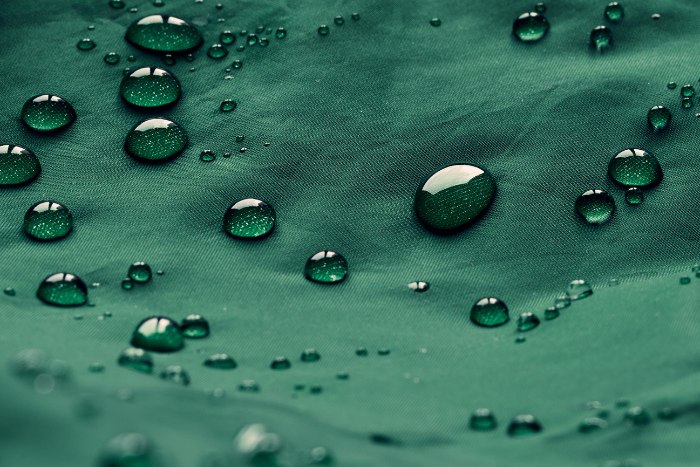
- Repellency is a surface effect. The fabric face has a low surface energy, so water beads up and rolls off instead of spreading and soaking in.
- Waterproofing is a barrier effect. A membrane or coating physically blocks water from passing through, which is what a hydrostatic head rating measures.
A durable water repellent (DWR) finish delivers repellency, not a full barrier. Many high-performance fabrics combine both: a membrane handles the barrier, while the DWR keeps the outer face from wetting out and feeling heavy. The distinction matters in practice, because a complaint about a jacket “leaking” is often a complaint about lost surface repellency rather than a failed membrane.
How DWR Finishes Work
A repellent finish lowers the surface energy of the fiber so water cannot easily wet it. The active molecules orient their water-hating tails outward, creating a microscopically rough, low-energy layer that encourages beading. The chemistry chosen sets the ceiling for both performance and wash durability. For the underlying mechanism and how it behaves in production conditions, see How Water Repellency Is Achieved in Textiles?
The most common repellent chemistries differ in what they protect against and how well they survive laundering.
| Chemistry | Water repellency | Oil and stain repellency | Wash durability | Typical use |
| Fluorocarbon (C6) | High | High | High | Performance and technical wear |
| Fluorine-free (C0) | High | Limited | Moderate to high | Eco-compliant apparel and home textiles |
| Silicone | High | None | Moderate | Soft-hand fashion, umbrellas |
| Paraffin or wax | Moderate | None | Low | Low-cost, basic protection |
Why Repellency Drops After Washing
Repellency rarely fails for a single reason. Several mechanisms usually stack up, and washing accelerates all of them at once.
Surface Contamination
Body oils, skin care residue, dust, and food soils settle into the fabric face during wear. These contaminants are hydrophilic, so they create wettable spots that pull water into the surface. The finish may still be chemically intact, yet repellency looks like it has failed simply because the surface is no longer clean.
Surfactant Residue
Detergents are designed to make water spread, which is the opposite of what a repellent finish needs. When rinsing is incomplete, surfactant molecules stay behind and bridge water to the fiber. Heavy-duty detergents and those carrying optical brighteners are common offenders.
Mechanical Abrasion
Tumbling, fabric-on-fabric friction, and agitation physically wear the finish off the high points of the fiber. Microfibers and brushed or napped fabrics are especially vulnerable, because they expose more surface area to abrasion.
Molecular Reorientation
This mechanism surprises many people. Even when the finish is still present, the low-energy tails can disorder and flip inward when the fabric is wet or compressed, so the surface temporarily loses its repellent character. Heat from drying or pressing re-orients the molecules and restores much of the beading, which is why a fabric that seems “dead” often revives in the dryer.
Finish Wash-Off
Finishes applied by padding are held mainly by physical adsorption at first, so without a crosslinking step they detach progressively under laundering agitation and detergent action. Low add-on, under-curing, and weak anchoring make this worse, stripping away a measurable amount of finish with every cycle.
The table below maps each cause to what is happening on the fabric and the most common corrective action.
| Cause | What happens on the fabric | Common fix |
| Surface contamination | Soils create wettable spots | Clean or re-launder with a residue-free detergent |
| Surfactant residue | Detergent bridges water to fiber | Improve rinsing, change detergent |
| Mechanical abrasion | Finish worn off fiber peaks | Re-apply finish, use a gentler care cycle |
| Molecular reorientation | Hydrophobic tails flip inward | Heat reactivation (tumble, press, cure) |
| Finish wash-off | Loosely adsorbed finish removed | Correct add-on and curing, add a crosslinking agent |

Factors That Reduce Durability
The seeds of wash failure are often planted long before the first wash, during finishing and even pretreatment.
Application and Curing Errors
Curing temperature and dwell time control how well the finish bonds to the fiber. Cure needs differ by chemistry, with C6 grades typically requiring roughly 150 to 160°C and fluorine-free grades often 160 to 180°C. Under-curing leaves the finish poorly anchored and is one of the most common causes of weak initial and post-wash ratings, while over-curing can degrade the chemistry or the fabric. Uneven padding, incorrect add-on, and inconsistent line speed all create weak spots that fail early.
Fabric and Fiber Effects
Fiber type and construction set the difficulty level. Cotton and other cellulosics, along with microfibers, present large, irregular surfaces that are harder to cover evenly. Smooth synthetics such as polyester are easier to finish and tend to hold repellency longer. Tight, smooth weaves generally outperform open or napped structures.
Water Hardness and pH
Hard water introduces calcium and magnesium ions that can destabilize the finishing emulsion and interfere with fixation. A bath pH outside the recommended window reduces how well the finish crosslinks and bonds. Either issue lowers wash durability even when the rest of the recipe is correct.
Softener Conflicts
Softeners and repellents often compete for the same fiber surface. Hydrophilic softeners can ruin beading outright, and some cationic or silicone softeners stop the repellent from anchoring. When a soft hand and high repellency are both required, the two finishes must be selected for compatibility and dosed carefully.
Testing Repellency
Reliable testing is what separates a confident shipment from a guess. Three methods cover most B2B needs, and each answers a different question.
Spray Test AATCC 22
The spray test is the fast, low-cost screen for surface repellency. Water is sprayed onto a mounted specimen, and the wetted pattern is graded against a standard chart, where 100 means no wetting. It is ideal for quick quality control, though it shows that a fabric failed without showing why. The official method is AATCC TM22.
Hydrostatic Head Test
When the requirement is resistance to water under pressure, the hydrostatic head test applies steadily increasing pressure until water penetrates. This sits on the waterproofing side of performance and is widely used for outdoor and technical fabrics. The European reference method is ISO 811.
Wash Durability Cycles
The true measure of a DWR is how it performs after laundering. A standardized wash procedure such as ISO 6330 subjects samples to a defined number of cycles, after which the spray test is repeated. Reporting performance after 5, 10, or 20 washes shows how repellency decays, rather than how it looks before any wear.
| Test | What it measures | Result format | Best used for |
| Spray test | Surface repellency | 0 to 100 rating | Fast quality control screening |
| Hydrostatic head | Resistance to water pressure | mm water column | Barrier and outdoor performance |
| Wash durability | Repellency after laundering | Rating per cycle count | Validating real-world durability |

Restoring Lost Repellency
Lost repellency is not always permanent. The right recovery step depends on whether the finish is still on the fabric.
Heat Reactivation
If the finish is intact but underperforming, heat is the simplest fix. A tumble dry, a press, or a short cure restores beading by re-aligning the finish, and it often recovers performance after normal wear and washing at almost no cost. It is worth trying before assuming the finish is gone.
Re-Application
When the finish has been abraded or washed away, heat alone will not help and the fabric must be re-finished. For protection that survives repeated laundering, pairing a repellent with a crosslinking agent is the decisive step, converting a physically adsorbed coating into a chemically anchored film.
For fluorine-free, strong water-repellent finishing on chemical fibers, cotton, and their blends, Sylic FU5355 is a milky white, weakly cationic emulsion (solid content 31.0 to 34.0%, pH 3.0 to 5.0) that delivers excellent anti-siphonage and water-repellent performance and passes the AATCC-35 rain test.
It is free of PFOA and PFOS, with a recommended dosage of 30 to 60 g/L. Pairing it with the cationic crosslinking agent Sylic FU5235 (solid content 23.0 to 26.0%, pH 4.0 to 6.0 in a 1% aqueous solution, recommended dosage 5 to 20 g/L, roughly a quarter of the water repellent dosage) is reported to lift the initial water-repellent rating by about half a grade and extend the number of washes the finish can withstand, while also improving dry cleaning resistance and anti-yellowing performance.
SkyChem Group’s water and oil repellent finishes bring this together as one matched system, combining C6 and fluorine-free repellents with compatible crosslinking agents that hold wash durability on both cellulosic and synthetic fibers while preserving the original hand and breathability. The fluorine-free grades are free of PFOA, PFOS, and APEO, meeting strict environmental requirements without trading away repellency.
When to Reprocess
A simple decision path keeps the choice objective:
- Try heat reactivation first. If beading returns, the finish is intact and the cause was reorientation or light soiling.
- If beading does not return, the finish is depleted, and a repellent agent should be re-applied, ideally with a crosslinking agent for durability.
- If the fabric also shows abrasion damage or contamination that cleaning cannot remove, plan a full reprocess instead of a touch-up.
Preventing Wash Failure
Prevention is cheaper than recovery, and most durability problems trace back to a few controllable steps.
Process Control
Small drifts in finishing parameters are the most common reason a finish that passed in the lab fails in bulk production. Keep these under tight control:
- Add-on level
- Curing temperature and dwell time
- Bath pH
- Water quality and hardness
- Consistent line speed across the full fabric width
Fabric Preparation
Repellents need a clean, residue-free substrate. Leftover surfactants, sizing, or scouring residue compete with the finish and block fixation. Thorough pretreatment is a quiet but decisive factor in wash durability.
Pre-Shipment Checks
Verification at the end of the line protects both supplier and customer:
- Test after laundering, not only before.
- Keep a known-good control swatch to catch drift early.
- Document performance across the agreed wash cycles.
SkyGuard’s water and oil repellent system is built for these real mill conditions, supporting dip-pad, spray, foam, and garment application with stable bath behavior, consistent pickup, and predictable curing, so lab performance carries through to bulk production and holds up across repeated washing.
Why Source Repellent Finishes from SkyChem Group
Solving wash-durability problems is rarely about a single product. It depends on matched chemistry, correct application, and a supplier that can troubleshoot recipes under real production conditions. This is where SkyChem Group fits.
Experience and one-stop supply
SkyChem Group has worked in textile chemicals since 1999 and has supplied global markets since 2009, today operating through six specialist brands across textile dyes and auxiliaries. Because one group supplies both the color and the auxiliary side, repellents, crosslinking agents, softeners, and pretreatment chemistry can be selected for compatibility from the start, which removes many of the conflicts that quietly undermine wash durability.
A complete repellent toolkit
Under the SkyGuard line, C6 and fluorine-free repellents work together with Sylic crosslinking agents as one engineered system, such as the fluorine-free repellent Sylic FU5355 paired with the crosslinking agent Sylic FU5235. The combination is formulated to deliver strong water and oil repellency, hold that repellency through repeated laundering on both cellulosic and synthetic fibers, and preserve the original fabric hand and breathability. Fluorine-free grades are free of PFOA, PFOS, and APEO, and selected grades are validated by rain testing, making them suitable for outdoor gear, sportswear, workwear, home textiles, and denim.
Technical and compliance support
Beyond supply, SkyChem Group provides formulation development, end-to-end application solutions, local market support, and after-sales technical assistance, along with export and compliance support for buyers in regulated markets. Free samples and recipe guidance are available on request, so a finish can be validated against a defined wash-cycle target before it reaches bulk production.
In Summary
Repellency that drops after washing is rarely a mystery once it is broken down. Surface contamination, surfactant residue, abrasion, molecular reorientation, and loosely anchored finish each play a part, and most are set in motion during finishing rather than during use.
Sound process control, clean fabric preparation, and validation by wash-cycle testing together deliver finishes that keep beading long after the first wear. When repellency does fade, heat reactivation handles a temporary loss, while re-application with a crosslinking agent rebuilds durable protection.
FAQs
How many washes should a finish survive?
It depends on the chemistry and the end use. A well-applied C6 finish on performance fabric can hold useful repellency through 20 or more home washes, while a basic paraffin finish may fade within a few. Specify a wash count and a minimum acceptable rating in the quality agreement.
Can lost repellency be fully restored?
Often yes, if the finish is still present. Heat reactivation can recover much of the original beading. If the finish has been abraded or washed off, full restoration requires re-application rather than heat alone.
Are fluorine-free finishes less durable?
Not necessarily on wash durability. Modern fluorine-free grades, especially when paired with a crosslinking agent, hold water repellency through repeated laundering. Sylic FU5355, for example, is formulated to pass the AATCC-35 rain test on its own, and when combined with the crosslinking agent Sylic FU5235 its wash durability and water-repellent rating are further improved.
The real trade-off is oil and stain resistance, because fluorine-free chemistries reach a higher surface energy that repels water but generally not oil. As regulatory pressure grows under initiatives such as ECHA’s PFAS restriction work, many buyers accept that trade-off.
Does softener damage repellency?
It can. Hydrophilic softeners make water spread and undermine beading directly. When a soft hand is essential, apply the softener and repellent as a compatible system and confirm beading on a lab swatch before bulk, rather than adding softener as an afterthought.
Why is repellency uneven on a roll?
Uneven repellency usually points to inconsistent application or curing, such as uneven padding, fluctuating temperature, or variable add-on. Water hardness and patchy fabric preparation can also create weak spots that test lower than the rest of the roll.
Recommended reading: