Water repellency is the reason rain droplets bead up and roll off a fabric instead of soaking in. It is not the same as waterproofing. This article explains what “water repellency” means, how it works at the surface level, and how mills achieve and verify it reliably in production.
“Water Repellency” Meaning
Repellency vs Waterproofing vs Water Resistance
Water repellency describes a fabric surface that resists wetting by liquid water. Droplets tend to stay rounded and can roll off under gravity or motion. Waterproofing is a higher barrier level. It aims to prevent water from passing through the fabric even under pressure, typically by using a membrane, a coating, seam sealing, or a tightly engineered construction. Water resistance is a broad, often loosely used term that can refer to either repellency or partial waterproof performance, so it should be clarified with specific test expectations.
A practical way to distinguish these terms is to ask two questions. First, does the surface bead and shed droplets. Second, does the fabric block water penetration when time, pressure, flexing, and abrasion increase. Water repellency mainly answers the first question. Waterproofing addresses both.

How Fabrics Shed Water
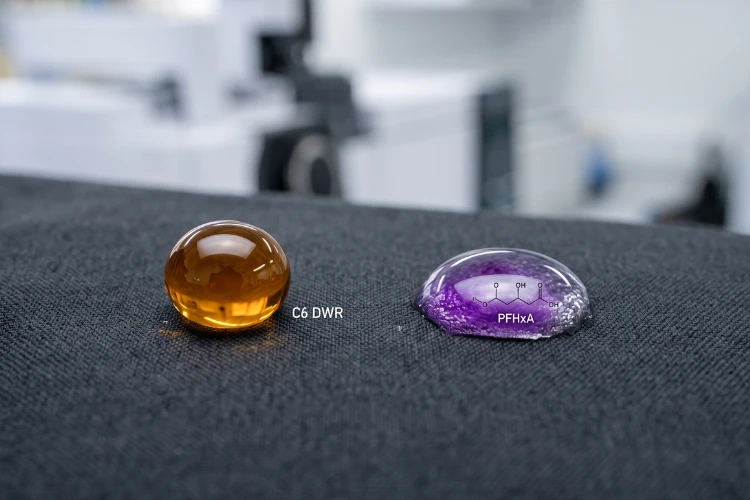
When a droplet lands on a textile, it either spreads and wets the fibers or holds together and sits on the surface as a bead. If the droplet maintains a rounded shape, it has less contact area and is easier to remove before it wicks into yarn gaps. Fabrics shed water best when the surface discourages wetting and the surface structure reduces droplet pinning, allowing water to roll off rather than cling.
How Repellency Works
Surface Energy Reduction
The most common route to water repellency is lowering the surface energy of the fiber surface. Water prefers to spread on higher-energy surfaces. A repellent finish creates a thin, continuous film that presents low-energy chemical groups outward. This makes it harder for water to wet and spread, so droplets remain more spherical and more likely to run off.
In practical mill terms, repellency depends on forming a uniform surface layer, not simply adding more chemical. Uniform coverage, correct drying, and proper curing determine whether the finish performs consistently and remains durable.
Surface Texture Effects
Surface texture influences how much of the droplet actually touches the textile. A textured surface can reduce effective contact area by supporting the droplet on surface peaks and bridging over valleys. This can amplify beading when combined with a low surface energy finish.
Texture alone rarely delivers durable repellency at industrial expectations, especially after laundering and abrasion. However, it can improve initial beading and help reduce the chemical add-on needed for a given target. This mechanism is often compared to the lotus effect, where micro-texture helps droplets bead up and roll off.

Main Ways to Achieve Repellency
Water Repellent Finishing on Fabric
For many apparel shells, workwear, and a wide range of home textiles, water repellency is achieved through chemical finishing on the fabric surface. The finish is typically applied by padding and then dried and cured to anchor the film to fibers. This approach is popular because it can preserve breathability and hand feel better than many barrier coatings, and it is relatively easy to integrate into existing finishing lines.
In production, performance is determined by three practical factors: even pickup across width and length, correct thermal profile for drying and curing, and compatibility with the rest of the finishing recipe. When any of these drift, mills often see issues such as uneven spray rating, fast wash-off, or unstable results across lots. A well-designed finishing package paired with tight process control is what turns strong lab results into stable bulk performance.
Coatings and Membranes
Coatings and membranes primarily address water penetration resistance, not just surface beading. They can deliver higher barriers under pressure, but they often involve trade-offs in breathability, hand feel, stiffness, noise, and cost. They may also require seam sealing and changes in garment construction.
Many end products use a combined strategy. A membrane or coating provides the barrier, while a surface repellent finish improves beading, reduces face-fabric wet-out, and helps maintain comfort by keeping the outer layer from holding water.
Water Repellent Finish in Textile
If your goal is durable repellency in real mill conditions, the key question is not only “Does it bead water on day one” but “Can it keep beading after normal process variation, handling, and end-use stress.” That is where a purpose-built finishing system and application support matter.
SkyChem Group supplies textile dyes and auxiliaries with a strong focus on mill practicality and repeatable outcomes. For water and oil repellency, SkyGuard is developed as a finishing solution that fits real production recipes and equipment, not just lab trials. In practice, this means prioritizing stable bath behavior, consistent pickup, and predictable film formation under typical drying and curing conditions. It also means designing for compatibility with commonly used softeners and other finishing agents, since many bulk issues come from recipe interactions rather than dosage alone.
When selecting a repellent finish, mills should evaluate both initial beading and durability after washing and abrasion, while also checking shade impact and hand feel, especially on dark shades. For SkyGuard options matched to your fabric and performance target, explore durable water repellent finishes for textiles.

How Mills Apply Repellent Finishes
Pad and Cure Basics
Padding is widely used because it is scalable and cost-effective. The fabric passes through a finishing bath, then through a nip to control pickup, followed by drying and curing. Two variables dominate outcomes: pickup consistency and curing completeness.
If pickup fluctuates, repellency fluctuates. If curing is insufficient, the finish may not anchor well and can wash off or abrade quickly. If curing is too aggressive, mills may see harsher hand feel, potential yellowing on sensitive substrates, or changes in stretch and recovery, depending on the fabric system.
Compatibility With Softeners
Many applications require a soft hand feel, so repellents are often used alongside softeners. Compatibility matters because mismatched systems can destabilize the bath, cause streaks, create uneven deposition, or reduce repellency by interfering with film formation.
A practical approach is to treat the bath as a managed system rather than a single chemical. Stability at working concentration, tolerance to water quality variation, and predictable behavior with other auxiliaries are essential. When problems appear, the fix is rarely only increasing dosage. It usually involves adjusting the recipe balance, sequencing, and process controls.
Common Defects and Fixes
Common production issues include:
- Low or uneven repellency across width: Often caused by uneven pickup, bath instability, or non-uniform drying airflow. Check nip pressure consistency, bath circulation, and stenter profile uniformity.
- Good initial beading, poor wash durability: Typically points to insufficient curing, weak anchoring, or incompatibility in the finishing package. Verify thermal conditions and review the full recipe, including softeners and resins.
- Harsh hand feel or fabric noise: Often linked to excessive add-on or a film that is too rigid for the substrate. Optimize dosage and consider chemistry selection and softener compatibility.
- Shade change or whitening on dark shades: Can result from surface scattering or uneven film formation. Improve application uniformity and evaluate recipe adjustments that reduce optical impact.
For efficient troubleshooting, isolate variables in sequence: pickup, drying, curing, then recipe interactions. This reduces trial-and-error and shortens the path to stable bulk production.
How to Verify Performance
Quick Tests vs Durability Tests
Quick checks provide fast feedback during development and production. They help confirm that the surface is beading and can reveal process drift. However, they do not answer durability questions.
Durability testing evaluates how performance changes after laundering, abrasion, flexing, and contamination. If the textile will be washed or worn hard, durability must be part of the acceptance plan. Many disputes occur when initial beading is used as a proxy for long-term performance, which is rarely sufficient.
Wash and Abrasion Durability
Wash durability depends on anchoring and resistance to surfactants and mechanical action. Abrasion durability depends on film toughness and how the finish bonds and redistributes on fiber and yarn surfaces under wear.
Verification should match end use. A fashion shell, a uniform fabric, and a home textile cover do not face the same stress profile. The most useful results show not only a pass or fail outcome but how performance decays across repeated wash and abrasion cycles.
Conclusion
Water repellency is achieved by discouraging wetting at the fabric surface, mainly through lowering surface energy, often supported by surface texture effects. Mills typically deliver repellency through chemical finishing, while coatings and membranes address higher barrier needs. Consistent pickup, correct curing, and recipe compatibility determine whether lab performance remains stable in bulk production and real use.
SkyChem Group is a global chemical solutions provider with nearly 30 years of industry experience, supported by six major brands and production bases. Its R&D center focuses on high-performance, green products across dyes and auxiliaries, backed by a business network covering more than 70 countries and regions. If you are planning a durable water and oil repellent program, explore SkyGuard solutions for water repellent finish in textile.

Recommended reading: