Exhaust dyeing and continuous Thermosol dyeing can both produce well-dyed disperse-dyed polyester. But they operate on different economics, suit different fabrics, and fail in different ways when the process is not matched to the order.
Exhaust Dyeing with Disperse Dyes
Exhaust dyeing is a batch process in which fabric is immersed in a dye bath and the dye gradually transfers from the liquor into the fiber over time. For polyester, this transfer depends on elevated temperature and pressure to open the fiber structure and allow dye molecules to penetrate.
HT/HP Dyeing at 130°C
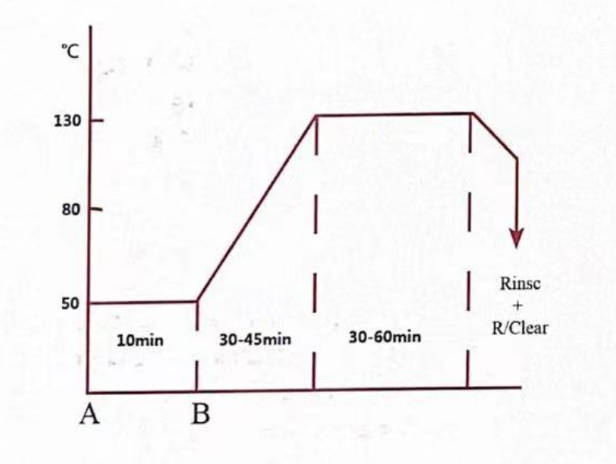
High-temperature, high-pressure (HT/HP) dyeing is the industry standard exhaust method for polyester. The fabric is processed in a sealed, pressurized vessel where the dye bath temperature is raised to 130°C. At this temperature, the polyester polymer chains relax and expand, creating temporary space for disperse dye molecules to diffuse deep into the fiber interior.
The temperature is typically held for 30 to 60 minutes to ensure thorough dye penetration, after which the bath cools gradually. As the fiber returns to its normal state, the dye becomes physically locked inside the polymer structure. When process conditions are well controlled, HT/HP dyeing delivers excellent color build-up, reliable wash fastness, and consistent shade reproduction.
Carrier Dyeing
Carrier dyeing is an alternative for substrates that cannot tolerate 130°C conditions. Chemical carrier agents are added to the dye bath, allowing polyester to be dyed at atmospheric pressure and temperatures of 95 to 100°C. These carriers temporarily swell the fiber and reduce the activation energy needed for dye penetration.
The trade-offs are notable:
- Many carrier agents raise environmental and occupational health concerns.
- Sublimation fastness is generally lower than what HT/HP dyeing achieves.
- Some carriers cause residual yellowing or odor in the finished fabric.
For these reasons, carrier dyeing is typically reserved for heat-sensitive blends, such as polyester/wool or polyester/elastane constructions, where HT/HP conditions would damage the fiber.

Equipment
The most common machine types for polyester exhaust dyeing are:
- Jet and overflow dyeing machines: circulate fabric through the liquor at controlled velocity; overflow machines operate at lower tension and are well suited for delicate knits and stretch constructions.
- Beam dyeing machines: process fabric or yarn wound onto a perforated beam inside a pressurized vessel; preferred for warp beams and constructions where mechanical agitation must be minimized.
- Jigger dyeing machines: process woven fabrics in open width; commonly used for heavier wovens where flat, open-width processing is preferred.
Process Parameters
| Parameter | Exhaust Dyeing | Continuous Dyeing (Thermosol) |
| Peak/fixation temperature | 130°C (HT/HP); 95–100°C (carrier) | 180–220°C |
| pH | 4.5–5.5 | Not applicable (dry process) |
| Time at peak / dwell time | 30–60 minutes | 30–90 seconds |
| Heating rate | 1–2°C per minute | Not applicable |
| Liquor ratio | 1:5 to 1:20 | Not applicable |
| Padding pick-up | Not applicable | 60–70% |
| Pre-drying temperature | Not applicable | 100–120°C |
| Migration inhibitor dosage | Not applicable | 5–20 g/L (product dependent) |
In exhaust dyeing, the dye bath pH is adjusted with acetic acid to maintain dye dispersion stability and prevent premature aggregation during heating. Heating rate is particularly critical for levelness: too fast a temperature ramp can cause uneven dye uptake before the bath reaches equilibrium.
In continuous dyeing, consistent padding pressure across the full fabric width is one of the most critical operational requirements. Any lateral variation in pick-up produces a corresponding shade gradient in the finished fabric.
The Skycron® disperse dyes cover E-type, SE-type, and S-type grades to match different temperature profiles and fastness requirements across HT/HP and carrier exhaust processes. Grades are available for standard polyester, microfiber, and high light fastness applications, with strong shade consistency and compatibility across a broad color range.
Continuous Dyeing with Disperse Dyes
Continuous dyeing passes fabric through a series of process units in an uninterrupted sequence. Rather than immersing fabric in a large dye bath, dye is applied through a padding step at a controlled pick-up rate and then fixed by heat. The result is significantly higher throughput than exhaust dyeing, with strong color consistency across long fabric runs.
Thermosol Process
The Thermosol process is the dominant continuous dyeing method for polyester and follows a defined sequence:
- The fabric passes through a padding mangle, where it absorbs a prepared dye liquor containing disperse dye, dispersing agents, and migration inhibitors.
- The padded fabric moves through a pre-drying unit to remove moisture at controlled temperature.
- The fabric then enters a thermosol chamber, where dry heat at 180–220°C is applied for 30 to 90 seconds.
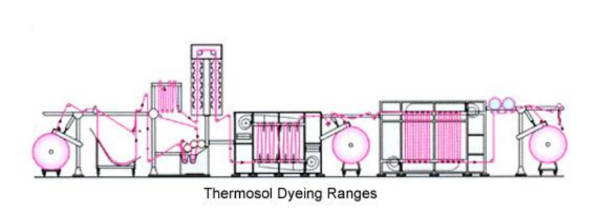
At these temperatures, disperse dye molecules sublimate from the fabric surface directly into the polyester fiber through thermal diffusion. Because fixation occurs without liquid water, the mechanism differs fundamentally from exhaust dyeing. For polyester-cotton blends where both fiber components are dyed in a single pass, pad-steam is an alternative; however, for pure polyester, Thermosol achieves significantly better disperse dye fixation and remains the standard approach.
Equipment
A standard Thermosol dyeing range consists of the following units in sequence:
- Padding mangle: applies dye liquor at controlled pick-up across the full fabric width
- Pre-drying section: removes moisture using infrared or hot air while limiting dye migration
- Thermosol chamber: applies dry heat at precise temperature for dye fixation
- Multi-bath washing range: performs reduction clearing, neutralization, and rinsing
- Final dryer and winder: completes the process before fabric is wound for the next stage
Exhaust vs. Continuous
Both processes can produce high-quality disperse-dyed polyester, but they are optimized for different production environments.
Fixation Mechanism and Temperature
The two processes fix dye through fundamentally different mechanisms. Exhaust dyeing relies on diffusion within a liquid system, driven by concentration gradient and thermal energy under heat and pressure. Thermosol dyeing relies on dry-heat sublimation with no water involved in the fixation step. This distinction has practical implications:
- Exhaust dyeing is more sensitive to dye bath chemistry, water quality, and liquor circulation.
- Thermosol dyeing is more sensitive to temperature uniformity across the chamber width, fabric tension, and migration control during drying.
Production Speed and Minimum Volume
Exhaust dyeing operates in batches. Each cycle includes heating, dyeing at peak temperature, cooling, and reduction clearing, typically taking several hours from loading to unloading. Continuous dyeing can process several thousand meters per hour at steady state, but requires setup yardage that cannot be sold as first-quality goods, making it impractical for short orders.
Color Consistency
Exhaust dyeing delivers excellent consistency within a single batch; the main challenge is batch-to-batch variation, managed through careful recipe control and accurate dye weighing. In continuous dyeing, shade consistency across width and length is very high within a steady-state run, with the main risk points at the start and end of each production run.
| Factor | Exhaust Dyeing | Continuous Dyeing (Thermosol) |
| Fixation mechanism | Diffusion in water under heat and pressure | Thermal sublimation in dry heat |
| Fixation temperature | 130°C | 180–220°C |
| Production speed | Batch-by-batch | High throughput |
| Suitable order volume | Small to medium batches | Large, long runs |
| Color consistency | Excellent within a batch | Excellent across long runs |
| Water consumption | High | Low |
| Energy consumption | Moderate | High |
| Shade flexibility | High | Low |
| Suitable fabric types | Knits, stretch, complex constructions | Flat wovens, stable constructions |
Reduction Clearing
Why Disperse Dyes Require It
After polyester is dyed with disperse dyes, a portion of the dye remains on the fiber surface rather than being fully diffused into the polymer interior. This surface dye has weak adhesion and contributes to:
- Poor wash fastness
- Staining of adjacent fabrics during laundering
- Reduced rubbing fastness
- Sublimation problems when the fabric is exposed to heat during pressing, heat-setting, or end use
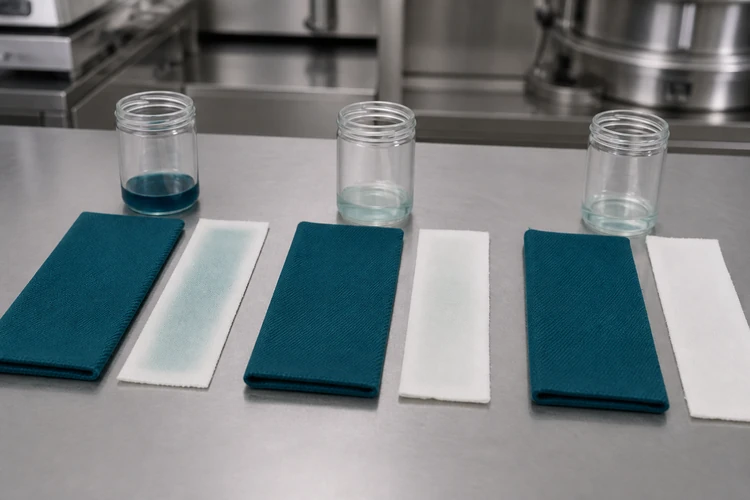
Reduction clearing is a chemical post-treatment that removes this surface dye by breaking it down chemically. It is a standard, necessary step for medium to dark disperse-dyed polyester in both exhaust and continuous processes. Omitting it typically results in fastness failures that are difficult to address once the fabric has left the dyehouse.
Process Differences in Exhaust and Continuous
In exhaust dyeing, reduction clearing is conducted as a separate bath after the main dyeing and cooling cycle. The fabric is treated with a reducing agent at approximately 70 to 80°C in a controlled pH environment, followed by thorough rinsing. The process takes place in the same dyeing machine, with the bath drained and refilled between dyeing and clearing.
In continuous dyeing, reduction clearing is integrated into the washing range that follows the Thermosol fixation unit. The fabric passes through reduction clearing baths at controlled temperature and dwell time as part of the same uninterrupted production sequence.
The Sylic D2740 Reducing Cleaning Agent is formulated for acid reduction clearing of polyester and polyester blends. It is effective for medium and light shades without requiring a full bath drain and refill, and it is compatible with spandex-containing constructions where conventional sodium hydrosulfite-based agents can cause yellowing or fiber damage.
Key Auxiliaries
Both exhaust and continuous disperse dyeing rely on a supporting chemistry program that stabilizes dye behavior, promotes levelness, and protects final fastness performance. Selecting the right auxiliary for each function and each process type is as important as dye selection itself.
Dispersing and Leveling Agents
In exhaust dyeing, dispersing agents keep dye particles evenly distributed throughout the bath at high temperature, preventing aggregation that leads to specks or uneven color uptake. Leveling agents slow the initial rate of dye uptake and improve dye migration across the fabric surface, allowing the bath to equilibrate before exhaustion is complete.
In Thermosol dyeing, dispersing agents stabilize the pad liquor over long production runs and prevent dye precipitation on mangle rollers or within the pad bath. Inconsistent dye dispersion in the pad bath directly affects shade uniformity along the fabric length.
Sylic® Dyeing Auxiliaries for PES include products developed specifically for polyester dyeing, covering high-temperature leveling, dispersing, and reduction clearing functions for both exhaust and Thermosol processes.
Migration Inhibitors
Migration inhibitors are specific to the continuous Thermosol process. During the pre-drying phase, water evaporation creates a capillary flow that carries dissolved dye toward the fabric surface, a phenomenon known as dye migration. If not controlled, this results in uneven dye distribution through the fiber cross-section, reduced wash fastness, and a higher concentration of surface dye.
Migration inhibitors are added to the pad liquor to increase its viscosity and restrict dye mobility during drying. Common types include sodium alginate and synthetic polymer thickeners. Dosage must be balanced carefully: excessive viscosity can reduce dye penetration into the fiber and create processing issues in the downstream washing range.
Reduction Clearing Agents
For dark shades, reduction clearing is critical for achieving the wash fastness levels required by major textile testing standards, including ISO 105-C06 for color fastness to domestic and commercial laundering. The selection of reduction clearing chemistry should account for shade depth, fiber composition, and the presence of elastane. Purpose-formulated agents are preferable for stretch polyester constructions where conventional reducing agents may affect fiber integrity or appearance.
Summary
Exhaust dyeing suits small batches, flexible shade programs, and knitted or stretch polyester. Continuous Thermosol dyeing delivers efficiency and consistency for large-volume woven polyester. Matching the process to production requirements, supported by the right auxiliary and post-treatment program, reduces rework and improves fastness outcomes. For product recommendations or process support, contact Skychem Group.
FAQs
What is the main difference between exhaust and continuous disperse dyeing?
The core difference is in how fixation occurs. Exhaust dyeing immerses fabric in a heated dye bath where dye diffuses into the fiber over time. Continuous Thermosol dyeing pads dye onto the fabric surface and fix it through dry heat at 180–220°C. The two processes suit different order volumes, fabric types, and production structures.
Which process is better for small production runs or sample lots?
Exhaust dyeing is better suited for small runs. Its batch structure allows frequent shade changes with minimal transition waste, making it practical for sample production, short orders, and multi-colorway programs. Continuous dyeing requires significant setup yardage each time a shade changes, which makes it economically unsuitable for low-volume production.
Is reduction clearing always required for disperse-dyed polyester?
It is standard practice for medium to dark shades and should not be skipped. Surface dye that remains after fixation directly reduces wash fastness, rubbing fastness, and sublimation resistance. For very light shades, the need may be lower, but the risk of fastness failure generally outweighs the cost of the additional step.
Can knitted polyester be dyed on a Thermosol continuous range?
Thermosol dyeing is designed for flat, stable woven constructions that can run through a padding mangle and drying range under consistent tension. Knitted polyester, particularly stretch fabrics, is not well suited to this process due to fabric distortion and tension sensitivity. Exhaust dyeing in jet or overflow machines remains the standard approach for knitted polyester.
More reading: