A mill running crepe and silk on the same line often defaults to overlapping recipes, until uneven dyeing, yellowing, or a flattened texture shows up in the finished batch. The two fibers respond to heat, pH, and mechanical stress differently, so the textile auxiliaries built for one rarely perform on the other. This guide breaks down where those requirements diverge and what to check when sourcing an auxiliary supplier.
Quick Reference: Crepe vs. Silk at a Glance
Crepe and silk both appear in fashion, scarves, and high-quality apparel, and both benefit from auxiliaries that balance dye uptake and handfeel. Their fiber structures, however, diverge sharply: silk is a natural protein fiber sensitive to heat and alkalinity, while crepe can be woven from almost any fiber, including silk, polyester, viscose, and wool, and depends instead on twist and texture stability. This difference drives every auxiliary choice covered below.
| Property & Auxiliary Need | Crepe | Silk |
| Fiber composition | Synthetic or natural blends | Natural protein fiber |
| Heat sensitivity | Low to moderate | High |
| Dyeing challenges | Leveling, penetration | Yellowing, unevenness |
| Key auxiliaries | Anti-shrink agents, spreaders, stability agents | Softening, anti-yellowing, and protective agents |
| Finish goals | Maintain texture and strength | Preserve sheen and smoothness |
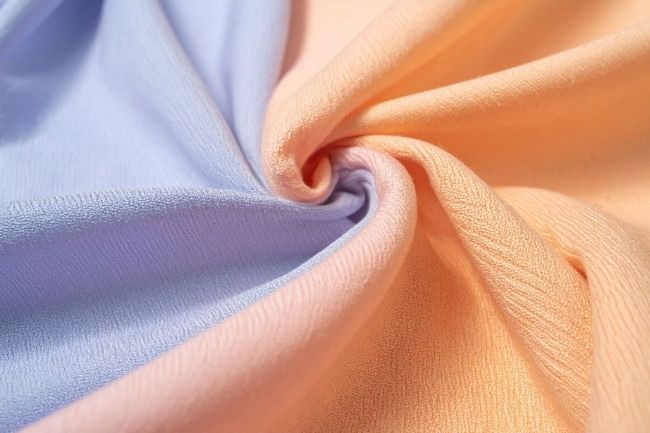
Fiber and Process Differences That Drive Auxiliary Selection
Fiber Structure Differences
Crepe’s texture relies on heat treatment and yarn twist, so auxiliaries must maintain that tension to prevent the surface from flattening. Silk’s protein structure instead needs protection from harsh acids, bases, or oxidizers; auxiliaries here work to fix the fiber while improving softness and dye consistency.
Process Temperatures, pH, and Recipe Adjustments
Synthetic-fiber crepe tolerates higher temperatures and alkalinity, while silk requires relatively low temperatures and a moderate acidic pH. This difference changes the type and quantity of wetting agents, leveling agents, softeners, and finishing chemicals used in each process.
Cost and Performance Considerations
Synthetic blends and flexible processing stages generally make crepe production more cost-efficient. Silk’s fragility calls for higher-quality auxiliaries, gentler finishing agents, and closer process control during dyeing and drying. That added cost typically pays off through fewer reworked batches and better-retained fabric value at the end of the line.
These structural and process differences set the framework for the auxiliary solutions below.
Auxiliary Solutions for Crepe Processing
Finishing Agents for Handfeel and Stability
Crepe needs to hold its signature crinkled texture while remaining soft to the touch. Two auxiliary types address this:
- Softeners reduce stiffness in draping without flattening the crinkle effect.
- Anti-shrink agents fix the yarn twist so the surface texture holds up through washing and heat exposure.
Dyeing and Color Performance Auxiliaries
Tight yarn structures and mixed-fiber blends can cause uneven dye uptake on crepe:
- Dispersing and leveling agents help dye penetrate more uniformly across the fabric.
- Pre-treatment auxiliaries remove oils and impurities that would otherwise cause patchy dyeing.
Sylic® Dyeing Auxiliary improves both uniformity and color fastness at this stage.
Mechanical Performance Enhancers
Crepe fabric used in fashion applications depends on retaining its twist-based texture through repeated handling and wear:
- Anti-wrinkle finishes add shape stability, particularly on polyester crepes.
- Mechanical stability agents help retain yarn twist and preserve the fabric’s characteristic texture over time.

Auxiliary Solutions for Silk Processing
Silk processing auxiliaries operate within a narrower chemical window than those used for crepe, protecting the protein fiber while still delivering the finish a buyer specifies.
Softening and Anti-Yellowing Agents
Silk’s defining qualities are smoothness and sheen:
- Specialized softeners add suppleness without dulling the shine.
- Anti-yellowing agents prevent discoloration during drying or storage, which matters most for light-colored silk exposed to high drying temperatures.
Sylic® Softening Finishing Auxiliary provides balanced diffusion across the fabric surface, improving drape without flattening it.
Dyeing and Printing Auxiliaries
- Leveling agents distribute dye evenly without damaging protein bonds.
- Binders and thickeners used in printing protect the fiber while delivering sharp, accurate color.
Sylic®Dyeing Auxiliary and Printing Auxiliary improve consistency, prevent spotting, and preserve silk’s natural luster.
Protective and Care Agents
- Anti-pilling finishes reduce abrasion marks that build up with wear.
- UV-protection treatments slow fiber degradation from sunlight exposure.
- Moisture-control and anti-static finishes add a further layer of silk care performance.

Sourcing Considerations: What to Look for in a Textile Auxiliary Manufacturer
Sourcing auxiliaries for crepe or silk processing comes down to a few concrete criteria beyond product specifications:
| Evaluation Criterion | Why It Matters |
| One-stop supply capability | Dyeing, softening, finishing, waterproofing, and pre-treatment auxiliaries from a single supplier reduce formulation mismatches across a process line. |
| Technical and compliance support | Guidance on recipe adjustments for a specific fiber blend, along with support navigating compliance frameworks such as ZDHC, prevents costly trial-and-error. |
| Batch-to-batch consistency | For continuous production, auxiliary performance needs to be reproducible order after order, not just in a lab sample. |
| Sustainable processing options | Eco-friendly auxiliary formulations are increasingly a requirement for brands sourcing crepe fabric and are worth confirming upfront rather than retrofitting later. |
The Sylic products referenced throughout this guide are part of Skychem Group’s broader auxiliary line; full technical datasheets are available on request for exact formulation matches.
Conclusion
Crepe needs auxiliaries that stabilize texture and even out dye uptake; silk needs gentler, protective chemistry that preserves shine and softness. The right match starts with the fiber and process differences outlined above, then narrows down to a supplier that can back product performance with technical and compliance support. For a formulation recommendation or product sample suited to specific crepe or silk processing requirements, contact Skychem Group.

FAQs
What auxiliaries are used for silk dyeing?
Silk dyeing typically requires leveling agents suited to protein fibers, along with softening and anti-yellowing agents applied after dyeing to protect sheen and prevent discoloration during drying or storage.
Can the same auxiliaries be used for crepe and silk?
Not directly. Crepe processing centers on stabilizing yarn twist and evening out dye penetration across mixed-fiber structures, while silk processing centers on protecting a protein fiber from heat, alkalinity, and mechanical stress. The two require different auxiliary chemistries, even when the finish goal, such as softness, looks similar on paper.
Why does silk need lower processing temperatures than crepe?
Silk is a protein fiber that degrades under high heat and strong alkalinity, so auxiliaries for silk are formulated for lower temperatures and moderate acidic pH. Synthetic-fiber crepe tolerates higher temperatures and alkalinity, allowing a wider processing window.
What causes uneven dyeing on crepe fabric?
Tight yarn twist and mixed-fiber blends are the two most common causes. Dispersing and leveling agents address dye penetration, while pre-treatment auxiliaries remove oils and impurities that would otherwise cause patchy results.
Recommended reading: