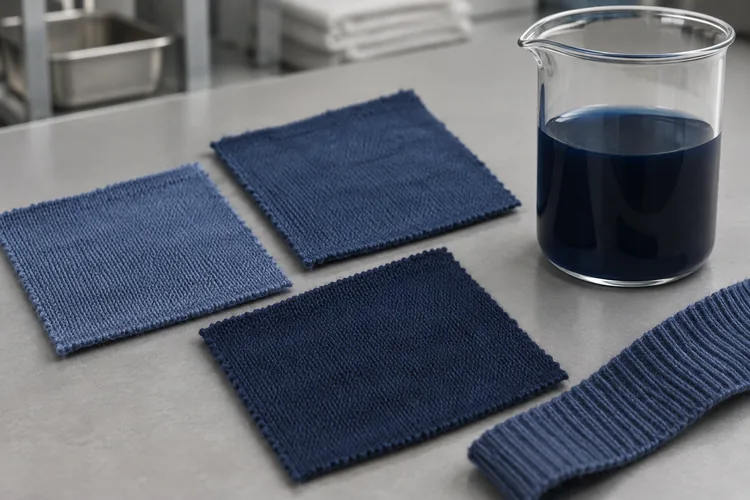
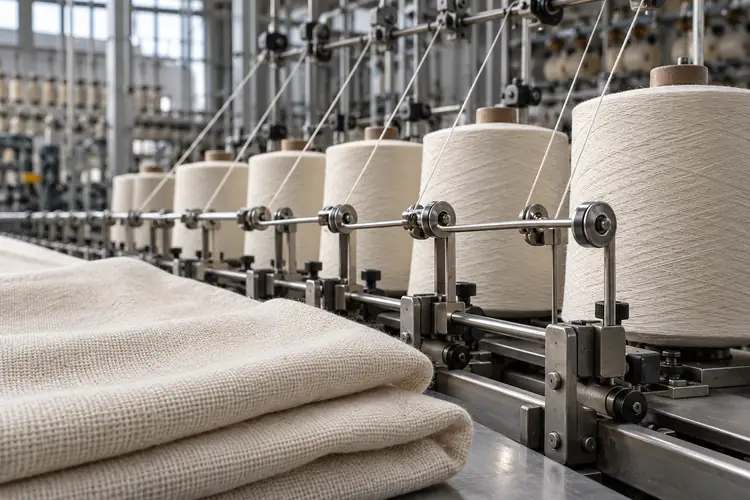
APEO-free nonionic wetting agents help pretreatment liquors spread across fabric and penetrate its structure, supporting uniform desizing, scouring, and bleaching. Selecting a replacement for an APEO-based auxiliary requires more than an APEO-free declaration: wetting speed, foam, cleaning performance, and bath compatibility must meet the process requirements.
For mills and textile chemical buyers, the key is to verify performance at a practical working dosage and confirm compliance with product-specific evidence.
What Does APEO-Free Mean?
APEO-Free vs. NPEO-Free
Alkylphenol ethoxylates, or APEOs, are a family of nonionic surfactants that includes nonylphenol ethoxylates (NPEOs) and octylphenol ethoxylates (OPEOs). Commercial and regulatory documents may use either “NPE” or “NPEO” for nonylphenol ethoxylates.
An NPEO-free declaration covers only part of this family. It does not establish that OPEOs or every substance covered by an APEO specification are absent.
Likewise, “nonionic” describes ionic character, not restricted-substance content. APEOs themselves are nonionic.
An APEO-free claim needs a defined substance scope and acceptance limit, as discussed in the compliance section below.
Nonionic Alternatives to APEO
Fatty alcohol ethoxylates and other alcohol alkoxylates are common alternatives. Their alcohol structure, ethoxylation level, and formulation influence wetting, emulsification, solubility, and foam.
AEO-9 is a fatty alcohol ethoxylate with an average of about nine ethylene oxide units. It supports oil emulsification and cleaning in textile auxiliary formulations. Emulsifying oil and rapidly penetrating dense fabric are different functions, so assess wetting speed and cleaning performance separately when selecting a pretreatment formulation.
APEO-free chemistry alone does not establish ready biodegradability or overall product safety.
Performance After APEO Replacement
Wetting Speed and Fabric Penetration
Surface wetting is only the first step. The liquor must also reach the interior of yarns and fabric so that pretreatment chemicals can act evenly.
Dense woven fabrics, compact knits, and yarn packages can reveal penetration problems that are not apparent in a simple solution test. Evaluate representative material at the intended concentration and temperature.
On continuous lines, compare performance within the available contact time. In batch equipment, check wet-out across the load, including areas where trapped air or restricted circulation may delay penetration.
Oil Removal and Redeposition
Rapid wetting does not prove effective scouring. Cotton waxes, knitting oils, and other hydrophobic impurities may remain even when the treatment liquor spreads easily.
The recipe must release these materials, keep them emulsified or dispersed, and remove them during washing. Check for oily spots and deposits after cooling and rinsing, when unstable emulsions may allow impurities to redeposit.
If wetting is satisfactory but cleaning is poor, investigate detergency, temperature, treatment time, and washing efficiency before increasing the wetting-agent dose.
Foam Control and Rinsability
APEO-free and nonionic are not synonyms for low-foaming. Foam behavior depends on the formulation, working concentration, agitation, temperature, and impurities entering the bath.
Evaluate low-foam wetting performance throughout filling, treatment, cooling, and rinsing. A quiet bath at the scouring temperature may still foam during dilution or circulation at a lower temperature.
Sylic P1412 nonionic low-foaming wetting agent is based on polyoxyethylene compounds and combines wetting and emulsification for dyeing and finishing applications where foam control matters. Its reference dosage of 0.5–3.0 g/L provides a starting range for application trials, not a fixed pretreatment recipe. For APEO-free pretreatment, confirm product-specific APEO evidence and test foam, penetration, and compatibility at the intended alkali concentration and temperature.
Assess rinsability alongside foam. A low-foaming product still needs to wash out sufficiently for the next processing stage.

Cloud Point and Operating Temperature
Many ethoxylated nonionic surfactants become cloudy when heating changes their hydration and water solubility. The measured cloud point depends on concentration, solution composition, and test conditions.
A water-based data-sheet value may not represent a bath containing caustic soda, salts, and other auxiliaries. Electrolytes can shift clouding behavior, so test the complete recipe through its actual temperature cycle.
Cloudiness alone is not a pass-or-fail criterion. Some formulations function effectively near or above their measured cloud point. The relevant checks are uniform treatment, adequate wetting, and the absence of troublesome separation or deposits.
Pretreatment Bath Compatibility
Alkali Concentration and Stability
Specify alkali resistance in terms of sodium hydroxide concentration, temperature, and exposure time. Neither a broad working-pH range nor the measured pH of a dilute product solution establishes stability in concentrated caustic liquor.
Check both physical stability and wetting performance. A bath may remain dispersed while penetration becomes too slow for the process.
Cold pad-batch treatment, hot scouring, and mercerizing require separate assessments. Approval for alkaline scouring should not be extended to mercerizing without testing at the intended caustic concentration.

Peroxide and Bleach Stabilizers
In combined scouring and bleaching, evaluate the candidate with the actual peroxide, alkali, stabilizer, and sequestering system.
Monitor bath appearance, foam, peroxide behavior, whiteness, and fabric condition. Unexpected peroxide loss or uneven bleaching requires investigation of the whole recipe, including water quality and metal contamination.
The wetting agent distributes the liquor and supports impurity removal. It does not replace peroxide stabilization or metal-ion control.
Desizing and Scouring Enzymes
Test compatibility with the specific enzyme preparation and complete recipe under the enzyme supplier’s recommended conditions. Chelants, preservatives, solvents, and other ingredients may affect enzyme activity even when the main surfactant is compatible.
For amylase desizing, compare residual starch size after identical washing. For enzymatic scouring, compare cleaning and absorbency.
Hard Water and Other Auxiliaries
Nonionic surfactants do not form insoluble calcium salts through the same mechanism as soaps. Nevertheless, water hardness and electrolytes can alter the behavior of a formulated auxiliary.
Use mill water for compatibility trials and include detergents, sequestering agents, defoamers, and expected chemical carryover.
Follow the recommended dilution and addition sequence. Products that work together in a dilute bath may separate or gel if mixed directly as concentrates.
Selecting and Testing Alternatives
Match the Fabric and Equipment
Start with the process problem. Cotton wax removal, polyester oil removal, and starch desizing place different demands on an auxiliary system.
Compare textile wetting agents by ionic character, intended application, and reference dosage. Narrow the choice to suitable nonionic formulations, then check their APEO-free evidence individually.
Provide the following information when requesting application guidance:
- Fiber composition, fabric construction, and main impurities
- Equipment type, liquor ratio, and circulation conditions
- Operating temperature, contact time, and alkali concentration
- Complete chemical recipe and water quality
- Required absorbency, foam, and compliance criteria
Compare Active Content and Working Dosage
Equal commercial-product dosage does not necessarily mean equal surfactant dosage. Formulations may differ in active content and supporting ingredients.
When dosage is expressed in g/L and active content is a mass fraction:
Active concentration = product dosage × active fraction
For example, 1.0 g/L of a 50% active product supplies 0.5 g/L of active material. A 100% active product supplies the same amount at 0.5 g/L. This calculation provides a comparison basis; it does not predict equal performance.
Confirm what “active content” means in the specification. Total solids may include salts or other ingredients and should not automatically be treated as surfactant content.
Compare cost at the effective working dose, including washing demand and reprocessing. For volume-based dosing, account for product density.
Benchmark Against the Existing Product
Use an approved reference treatment where permitted. Keep fabric lot, water, recipe, temperature profile, treatment time, and washing conditions consistent.
| Evaluation | What to compare | What it reveals |
| Wetting and penetration | Wetting time and uniformity on representative fabric | Slow or uneven liquor access |
| Foam | Buildup and collapse during circulation, heating, and cooling | Problems at different operating stages |
| Bath stability | Separation, deposits, and changes over the treatment cycle | Formulation incompatibility |
| Cleaning and rinsing | Residual impurities, redeposition, and wash-off behavior | Whether rapid wetting produces effective preparation |
| Fabric quality | Absorbency, whiteness where relevant, and fabric condition | Whether the treated fabric meets production needs |
Set acceptance criteria before reviewing results. Start with a controlled comparison, then optimize the candidate’s dosage in a separate series of trials.
Verify Absorbency and Dyeing Uniformity
Assess absorbency after thorough washing, neutralization where required, and consistent sample conditioning. Test several locations across the fabric rather than relying on one water-drop result.
Residual surfactant can mask incomplete cleaning, so pair absorbency measurements with an appropriate impurity-removal assessment.
Then run a dyeing trial using the intended dye class and process. Compare shade uniformity, reproducibility, and visible defects. Confirm the preferred treatment at production scale, where loading, circulation, and washing may differ from laboratory conditions.

Compliance and Supplier Evidence
APEO-Free Claims and Detection Limits
A useful declaration identifies the commercial product, substances covered, and basis of the claim. Define whether “APEO-free” means no intentional addition, content below an analytical limit, or both. Formulation declarations and sample test results provide different evidence.
Check whether the purchasing requirement covers alkylphenols as well as their ethoxylates. An APEO-only report may not address the complete specification.
For test reports, verify the analyte scope, method, units, and reporting limit or limit of quantification. “Not detected” means no detection under the stated conditions, not proof of absolute zero. The analytical limit must be low enough to assess the buyer’s requirement.
REACH: Formulations vs. Textile Articles
The REACH Annex XVII restrictions on nonylphenol and nonylphenol ethoxylates address different points in the supply chain:
- Entry 46: Restricts placing on the market or using nonylphenol and nonylphenol ethoxylates as substances or in mixtures at concentrations of 0.1% by weight or higher for specified purposes, including textile and leather processing, subject to stated exceptions.
- Entry 46a: Since February 3, 2021, restricts placing on the market covered textile articles reasonably expected to be washed in water when NPE content is 0.01% by weight or higher, equivalent to 100 mg/kg, of the article or each part. Its article definition and exemptions also apply.
The textile-article threshold is not an APEO limit for a wetting-agent formulation. These entries also do not establish a universal restriction covering every APEO or every destination market. Check the applicable legal scope and buyer specification separately.
ZDHC MRSL vs. Brand RSLs
The ZDHC Manufacturing Restricted Substances List addresses restricted substances in chemical formulations used in manufacturing. A brand restricted substances list, or RSL, typically addresses substances in materials or finished products.
Input-chemical approval and finished-fabric testing therefore answer different questions. A conforming wetting agent alone cannot guarantee a passing fabric result because other chemicals and contamination sources may contribute residues.
An APEO-free declaration covers only part of the formulation’s chemical profile and cannot establish full MRSL conformance.
Supplier Declarations and Test Reports
Keep application information and compliance evidence tied to the same product identity.
| Document | Key checks |
| Technical data sheet | Ionic character, intended processes, dosage, and application limits |
| Safety data sheet | Product identity, hazards, handling guidance, and revision date |
| APEO declaration | Covered substances and whether the claim addresses intentional addition, tested content, or both |
| Analytical report | Sample identity, test date, analytes, method, units, and reporting limits |
| MRSL conformance evidence, when required | Exact product, applicable version, scope, and validity |
| Batch quality record | Agreement with the approved product specification |
An SDS communicates hazards; it is not a complete formula disclosure or proof of APEO absence. A routine certificate of analysis supports an APEO-free claim only if it includes relevant evidence.
After approval, retain the agreed specification and require notification of formulation changes that could affect application performance or chemical compliance.

FAQs
Is APEO-Free the Same as NPEO-Free?
No. NPEO-free addresses nonylphenol ethoxylates; an APEO specification may also cover octylphenol ethoxylates and other specified substances.
Can APEO-Free Alternatives Be Used at the Same Dosage?
Sometimes. Confirm the effective dose through trials because active content, formulation, and process conditions may differ.
Does APEO-Free Mean ZDHC MRSL Conformance?
No. It addresses one substance family, while MRSL conformance requires appropriate evidence for the applicable requirements of the complete formulation.