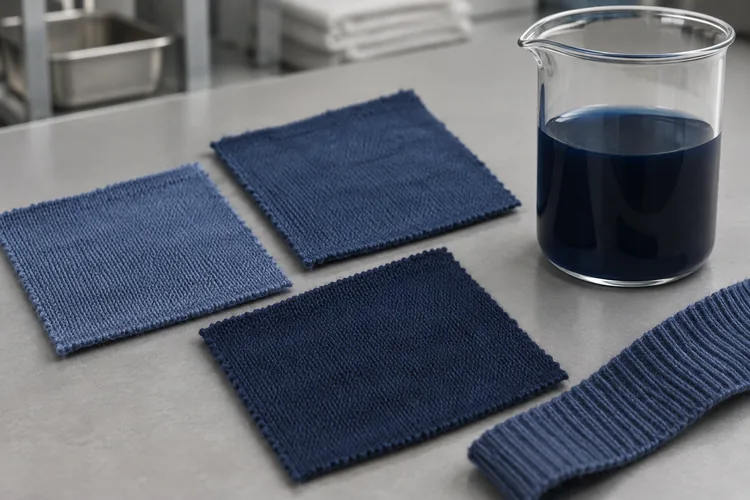
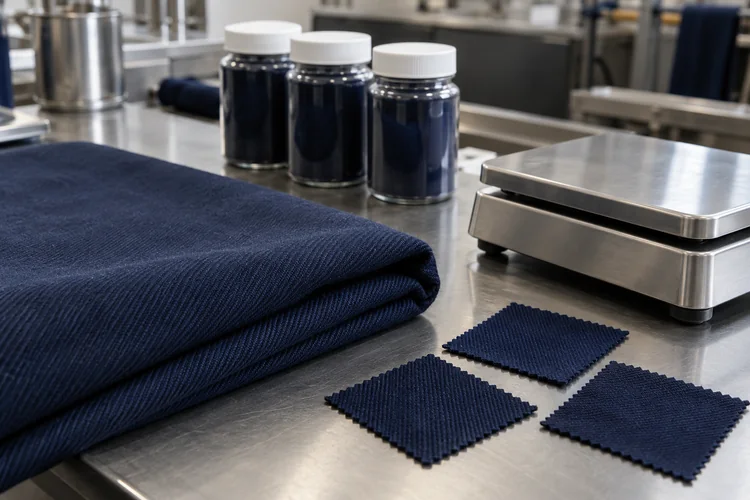
A competitive price and a good-looking lab dip are useful starting points, but neither proves that a vat dye will perform reliably in production. Differences in commercial strength, formulation, reduction behavior, and lot quality can lead to shade corrections, longer processing, and rejected fabric.
Evaluate suppliers on shade coverage, batch consistency, reduction behavior, and finished-fabric fastness.
Give each supplier the same application brief before requesting samples. Include the substrate, pretreatment, dyeing method, target shades, shade depths, finishing route, and customer requirements. A clear brief makes recommendations more relevant and comparisons more reliable.
1. Shade Range
Target-Shade Coverage
Judge shade coverage against your production requirements. Start with repeat-order colors, high-volume dark shades, and combinations that are difficult to reproduce.
For cotton dyeing, select Skythrene® vat dyes against the required shade and process, then verify the selected grades through lab dips on the intended fabric or yarn. Shade cards and screen images support initial selection, but they do not establish color accuracy or fastness on your substrate.
Evaluate relevant depths, including pale shades where small hue differences are visible and deep shades where build-up and washing-off become more demanding. For blends, specify which fiber component the vat dye will color and assess the complete processing route.
Product Identity and Strength
Request the Colour Index name where applicable, commercial grade, physical form, and declared strength. Clarify whether each product is a single colorant or a formulated blend.
Products with the same Colour Index name can differ in strength, formulation, dispersion, and application behavior. A shared identity therefore does not establish that two commercial grades are interchangeable.
Strength labels also need context. A designation such as 100% or 200% refers to a defined reference basis, which may differ between suppliers. Compare the dosage required to reach the same approved shade instead of assuming that matching labels indicate equal performance.
Recipe Compatibility
Dyes that perform well individually may behave differently in a combination. Check whether the proposed components have compatible reduction conditions and dyeing characteristics.
Ask for trials of complete recipes, especially those used for repeat orders. Assess whether the combination holds its hue within normal production variations.
2. Batch Consistency
Quality Control Evidence
Request certificates of analysis from separate production lots, supported by an explanation of the release tests. Relevant results may include relative color strength, shade difference against an approved reference, and physical quality checks appropriate to the product form.
Confirm the reference batch, measurement procedure, and acceptance limits behind the results.
Also confirm lot traceability, retained-sample practices, and notification procedures for formulation or manufacturing changes. These records help resolve discrepancies between an approved sample and a later shipment.
Multi-Lot Testing
Where practical, evaluate three lots using the same substrate batch, water, auxiliaries, equipment, and processing sequence. This is a practical qualification approach, not a universal minimum.
Use two comparisons when necessary:
- Equal-dosage trials: Apply the same product dosage to identify differences in supplied strength and hue.
- Matched-depth trials: Adjust dosage to the target depth to compare achievable shade, fastness, and treatment cost.
Assess the final color after consistent oxidation, soaping, drying, and conditioning. Keep lot numbers, recipes, test records, and dyed swatches together as references for incoming deliveries.

Acceptance Criteria
Agree on instrumental and visual assessment conditions before placing a bulk order. Define the color-difference formula, illuminant, observer, measurement setup, and sample preparation.
Avoid a universal color-difference limit. Acceptable variation depends on shade, fabric appearance, end use, and customer expectations. Visual checks under relevant lighting also help identify matches that change noticeably between light sources.
Finally, confirm how the supplier investigates an out-of-specification lot, communicates findings, and provides corrective action.
3. Reduction Behavior
Process-Specific Conditions
Vat dyes must be reduced to a soluble leuco form so the colorant can enter the cellulosic fiber. Oxidation then restores the insoluble form. This mechanism makes control of reduction and oxidation central to application performance.
Request grade-specific recommendations for reducing agent, alkali, temperature, time, and addition sequence. Confirm whether stock-vat preparation or another application procedure is recommended.
Account for the differences between continuous and exhaust vat dyeing. The available reduction time, application sequence, and exposure to air vary by process. A grade approved for one route should still be verified before use in another.

Reduction Completeness and Stability
Evaluate whether the dye reaches an adequately reduced state within the available processing time. Record residual particles or deposits, penetration, levelness, and final shade.
Then assess stability within your normal operating window. Small, controlled variations in temperature, time, or chemical addition can help reveal whether a recipe is robust enough for production. Follow product-specific guidance, since excessive reduction can damage some vat dyes and cause irreversible shade changes.
If redox potential is monitored, define the electrode and reference system, temperature, calibration checks, and measurement procedure. A reading without this context is an unreliable basis for comparing suppliers.
Record chemical consumption, cycle time, and correction frequency alongside reduction speed.
Auxiliary Compatibility
Test the selected dyes with the textile dyeing auxiliaries intended for production. Confirm compatibility with the required alkalinity, temperature, reducing conditions, and equipment.
Wetting, dispersion, water hardness, and foam can all influence uniformity. For applications requiring rapid wetting and penetration, Sylic P1400 wetting agent has an anionic/nonionic character and is used in pretreatment, dyeing, and finishing. Reference dosages are 0.5–2 g/L for intermittent processing and 2–6 g/L for continuous processing. Use these ranges as trial starting points, then check penetration, foam, and compatibility at the actual alkalinity, temperature, and reducing conditions. Improved wetting does not compensate for incomplete reduction or guarantee better fastness.
Keep the auxiliary system consistent during initial dye comparisons. When adjustments are needed, change one factor at a time and record the effect.
4. Fastness Performance
End-Use Requirements
“Excellent fastness” is too broad to support supplier approval. Specify the exposure conditions the finished textile must withstand, then agree on test methods and acceptance ratings.
| Property | What to verify |
| Washing | Required laundering conditions, color change, and staining |
| Rubbing | Separate dry and wet performance requirements |
| Light | Relevant exposure method and target rating |
| Perspiration | Applicable acidic and alkaline test conditions |
| Bleaching | Resistance to the specified bleaching agent and treatment conditions, where required |
Vat dyes generally offer good washing fastness, but performance varies by individual dye, shade depth, substrate, and processing. Strong washing results do not establish equivalent light, rubbing, or bleach resistance.
Shade-Specific Results
Request reports that identify the commercial grade, substrate, shade depth, dyeing procedure, and after-treatment. Data from a different shade depth or finishing route may be informative without being directly representative of your product.
Test complete combination recipes as well as individual components when necessary. Components can respond differently to exposure, causing a hue shift in a shade that initially matched.
Distinguish color change from staining of adjacent materials. They describe different failure modes and should be assessed against the relevant customer requirement.
Finished-Fabric Verification
Verify performance after complete oxidation, appropriate soaping, and the intended finishing treatment. Soaping helps remove loosely held surface color and develop the final shade and fastness. Keep these conditions consistent when comparing samples.
If a trial fails, investigate both the dye and the process. Inadequate reduction, poor penetration, incomplete or excessive oxidation, insufficient afterwashing, and finishing effects can contribute to poor results.
Technical support should help identify the likely cause and propose a controlled follow-up trial. A finishing treatment that improves one test result should not replace correction of an underlying dyeing problem.

5. Supplier Comparison and Approval
Evidence-Based Comparison
Use a scorecard to compare results against your application brief. Weight the criteria according to production priorities, while treating mandatory performance requirements as pass-or-fail conditions.
| Criterion | Evidence for approval |
| Shade coverage | Approved lab dips at relevant depths and compatible combination recipes |
| Batch consistency | Multi-lot strength and shade results, defined release limits, and traceability |
| Reduction behavior | Adequate reduction, process stability, penetration, and chemical demand |
| Fastness | Acceptable results on the intended substrate, shade, and finish |
| Production cost | Strength-adjusted dye dosage, auxiliary use, processing time, and rework |
Compare cost per kilogram of acceptable dyed fabric. A lower purchase price may offer little benefit if the product requires more dye, additional chemicals, longer cycles, or repeated shade corrections.
Pilot Qualification
Run a representative pilot before regular bulk purchasing. Choose a commercially important shade that tests the product’s suitability for the intended process.
Record the recipe, chemical additions, operating conditions, shade assessment, fastness results, and corrective work. Confirm that laboratory results transfer to production with an acceptable level of adjustment.
Document the approved grades, reference shades, acceptance criteria, and quality responsibilities in the purchasing specification.
Continue checking incoming lots against the approved reference. Supplier approval should reflect ongoing delivery performance as well as the initial trial.
To arrange an application-specific evaluation, request vat dye samples and technical guidance with details of the substrate, target shades, equipment, and fastness requirements.
6. FAQ
How can I verify a vat dye supplier’s shade range?
Request lab dips on your own substrate at the depths you use commercially. Include repeat-order colors and complete combination recipes. Check both the ability to match the shade and the continued availability of essential recipe components.
How do I check vat dye batch consistency?
Test samples from separate production lots under controlled conditions. Compare equal-dosage strength and hue, then assess matched-depth performance where needed. Retain the approved swatches and agree on measurement conditions, tolerances, and lot traceability.
Are vat dyes with the same Colour Index name interchangeable?
Not automatically. Commercial strength, formulation, physical form, and reduction behavior can differ. Confirm substitution through shade matching, application trials, and relevant fastness testing before changing an established recipe.
How should I compare reduction behavior?
Start with grade-specific supplier recommendations, then test within your intended production conditions. Compare reduction completeness, stability, penetration, levelness, chemical consumption, and final shade. Interpret redox readings only with a defined measurement setup.
Which fastness tests should I request?
Choose tests according to the end use and customer specification. Washing, dry and wet rubbing, light, perspiration, and bleaching may be relevant. Verify critical requirements on the actual shade and finished fabric.
Can textile auxiliaries affect vat dye performance?
Yes. Wetting agents, dispersants, sequestrants, and soaping products can influence penetration, bath stability, surface-color removal, and reproducibility. Select them for the specific dyeing conditions and verify compatibility through controlled trials.