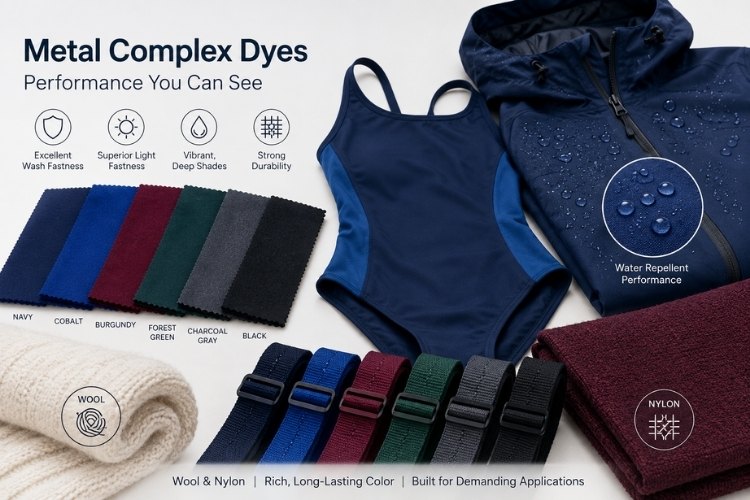
Metal complex dyes deliver outstanding fastness and consistent shading on wool and nylon when deep shades, strong fastness, and stable dyeing performance are required. Their coordinated metal-dye structure improves molecular stability, making them suitable for textiles that need reliable color performance in demanding applications.
What Are Metal Complex Dyes?
Metal complex dyes are acid dyes in which one or more dye molecules coordinate with a metal ion, commonly chromium, cobalt, copper, or nickel, depending on the dye chemistry. Many commercial metal complex dyes are based on azo structures, where the metal ion forms a stable coordination complex with the dye molecule.
This structure improves shade depth, dye stability, and resistance to light, washing, perspiration, and rubbing. Because metal complex dyes contain anionic groups, they are especially suitable for fibers with cationic dyeing sites, such as wool and nylon.
Why Wool and Nylon Are the Primary Substrates
Wool and nylon both contain amino groups that become positively charged under acidic dyeing conditions. These positively charged sites attract anionic dye molecules, allowing metal complex dyes to penetrate and fix effectively.
Wool’s protein structure supports strong dye uptake, while nylon’s polyamide structure provides similar dyeing behavior when pH and temperature are properly controlled. This makes both fibers suitable for metal complex dyeing, especially in medium to deep shades.
Skychem Group supplies metal complex dyes for wool, nylon, leather, and silk applications. The Skyacido® range is designed for strong metal coordination, rich shades, uniform penetration, and excellent light, wash, and perspiration fastness, supporting textile mills that need consistent color performance across demanding end uses.
Types of Metal Complex Dyes
Metal complex dyes are commonly classified into 1:1 and 1:2 types. The difference refers to the ratio between the metal ion and the dye molecule within the dye complex.
1:1 Metal Complex Dyes
A 1:1 metal complex dye contains one metal ion coordinated with one dye molecule. These dyes are usually applied from a strongly acidic bath, often around pH 2 to 3, depending on the dye, fiber, and supplier recommendation.
1:1 metal complex dyes are known for good leveling and penetration, especially on wool. The acidic dye bath promotes fiber swelling and dye movement, which helps produce even shades. However, strong acid conditions require careful control because excessive acidity, heat, or mechanical action can damage sensitive wool fibers. As a first-generation metal complex dye type, the 1:1 structure is relatively simple. While initial levelness is acceptable, its wash fastness and light fastness are limited compared to more modern alternatives. As market requirements for fastness and durability continue to rise, 1:1 metal complex dyes are gradually being phased out in favor of more stable dye systems.
1:2 Metal Complex Dyes
A 1:2 metal complex dye contains one metal ion coordinated with two dye molecules. These dyes are usually applied from weakly acidic to near-neutral conditions, often around pH 5 to 7.
1:2 metal complex dyes are widely used when high wet fastness and light fastness are required. They generally have stronger fixation and lower migration than 1:1 dyes. Their more stable molecular structure delivers noticeably superior wash and light fastness performance, making them the dominant choice in modern textile dyeing. This improves final performance but makes process control more important, especially for deep shades and substrates with uneven dye affinity.
Within the 1:2 metal complex category, structural differences between product series affect dyebath behavior and final fastness. The Skyacido® metal complex range includes two series:
- PA series (Yellow PA, Red PA, Bordeaux PA, Blue PA-2R, Navy PA): carries two sulfonic acid groups, supporting good solubility and level dyeing across a range of depths.
- NHF-S series (Yellow NHF-S, Red NHF-S, Blue NHF-S, Grey NHF-S): carries a single sulfonic acid group, promoting deeper fixation and particularly strong wet fastness performance.
Both series deliver vivid, layered shades with outstanding wash, light, and rubbing fastness, making them well suited to demanding applications such as swimwear, webbing, and outdoor apparel.
The differences between 1:1 and 1:2 metal complex dyes affect nearly every aspect of the dyeing process and the finished product.
| Property | 1:1 Metal Complex | 1:2 Metal Complex |
| Metal:Dye Ratio | 1:1 | 1:2 |
| Typical Metal | Chromium | Chromium, Cobalt |
| Dyebath pH | 2–3 | 4–7 |
| Shade Brilliance | High | Moderate |
| Light Fastness | Good | Excellent |
| Wash Fastness | Good | Excellent |
| Fibre Friendliness | Moderate | High |
| Leveling Properties | Good | Very Good |
Skychem Group’s textile color solutions span both 1:1 and 1:2 metal complex dye ranges, giving dyeing operations the flexibility to match dye type to substrate, shade, and process conditions from a single, reliable supplier rather than managing multiple sourcing relationships.

How Metal Complex Dyeing Works
Metal complex dyeing depends on controlled pH, temperature, dye bath circulation, auxiliaries, and dyeing time. The process should allow the dye to distribute evenly before exhaustion and fixation become too strong.
Poor process control can lead to rapid strike, uneven penetration, shade variation, or reduced fastness. For this reason, lab dips, compatibility checks, and controlled bulk trials are important before full-scale production.
Dyeing Wool with Metal Complex Dyes
Wool dyeing usually begins with a clean, evenly prepared substrate. Residual grease, alkali, uneven moisture, or poor scouring can cause shade variation.
A typical wool dyeing process includes:
- Preparing the dye bath with dye, acid, buffer, and leveling agent.
- Starting at a moderate temperature to support even dye distribution.
- Raising the temperature gradually to improve fiber swelling and dye diffusion.
- Holding at the recommended dyeing temperature until target exhaustion is reached.
- Cooling gradually before rinsing and finishing.
Wool is sensitive to strong acid, high temperature, and mechanical stress. The selected dye type and dyeing recipe should achieve the target shade while protecting fiber strength, handle, and surface quality.
Dyeing Nylon with Metal Complex Dyes
Nylon contains amide groups that provide dyeing sites under acidic conditions. Although nylon is more uniform than wool, it can still show barre, streaks, or shade variation when yarn batches, heat-setting conditions, or fiber modifications differ.
Metal complex dyes are often used on nylon for swimwear, hosiery, outdoor fabrics, upholstery, technical textiles, and deep fashion shades. Good process control is important because nylon can absorb acid dyes rapidly, especially in dark shades.
Effective nylon dyeing practice includes:
- Checking yarn or fabric affinity before bulk dyeing
- Using suitable leveling agents
- Controlling pH throughout the process
- Raising temperature gradually
- Avoiding unnecessary electrolyte
- Running lab dips and production trials before large-scale dyeing
pH, Temperature, and Auxiliaries
pH is one of the most important controls in metal complex dyeing. Lower pH increases the positive charge on wool or nylon, which can improve dye uptake but also increase the risk of rapid strike. Higher pH can improve levelness, but excessive pH may reduce exhaustion or shade depth.
Temperature affects fiber swelling, dye diffusion, and final exhaustion. Gradual heating helps prevent uneven uptake, especially when dyeing dense fabrics, dark shades, or nylon materials with variable affinity.
| Process Factor | Main Function | Risk if Poorly Controlled |
| pH | Controls dye uptake and exhaustion | Unlevel dyeing, weak shade, or fiber damage |
| Temperature | Supports diffusion and fixation | Streaks, poor penetration, or rapid strike |
| Leveling agent | Slows initial dye uptake | Patchy or uneven shades |
| Buffer | Stabilizes bath acidity | pH drift and shade inconsistency |
| Sequestering agent | Reduces hard-water interference | Precipitation or dull shades |
| Rinsing and neutralization | Removes surface dye and restores pH | Poor wet fastness or harsh handle |
Skychem Group offers textile auxiliary solutions for pre-treatment, dyeing, printing, finishing, softening, and functional finishing processes. These auxiliaries help textile manufacturers improve bath stability, leveling, handle, and process reliability when working with wool, nylon, and blended substrates.

Fastness Properties and Performance
Metal complex dyes are valued for their fastness properties, especially in medium and deep shades. Final performance depends on dye structure, substrate condition, shade depth, dyeing recipe, rinsing efficiency, aftertreatment, and the required test method.
Light Fastness
Light fastness measures how well a dyed material resists fading under light exposure. Metal complex dyes usually perform well because their coordinated structure improves molecular stability.
This makes them suitable for upholstery, uniforms, outdoor apparel trims, carpets, and other textiles exposed to prolonged light. Performance still varies by dye structure and shade. Dark shades such as navy, black, brown, and grey may perform differently from brighter red, orange, or violet shades. Testing should always follow the buyer’s required standard.
Wash and Wet Fastness
Wash and wet fastness are important for apparel, sportswear, socks, upholstery, and nylon-rich fabrics. 1:2 metal complex dyes generally provide stronger wash, perspiration, and rubbing fastness than 1:1 dyes because of their more stable structure and stronger fixation behavior.
Wet fastness may be reduced by:
- Incomplete exhaustion
- Surface dye residues
- Poor rinsing
- Incorrect final pH
- Incompatible finishing agents
- Excess dye that remains loosely attached to the fiber surface
Controlled rinsing and neutralization are important, especially for wool and nylon products that will undergo repeated washing or wet processing.
1:1 vs 1:2 Fastness
1:1 metal complex dyes generally offer good fastness with better leveling and penetration. 1:2 metal complex dyes usually deliver higher wet and light fastness, making them more suitable for demanding applications.
A fine wool fabric that requires excellent levelness may benefit from a 1:1 dye system. A nylon fabric for outdoor or performance use may require a 1:2 dye system because fastness is usually the stronger priority.
Metal Complex Dye Regulatory and Environmental Considerations
Chemical compliance is now a key part of dye selection. Export-oriented mills often need to consider buyer restricted substance lists, the ZDHC MRSL, EU REACH Regulation, and product testing systems such as OEKO-TEX® STANDARD 100. ZDHC defines the MRSL as a list of substances banned from intentional use in manufacturing processes, REACH is the EU’s main chemicals law for protecting human health and the environment from chemical risks, and OEKO-TEX® STANDARD 100 applies to textiles tested for harmful substances.
Skychem Group supports manufacturers that need color performance, documentation, and sustainability alignment. Available qualification information can be reviewed through certificates, while environmental direction and related commitments are available under sustainability. Together with its dye and auxiliary portfolio, Skychem Group helps mills evaluate shade performance, compliance needs, and long-term supply suitability before production.
In Summary
Metal complex dyes are practical choices for wool and nylon when deep shades, strong fastness, and stable dyeing performance are required. The best result depends on dye type, substrate, pH, process control, fastness targets, and compliance requirements. Request product selection support or pricing through the contact us.