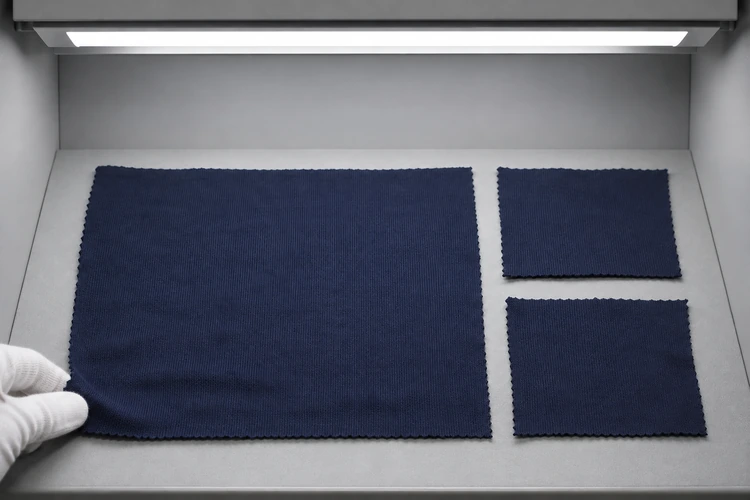
Dark cotton can match an approved shade and pass washing fastness tests, yet still transfer color when rubbed with a wet cloth. For dyehouses and finishing mills, the challenge is to improve wet rubbing fastness without compromising shade, softness, or absorbency.
Wet rubbing fastness improvers are finishing auxiliaries designed to reduce this transfer, also known as wet crocking. Effective treatment depends on choosing a formulation suited to the colorant and fabric, applying it evenly, and verifying its performance with the complete finishing recipe.
How Wet Rubbing Fastness Improvers Work
Surface Protection and Reduced Color Transfer
Rubbing transfers color from the fabric surface to another material through mechanical contact. Water can make that transfer more severe, so a good dry rubbing result does not automatically mean acceptable wet rubbing performance.
Film-forming improvers deposit a polymer layer that helps hold surface colorants in place. Depending on the formulation, the finish may also alter surface friction. Effective protection requires an evenly distributed film with suitable adhesion, flexibility, and resistance to wet rubbing.
Rubbing Improvers vs. Dye Fixing Agents
Conventional dye fixing agents for reactive- and direct-dyed cotton generally reduce the mobility or water solubility of dye remaining on the fabric. Depending on their chemistry, they can improve washing fastness and may also contribute to rubbing fastness.
A rubbing improver targets mechanical color transfer, often through surface film formation. The functions can overlap, so commercial names alone are insufficient for selection. Compare wet rubbing results on the actual fabric, alongside any washing fastness requirements.
Performance Limits on Cotton
Finishing works best on properly processed fabric. Substantial loose color, inadequate washing-off, and a poorly formed pigment binder film should be investigated before selecting an after-treatment.
Deep shades and raised or brushed fabrics can be particularly demanding because of accessible surface color and colored fiber debris. Evaluate the improvement from the starting grade and confirm that the final result meets the buyer’s requirement.

Selecting the Right Improver
Matching the Dye or Pigment System
Start by identifying how the cotton was colored. The same low wet rubbing grade can arise from different causes.
| Cotton coloration | What to check first | Selection priority |
| Reactive dyes | Fixation and removal of hydrolyzed or unfixed dye | Performance on the specific shade after adequate washing-off |
| Direct dyes | Residual mobile dye and the existing fixation treatment | Rubbing improvement alongside acceptable washing fastness |
| Sulfur dyes | Oxidation, washing, and loose surface color | Suitability for the dye system and subsequent finishing conditions |
| Indigo denim | Surface color transfer and the intended washed appearance | Performance after the relevant garment washing or finishing sequence |
| Pigment dyeing or printing | Binder distribution, adhesion, and curing | Compatibility with the binder system and acceptable fabric handle |
Chemistry and Ionic Character
Select wet rubbing fastness improvers according to polymer chemistry, ionic character, solids content, and application requirements. For waterborne polyurethane formulations, evaluate film adhesion, flexibility, and wet rubbing resistance on the intended fabric. Polymer type and solids content alone do not predict the final result.
Ionic character provides an initial compatibility screen, but products with the same classification can still differ in bath stability and deposition. The complete recipe requires testing.
Distinguish product pH from working-bath pH. The pH measured at a specified product dilution describes that test solution; it does not automatically define the required application pH.
Fastness, Handle, Shade, and Absorbency
The preferred product meets the fastness requirement while preserving the properties needed for the end use. A finish acceptable for heavy cotton trousers may be unsuitable for an absorbent towel or a lightweight knit.
Assess these properties together:
- Handle: softness, flexibility, surface smoothness, and any tackiness.
- Shade: changes in depth, hue, or appearance after drying and heat exposure.
- Absorbency: water uptake or wicking where required by the product specification.
- Durability: retention of the improvement after the specified laundering process.
Compare treatment costs at the dosage that achieves an acceptable result. Price per kilogram of chemical is less useful when products differ in concentration, application efficiency, or processing requirements.
Application on Cotton
Washing-Off and Fabric Preparation
For reactive-dyed cotton, remove unfixed and hydrolyzed dye before applying the improver. The Sylic D2703 soaping agent for reactive-dyed cotton uses an anionic polycarboxylic acid polymer to disperse removed dye and help limit redeposition during washing-off.
Rinse thoroughly to remove residual soaping chemicals, salt, and alkali. Neutralization adjusts pH but does not replace rinsing.
Before treatment, check fabric pH, absorbency, and the baseline wet rubbing grade. Poor or uneven wetting can produce uneven chemical deposition even when the bath concentration is correct.
Padding vs. Exhaust Treatment
Padding applies the product through a finishing bath followed by controlled squeezing. Consistent wet pickup is essential because it determines how much treatment liquor remains on the fabric.
Exhaust treatment uses a bath in which the product deposits onto the substrate over time. Deposition depends on formulation, fabric affinity, liquor ratio, temperature, and treatment time. A product’s suitability for padding does not establish its suitability for exhaustion.
Sylic FU5523A polyurethane wet rubbing fastness improver is a weakly cationic, waterborne polyurethane formulation with 30% solids for cotton and cotton-blend fabrics. It can be applied by padding or immersion, depending on the available equipment and fabric form. Reference starting conditions are:
- Padding: 30–50 g/L, one dip and one nip, with 80–85% wet pickup, followed by drying.
- Immersion in washing factories: 2–4% on fabric weight, a 1:10–1:20 liquor ratio, and 15–20 minutes at room temperature, followed by drying.
Validate these conditions on the intended fabric before bulk treatment. Fabric pH should be 7 or below, with residual alkali, salt, and soaping chemicals removed. Avoid combining FU5523A with anionic auxiliaries. Use a separate bath from dye fixing agents unless a compatibility trial confirms acceptable bath stability and finished-fabric performance.
Dosage and Bath Conditions
Keep dosage units clear. Grams per liter describe bath concentration; percentage on weight of fabric, commonly written as % owf, describes product quantity relative to dry fabric weight. They cannot be compared directly without considering the application method.
For padding initially dry fabric, nominal product add-on can be estimated as:
Commercial product add-on (% owf) = concentration (g/L) × wet pickup (%) ÷ 1000
Use the numerical wet pickup percentage, such as 80, in this formula. At 40 g/L and 80% wet pickup, the nominal commercial product add-on is 3.2% owf, assuming liquor density is approximately 1 kg/L.
This value represents the formulated product, not dry polymer. An exhaust dose of 3.2% owf is not equivalent because only part of the charged product may deposit on the fabric. For wet-on-wet padding, incoming moisture and bath dilution also affect deposition, so final wet pickup alone is insufficient.
Follow the product’s dilution and addition sequence. Check working-bath pH after mixing, then monitor temperature, foam, and stability during production. Use the formulation’s recommended pH range rather than applying a universal acidic target.
Drying and Curing Requirements
Drying removes water and supports film formation. Some formulations also require curing to develop the intended properties; others specify drying without a separate curing stage.
Follow the specified drying or curing conditions. Excessive heat can affect shade and handle, while insufficient exposure may leave a cure-dependent finish underdeveloped. During scale-up, verify fabric temperature and residence time rather than relying solely on the stenter setting.
Compatibility with Textile Auxiliaries
Silicone and Non-Silicone Softeners
Compatibility with silicone softeners depends on the particular formulations and processing conditions. Amino, block, and other modified silicone systems should not be treated as one interchangeable category. Non-silicone softeners also vary in ionic character and composition.
Assess compatibility at two levels:
- Bath stability: no unacceptable separation, flocculation, deposits, or viscosity changes.
- Fabric performance: acceptable wet rubbing fastness, shade, handle, and absorbency after treatment.
A clear, stable bath does not prove that the softener preserves the improver’s performance.
Dye Fixing Agents and Anionic Residues
Two cationic products are not automatically suitable for the same bath. A fixing agent and a rubbing improver may interact through formulation components or alter each other’s deposition on cotton.
Anionic residues from earlier processing may interact with a cationic improver even when the finishing recipe contains no intentionally added anionic product. Include fabric carryover in the investigation, especially when a fresh laboratory bath performs well but production does not.
Same-Bath vs. Separate-Bath Treatment
A combined bath can shorten processing, provided it remains stable and delivers the required fabric properties. Separate treatment is useful when the products need different conditions or when the combined recipe reduces performance.
A practical compatibility check should:
- Use production water and the intended chemical concentrations.
- Follow the proposed dilution and addition order.
- Reproduce the expected temperature, pH, agitation, and holding time.
- Check for separation, particles, viscosity changes, excessive foam, and deposits.
- Apply the mixture to fabric and evaluate the dried or cured result.
A jar test screens for obvious instability. It does not replace a fabric trial or a production trial, where shear, contamination, and bath replenishment can affect behavior.

Validating Treatment Performance
Test Methods and Target Grades
Agree on the test method and acceptance grade before comparing products. ISO 105-X12 covers colorfastness to rubbing with dry and wet rubbing cloths. AATCC TM8 evaluates color transfer using a crockmeter and includes dry and wet procedures.
The buyer’s specification sets the passing grade and whether testing is required before or after laundering.
Use the specified method and edition consistently. Control specimen conditioning, rubbing-cloth moisture, test direction, and assessment conditions. Grades describe staining of the rubbing cloth; higher grades indicate less transfer. Results from different methods or preparation conditions are not automatically interchangeable.
Individual vs. Combined Finishes
Use fabric from the same lot to compare:
- A process control without the improver or softener.
- Improver-only treatment.
- Softener-only treatment.
- The complete finishing recipe.
Keep mechanical handling and heat exposure comparable. This separates the improver’s contribution from processing effects and reveals whether the combined finish preserves the benefit. Confirm the preferred recipe in a production trial, including checks across the fabric width and over the run.
Wash Durability and Fabric Properties
Evaluate durability using the wash conditions and number of cycles specified for the end use.
Record wet and dry rubbing results alongside shade, handle, and absorbency. For each trial, retain the recipe, wet pickup or liquor ratio, bath conditions, and drying or curing settings. Those records make it possible to investigate differences between laboratory approval and mill production.

Troubleshooting Common Problems
Insufficient Fastness Improvement
When the result falls short, identify the limiting factor before increasing dosage.
Increasing dosage beyond the effective range can stiffen the fabric without improving the rubbing grade.
| Observation | Possible cause | What to check |
| Little improvement across several dosages | Excess loose color or poor product suitability | Washing-off quality, dye system, and fabric surface |
| Good laboratory result but poor bulk result | Different application or thermal conditions | Wet pickup, bath condition, fabric moisture, and actual heat exposure |
| Improver-only sample passes but combined finish fails | Interaction with another auxiliary | Softener-only control, addition order, and separate-bath treatment |
| Result declines after laundering | Limited finish durability or changes during washing | Product suitability and the specified wash sequence |
Bath Instability and Uneven Finishing
For cloudiness, particles, or roller deposits, compare a fresh improver-only bath with the complete recipe. Introduce the other components individually in controlled trials, checking dilution, water quality, carryover, and addition order.
If the bath remains stable but finishing is uneven, check fabric absorbency, incoming moisture, nip pressure, and liquor distribution.
Shade Changes and Stiff Handle
For shade changes, compare a process control with the treated samples to distinguish heat effects from chemical effects. Use consistent viewing conditions and instrumental color measurement where specified.
A stiff handle may indicate excessive add-on, a film that is too rigid for the fabric, or an interaction within the recipe. Check wet pickup and compare lower dosages within the recommended range. If softness requires additional adjustment, repeat the compatibility trial with the revised softener level and confirm that wet rubbing fastness remains acceptable.