Disperse dyes are non-ionic dyes with low water solubility. Generally, dyeing is done at high temperature and high pressure. In order to achieve uniform dispersion and dyeing, a leveling agent is generally used during the dyeing process.
1. Slow dyeing
The slow-dyeing property of the leveling agent can inhibit the instantaneous dyeing in the early stage of dyeing, which is the primary factor in choosing a leveling agent. The test method for slow dyeing is generally as follows:
(1) Experimental materials:
Sample: degreased and refined polyester fabric
Formula:
C.I. Disperse Orange 30# 0.5% (O.M.F)
C.I. Disperse Red 60# 0.5% (O.M.F)
C.I. Disperse Blue 79# 0.5% (O.M.F)
Leveling agent x g/L
pH: 4.5
Bath ratio: 1:20
(2) Experimental process:
Dyeing with stock solution: dyeing at 40℃, heating to 130℃ for 30min and dyeing for 45min, sampling six times at 90℃, 100℃, 110℃, 120℃, 130℃, 130℃×45min, and half of the sample was reduced and cleaned (2g/L insurance powder, NaOH 2g/L, 80℃×20min), rinse the other half with tap water for about 30s and then dehydrate and dry.
Residual liquid dyeing: After each sampling, measure 40mL of residual dyeing liquid and add 2g of polyester cloth for dyeing. The process is the same as above.
(3) Result evaluation:
The more uniform the color increase between the dyeing samples at each sampling point, the lighter the color, which indicates that the slow dyeing effect of the leveling agent is better.
2. Migration
Migration is the process in which the leveling agent redisperses the part with high dye concentration on the dyed fabric into the dye bath, and then dyes the part with low dye concentration. Migration is an important performance of a dispersing dye color correcting agent.
Regarding the transfer property, the following method is generally used for testing:
(1) Experimental materials:
Dyed polyester fabric: one piece each of red (Un-se Red 0.5%) + yellow (Un-se Yellow 0.8%) + blue (Un-se Blue 0.5%) + undyed polyester fabric, four pieces of fabric are sewn together on one side to form a group.
Formula:
Leveling agent x g/L
pH 4.5-5
Bath ratio 1:20
(2) Experimental process:
Dyeing at 40℃, heating to 130℃ for 30min, and transfer dyeing for 60min, take out the fabric sample and wash it with water, and dry it.
(3)Result evaluation:
The closer the colors of the samples in the combination after transfer dyeing, the better the transfer dyeing effect.
3. Color elimination
For disperse dye leveling agents or color correcting agents, while achieving good slow dyeing and transfer dyeing effects, the smaller the color elimination, the better the performance of the auxiliary agent. The recommended method for the color reduction test is as follows:
(1) Experimental materials:
Sample: 4g polyester knitted fabric after degreasing treatment
Formula:
Leveling agent x g/L
C.I. Disperse Blue 79# 0.05% (O.M.F)
pH: 4.5
Bath ratio: 1:20
(2) Experimental process:
Dyeing at 40℃, heating to 130℃ for 30min, and dyeing for 60min, washing and drying after taking out the cloth sample.
(3) Result evaluation:
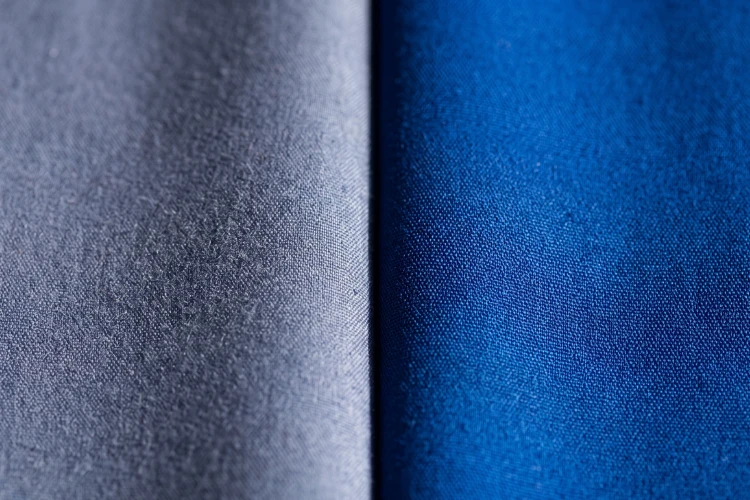
Using the strength of the blank (without leveling agent) dyed cloth sample as the standard sample, the color strength and color difference DE (can also be visually observed) of the dyed cloth sample under different leveling agents (color correcting agents) and dosage conditions are measured. The higher the strength, the smaller the color difference, indicating less color reduction.
4. Dispersibility
Dispersibility is also one of the necessary conditions for a good dispersing dye leveling agent. The dispersibility of the leveling agent can prevent the dye from agglomerating during the dyeing process (generally, a dispersant is added during the production of disperse dyes). The following is a test method for the dispersibility of the leveling agent:
(1)Experimental materials:
Formula:
C.I. Disperse Red 167# 1.0g/L
Leveling agent x g/L
pH value 4.5
Total liquid volume 100mL
(2) Experimental method:
Heat treatment of the dye solution: Heat the dye solution to 130℃ for 30 minutes, then cool it down to 70℃ at a rate of 2℃/min.
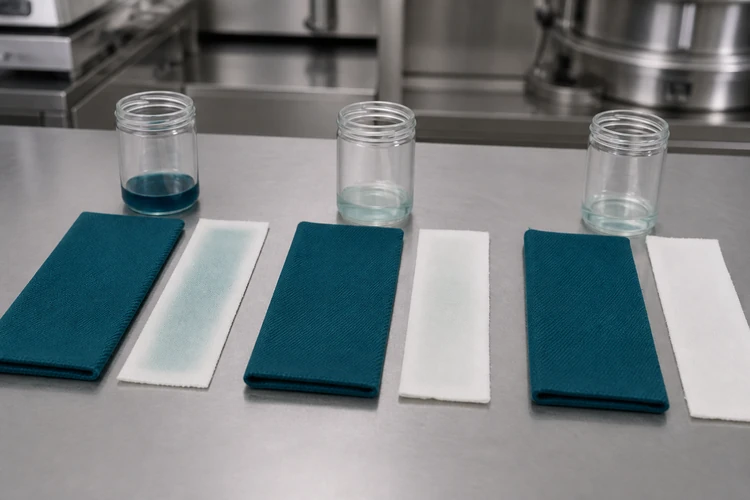
Dye solution filtration: First, preheat the Buchner funnel with 70℃ hot water and wipe it dry with a towel. Then, stack the medium-speed qualitative filter paper on top of the fast qualitative filter paper, place it in the funnel, turn on the vacuum pump, and pour the 70℃ dye solution into the funnel. When the appearance of the filter paper changes from wet to dry, it is the endpoint. Take out the filter paper, dry the upper filter paper, and evaluate.
(3) Result evaluation:
Visually observe the dye precipitation on the filter paper. The fewer the dye color points, the better the dispersion.
Related reading: