Nylon dyeing rewards precision. Acid dyes bond well with polyamide fibers, but shade consistency depends on how closely strike rate, pH, and trichromatic combinations are controlled together. A small mismatch in any one variable can shift a shade off standard, even when the recipe looks correct on paper. This article breaks down the practical factors that keep acid dye combinations compatible on nylon.
Understanding Strike Rate
Strike rate describes how quickly a dye moves from the bath onto the fiber. On nylon, this speed depends on dye structure, temperature ramp, and the number of available dye sites on the substrate. A dye with a fast strike rate can produce uneven color if it exhausts before the bath fully penetrates the goods, particularly on tightly constructed knits or dense yarns.

Factors Influencing Strike Rate
Three variables have the greatest effect on how fast a given acid dye takes up on nylon:
- Molecular size and structure: smaller, more mobile molecules tend to migrate and level more readily, while larger or more linear structures strike faster but migrate less once fixed.
- Konsentrasi elektrolit: higher salt levels in the bath slow strike by increasing ionic competition at the fiber surface, which can help leveling but may reduce total exhaustion if not balanced correctly.
- Temperature ramp speed: a ramp that heats too quickly gives the dye little time to migrate before fixation, raising the risk of streaks or tailing on the goods.
Matching Strike Rates in a Combination
When combining dyes for a shade, each component should have a comparable strike rate. If one dye in a mix strikes noticeably faster than the others, it dominates the early stages of dyeing and shifts the shade as the bath progresses. This is one of the most common causes of reproducibility problems in nylon dyehouses, especially when recipes are adjusted without checking how the new combination behaves as a system rather than as individual dyes.
The Role of pH in Dye Uptake
Acid dyes require an acidic bath to bond effectively with the amine groups on nylon fiber. pH does more than set the chemical environment; it also governs how fast dye uptake occurs and how much correction is possible once dyeing has started.
pH Ranges by Dye Class
Different acid dye classes are formulated to perform within specific pH windows. Working outside that window changes uptake speed and can affect fastness properties.
| Kelas Pewarna | Kisaran pH Khas | Uptake Behavior |
| Leveling acid dyes | pH 5 hingga 6 | Slower strike, good migration, easier to correct |
| Milling acid dyes | pH 4.5 hingga 5.5 | Moderate strike, less forgiving on unlevel dyeing |
| Metal complex acid dyes | pH 4 hingga 5 | Faster strike, stronger fastness, tighter process control needed |
These ranges are starting references. Actual performance depends on the specific dye grade, liquor ratio, and machine type, so lab confirmation on the intended substrate remains necessary before scaling to bulk.
Controlling pH During Dyeing
Holding pH steady throughout the cycle matters as much as setting the correct starting point. A pH that drifts upward during dyeing slows uptake and can leave the shade pale or uneven, while a sharp early drop can cause the dye to strike too fast for proper migration. Buffering systems and controlled acid addition keep the bath within range from start to finish. Leveling agents and buffering auxiliaries formulated for pH and strike control help stabilize uptake speed across different fabric constructions and machine conditions, particularly on constructions prone to rapid initial strike.

Trichromatic Selection Principles
Trichromatic dyeing uses a yellow, red, and blue dye to build a wide range of shades from a small working palette. Compatibility across these three dyes determines how predictable the resulting shades will be, both in the lab and in bulk.
Choosing Compatible Yellow, Red, Blue
A workable trichromatic set should share similar strike rates, similar pH sensitivity, and comparable migration behavior. Mismatched components can produce shade drift between lab dips and production batches, even when the total dye concentration is correct. The Skyacido Acid Dyes, formulated specifically for polyamide dyeing, offers a wide shade gamut with strong inter-shade combinability, which supports matching yellow, red, and blue components as a coordinated set rather than selecting each color independently based on shade alone.
The table below outlines what to check across each primary when building a trichromatic set:
| Komponen | Strike Rate Check | Sensitivitas pH | Perilaku Migrasi |
| Kuning | Compare exhaustion curve against red and blue | Note shift point where uptake accelerates | Confirm redistribution at hold temperature |
| Merah | Compare exhaustion curve against yellow and blue | Note shift point where uptake accelerates | Confirm redistribution at hold temperature |
| Biru | Compare exhaustion curve against yellow and red | Note shift point where uptake accelerates | Confirm redistribution at hold temperature |
Running this comparison during lab dip development, rather than after a bulk batch shows shade drift, catches mismatches while they are still inexpensive to correct.
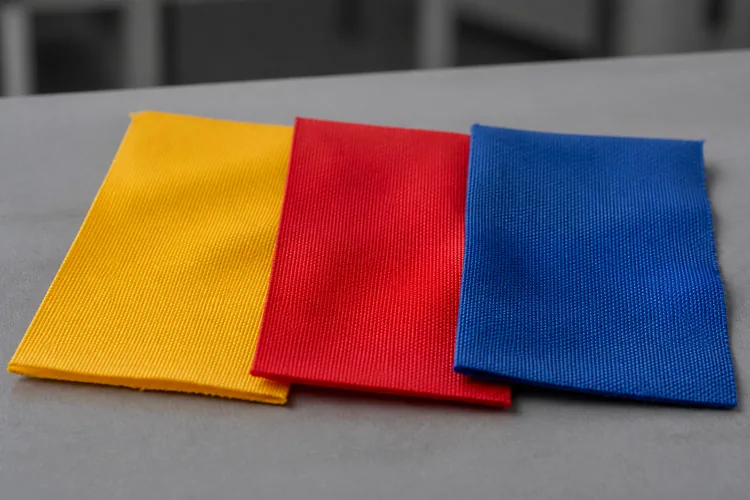
Typical Trichromatic Acid Dye Combinations for Nylon
In practical nylon dyeing, trichromatic combinations are usually selected according to shade depth, buildup requirement, and compatibility between dyes. Different combinations may be required for light shades and deep shades to maintain balanced exhaustion, migration, and shade reproducibility.
Light Shade Trichromatic Combination
For light and medium shades, dyes with good migration performance and moderate strike behavior are preferred to achieve excellent leveling and shade correction ability.
A typical light shade combination may include:
| Trichromatic Position | Example Acid Dye |
| Kuning | Skyacido Yellow 199 |
| Merah | Skyacido Merah 337 |
| Biru | Skyacido Blue 324 |
This combination provides good compatibility and is suitable for developing clean and bright shades where leveling performance is important.
Deep Shade Trichromatic Combination
For deep shades, dyes with stronger buildup performance and higher color strength are required. The combination should maintain balanced exhaustion behavior while achieving sufficient depth. The yellow position in this combination is filled by an orange-toned yellow dye, which delivers the added color strength needed to reach deep shades while still functioning within the standard Yellow, Red, Blue trichromatic structure.
A typical deep shade combination may include:
| Trichromatic Position | Example Acid Dye |
| Yellow (orange-toned) | Skyacido Orange 116 |
| Merah | Skyacido Merah 299 |
| Biru | Skyacido Blue 113 |
These dyes are commonly selected for deeper shades requiring high color strength and stable shade reproduction.
Migration and Buildup Properties
Migration determines how well a dye redistributes after initial strike, which affects leveling on uneven or variable-quality fabric. Buildup describes how shade depth increases as dye concentration rises. Dyes with weak buildup at higher depths force overloading of one component to reach the target shade, which distorts the intended color balance in a trichromatic mix. Checking buildup curves for each dye at the depths actually used in production helps catch this issue before it reaches bulk.
Avoiding Shade Shift
Shade shift between lab and bulk is usually a process difference rather than a dye fault. Water quality, liquor ratio, heating rate, and machine circulation can all vary between a lab dip and a full-scale run. Documenting these conditions alongside the recipe, and keeping them consistent from trial to production, is one of the most reliable ways to protect shade accuracy across repeat orders.
Practical Recipe Guidelines
Lab Trial Checklist
Before moving a trichromatic acid dye recipe into bulk production, a short verification pass can prevent costly rework:
- Confirm that pH at the start of the cycle matches the target range for the dye class in use, and that the buffering system can hold that range for the full cycle length.
- Check strike rate compatibility across all three trichromatic components by running a partial exhaustion sample, not just evaluating the finished shade.
- Compare buildup at the actual production depth rather than a standard reference depth, since buildup behavior varies across the shade range.
- Record water quality, liquor ratio, and heating profile used in the lab trial so the same conditions can be replicated at scale.
Getting strike rate, pH, and trichromatic selection to work together consistently takes the right dye system paired with disciplined process control. Corrections after the fact, such as stripping and redyeing, cost far more in time and material than a properly matched recipe from the start. For technical support on selecting compatible acid dye combinations for a specific nylon substrate or production setup, Hubungi Skychem Group to discuss shade targets and machine conditions.

Pertanyaan Umum Demo Slot
What causes uneven dyeing with acid dyes on nylon?
Uneven dyeing is usually the result of mismatched strike rates within a dye combination, an unstable pH during the cycle, or inconsistent fabric preparation before dyeing begins. Addressing all three areas together, rather than adjusting one variable in isolation, tends to resolve most leveling issues.
Bagaimana kontrol pH memengaruhi reproduktivitas?
Reproducibility depends on the bath reaching and holding the correct pH range for the dye class in use. A pH that drifts between lab and bulk changes uptake speed and shade depth, which is one of the most common reasons a recipe that worked in the lab does not repeat accurately in production.
Apa yang membuat kombinasi trikromatik dapat diandalkan?
A reliable trichromatic combination uses three dyes with comparable strike rates, similar pH sensitivity, and consistent buildup behavior across the intended shade range. When these properties align, shade prediction stays accurate across different depths and batch sizes.
Bacaan terkait: